Transition
The passage from the cosmos of matter towards the realm of pure consciousness.
Explore
Five floors. Five questions. More than thirty immersive exhibits. Enter through the roar of a modern city and leave beneath the light of the spiritual sky.
Your guide is a narrator in the tradition of the sūtradhāra, the thread-holder of Indian theatre, joined on every level by companions who ask exactly what a curious, scientific mind would ask.
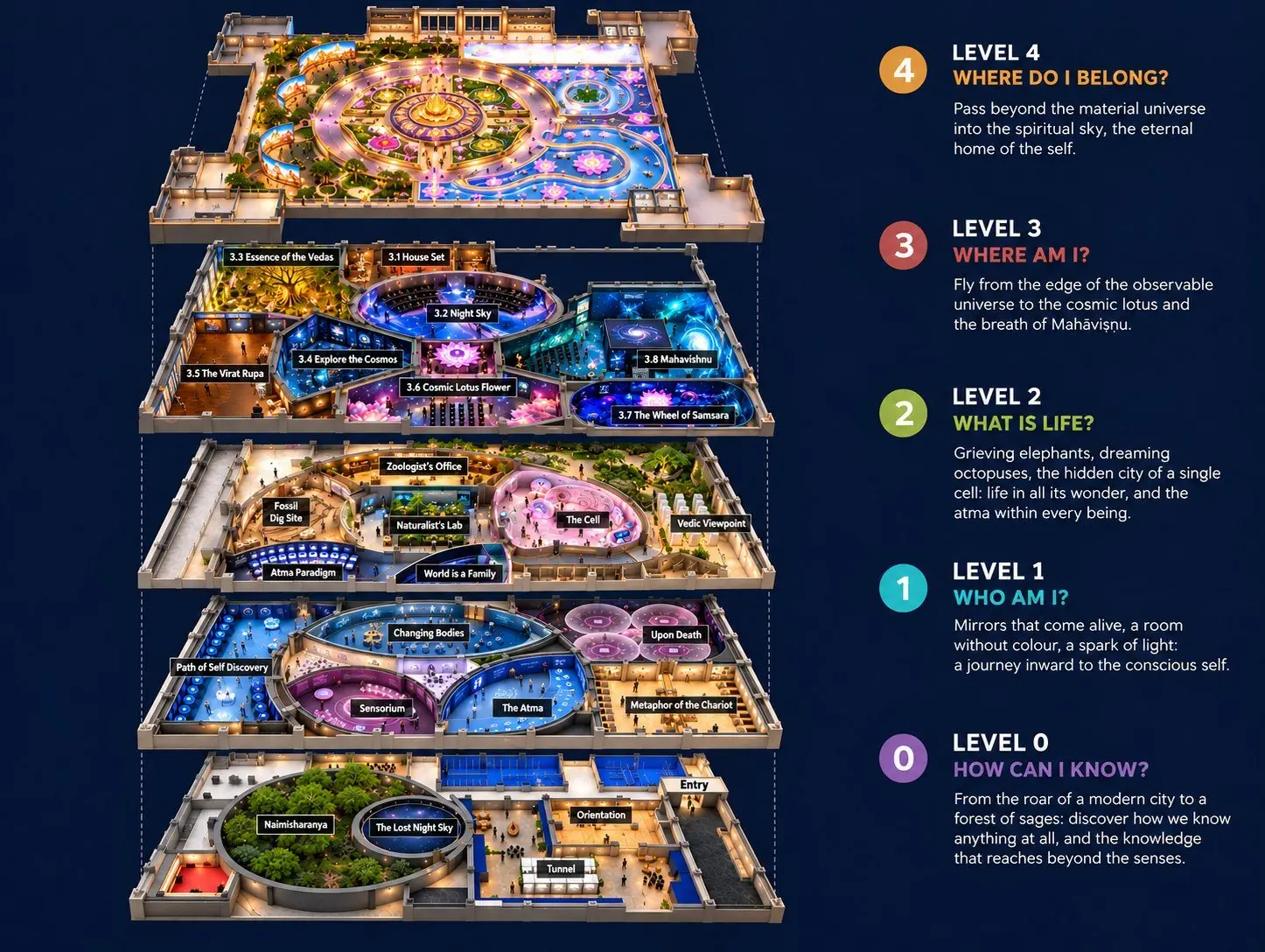
Level 0
From the roar of a modern city to a forest of sages: discover how we know anything at all, and the knowledge that reaches beyond the senses.
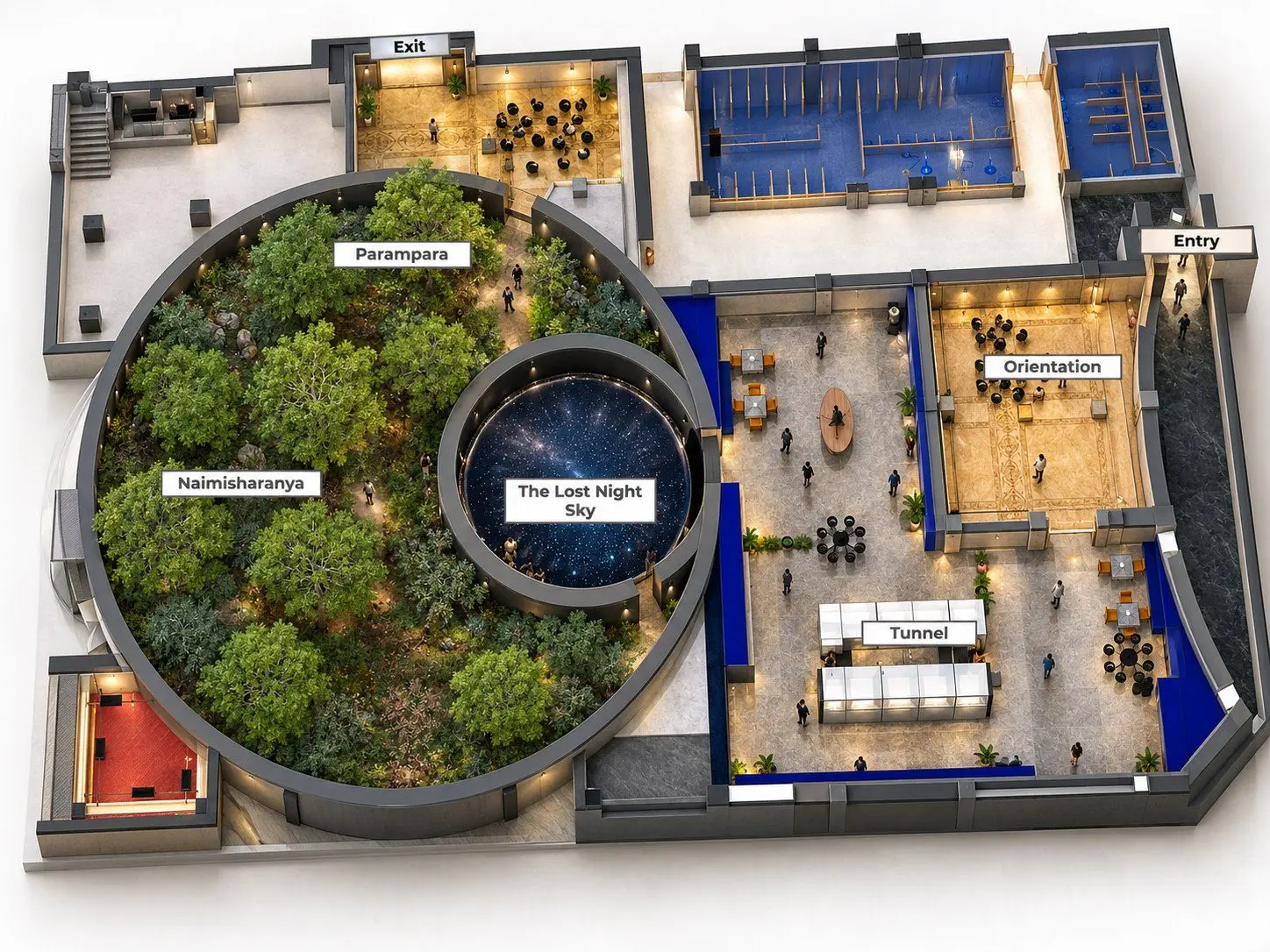
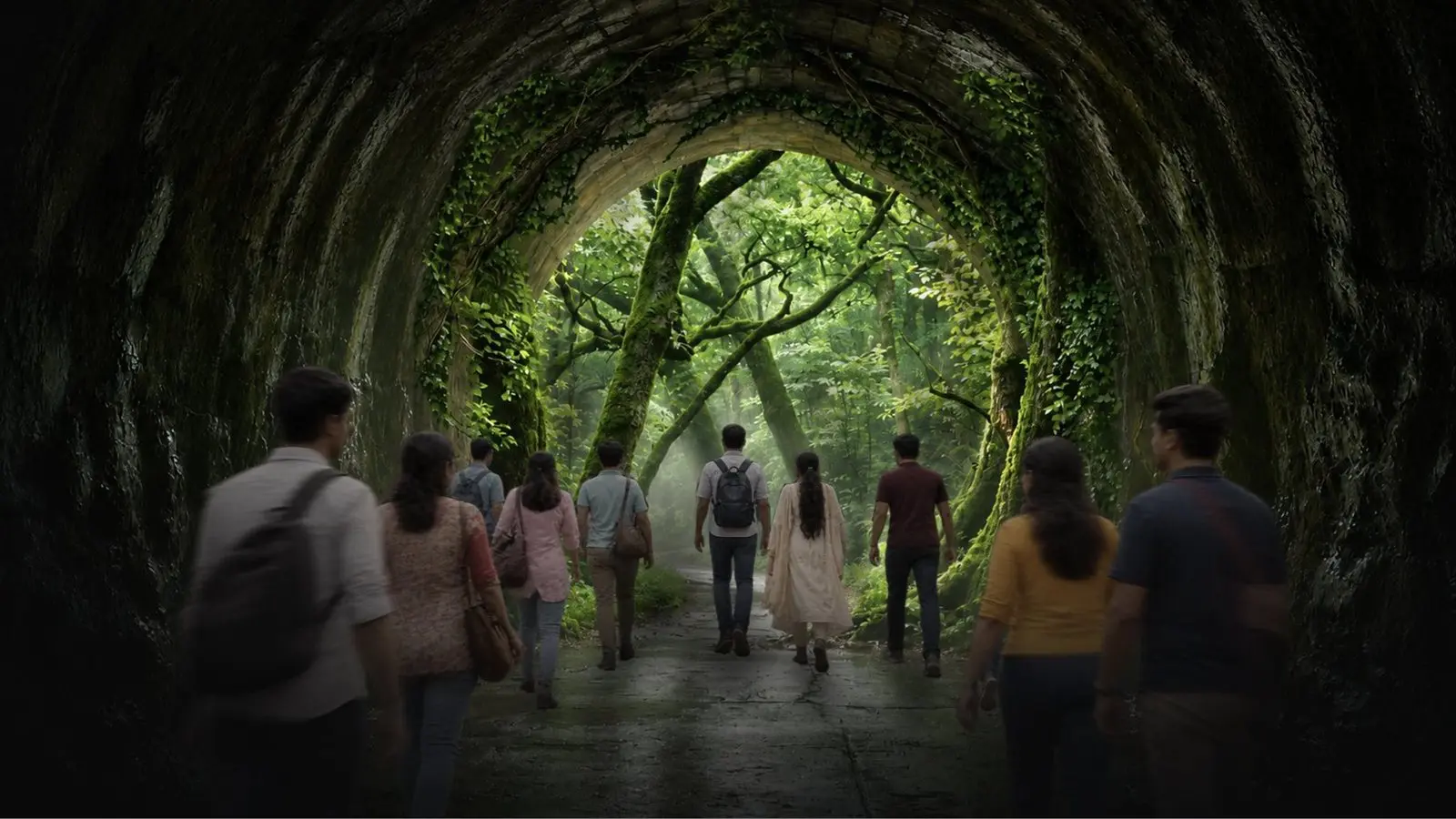
Level 0 guides you on a gradual journey from outer distraction to inner reflection, blending sensory immersion with philosophical inquiry. It begins with the Orientation, a symbolic space that frames Mayapur as a spiritual and scientific hub, where you are introduced to Srila Prabhupada's vision, the unique role of the TOVP and the museum's mission to explore consciousness, cosmology and Vedic philosophy. From there, the Tunnel contrasts this contemplative foundation with the overstimulation of modern life, highlighting material distractions and posing reflective questions that prepare you for deeper self-inquiry.
Next, the Lost Night Sky immerses you in cosmic infinity while exploring the limits of human knowledge (pratyakṣa, anumāna and śabda) and the need for revealed knowledge (apauruṣeya śabda). Naimiṣāraṇya brings you into the forest gathering of the sages, where eternal Vedic knowledge is preserved through contemplative yajñas and poetic recitation. Paramparā shows how this wisdom passes from generation to generation through a living lineage that keeps it relevant and accessible. The thematic lift then offers a contemplative pause on the nature of the self and consciousness. Together, Level 0 sets the mindset for the whole museum: reflection, awareness and readiness to engage with both the cosmos and the inner self.
0.1
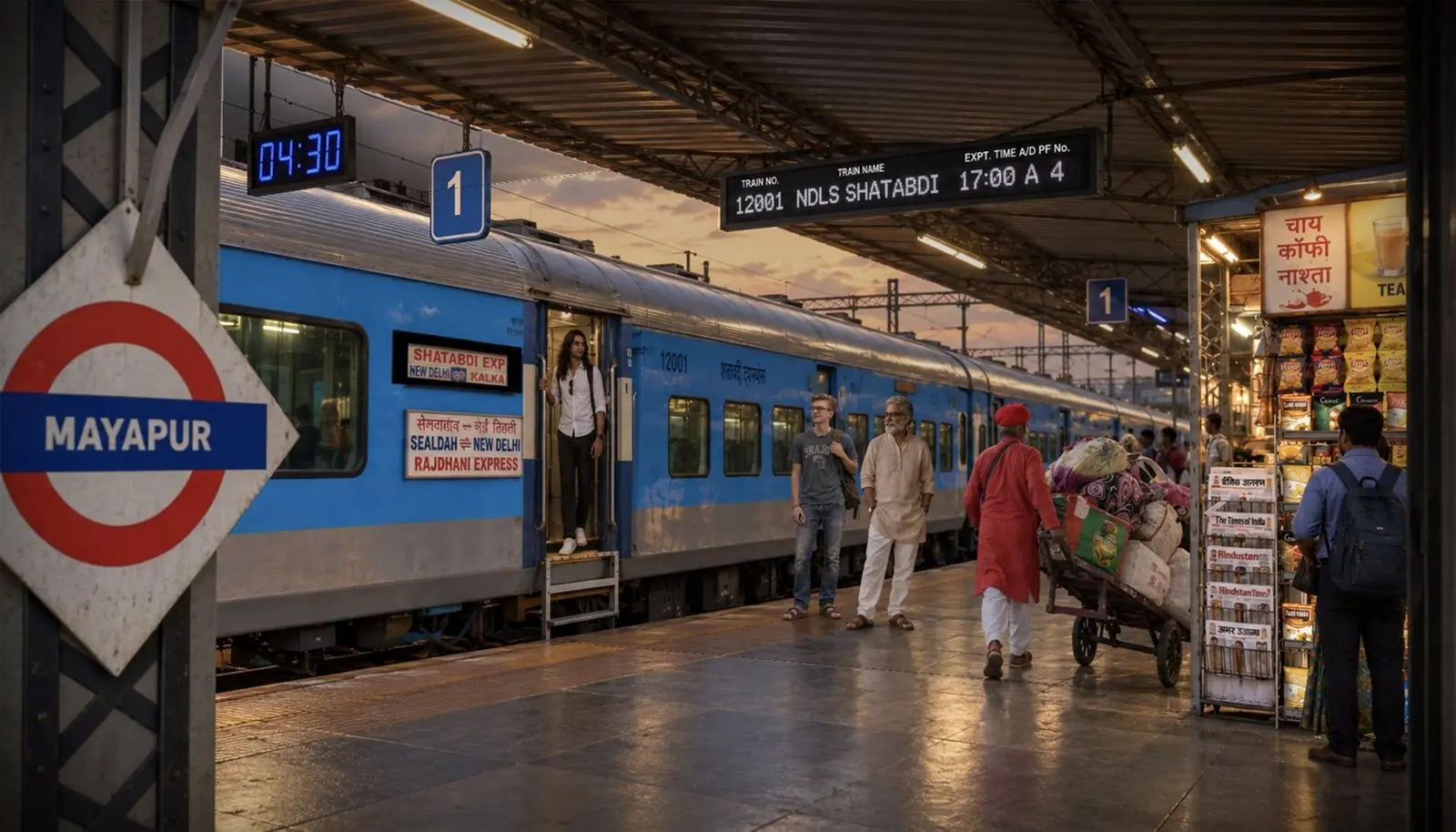
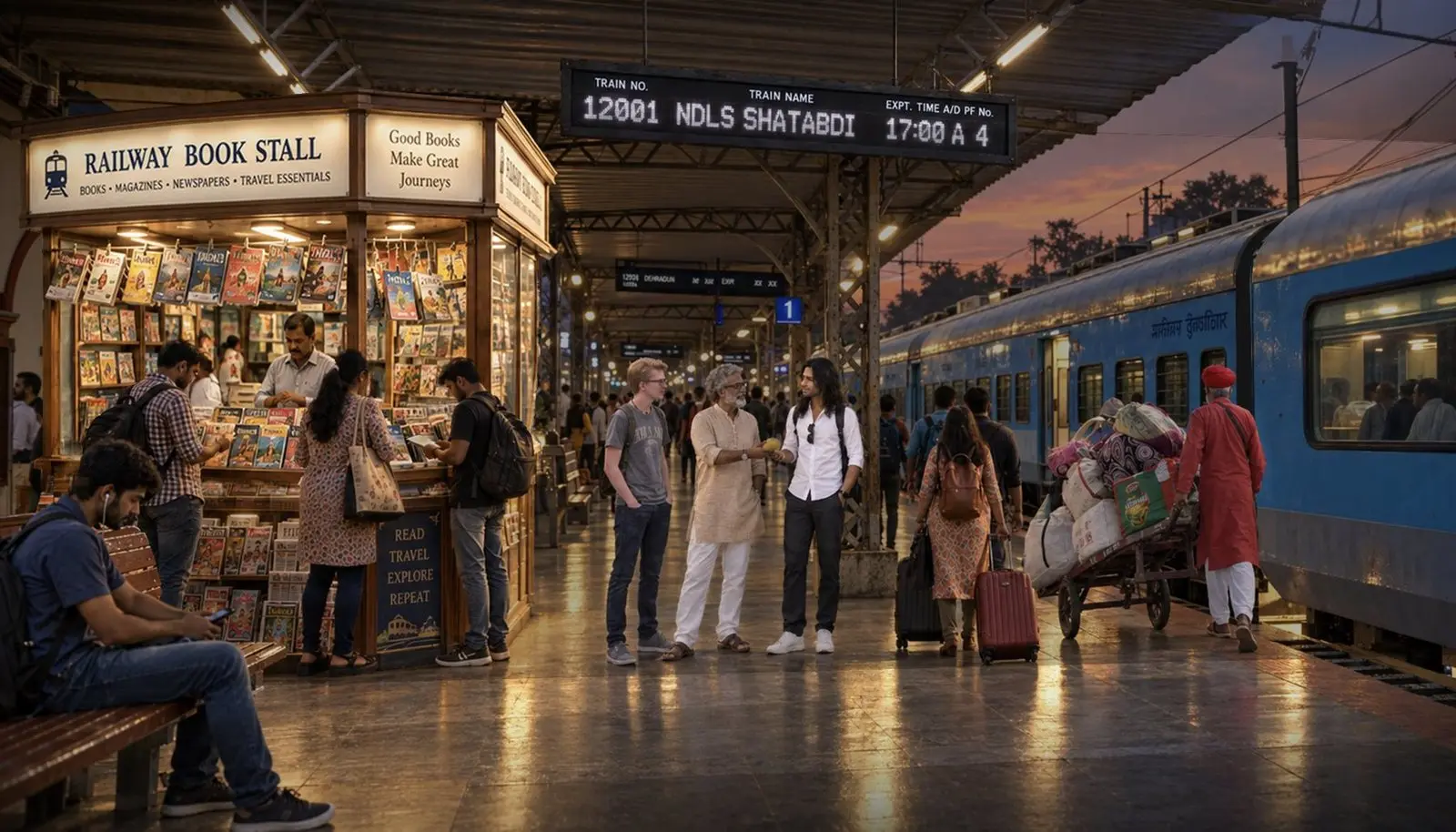
Mist parts to reveal Mayapur station. Two old friends, Vivaan and Leonardo, meet on the platform, and Devarshi, their guide, welcomes them and you to the journey ahead.
Discover and supportClose ×Step off the train at Mayapur station, where two old friends meet and a guide welcomes you all.
What you will experience
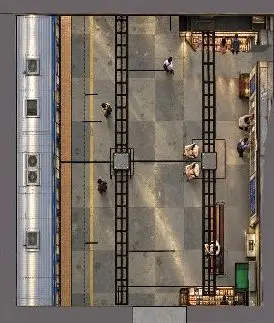
You enter through drifting mist that slowly reveals Mayapur station: an aged concrete platform, railway signage, a wing-shaped canopy and a train standing at the platform. Announcements, arrivals and departures fill the air with the bustle of a working Indian railway station.
Here you meet the two travellers who will walk with you through the museum. Vivaan, a successful but visibly stressed young professional, steps off the train to find his old friend Leonardo already waiting, a Western traveller seeking direction in his own life. Their reunion, brought to life in trompe l'oeil projection, reveals two very different personalities and an underlying tension between them.
Leonardo introduces Vivaan to Devarshi, his mentor and an experienced spiritual guide. Devarshi greets Vivaan with a slice of mango, then turns to welcome you and invites everyone to come along. As he leads the group towards the station exit, mist envelops the platform and carries you into the next gallery.
Drifting mist slowly reveals the station. A train stands at the platform, announcements echo under the canopy, and projections of arrivals, departures and reunions bring the platform to life.
Vivaan steps off the train and meets his old friend Leonardo, who is already waiting. Their conversation, shown in trompe l'oeil projection, reveals how different they are and hints at a tension between them.
Leonardo introduces Vivaan to Devarshi, his mentor and guide. Devarshi offers Vivaan a slice of mango, then turns to the visitors, welcomes everyone warmly and invites you to join the journey.
Devarshi leads Vivaan, Leonardo and the visitors towards the station exit. Mist envelops the platform, and the scene dissolves into the next gallery.
The big idea
Every journey begins with an arrival. On a busy station platform you meet the travellers and the guide whose questions, doubts and conversations will accompany you through every level.
Questions it asks
You will come away understanding
Bring it to life
Your support builds Mayapur station, with its train, sounds and projections, and gives every visitor a warm first step into the museum's journey.
Design Habit estimate for the gallery, including GST
Sponsor this exhibitLevel 0 · How Can I Know?The whole level: galleries and visitor spaces
Sponsor the levelAny amountEvery gift is recorded for this exhibit and for SMOVP
Donate to this exhibitEstimates from Design Habit (April 2026), shown in US dollars at ₹95 per US$1. Final costs are confirmed with each sponsor.

0.2
A bustling Cyberhub of shops, cafés and glowing screens, until the power fails, the stars appear and the advertisements return as questions.
Discover and supportClose ×A bustling Cyberhub, a sudden blackout, and the questions we forgot to ask.
What you will experience
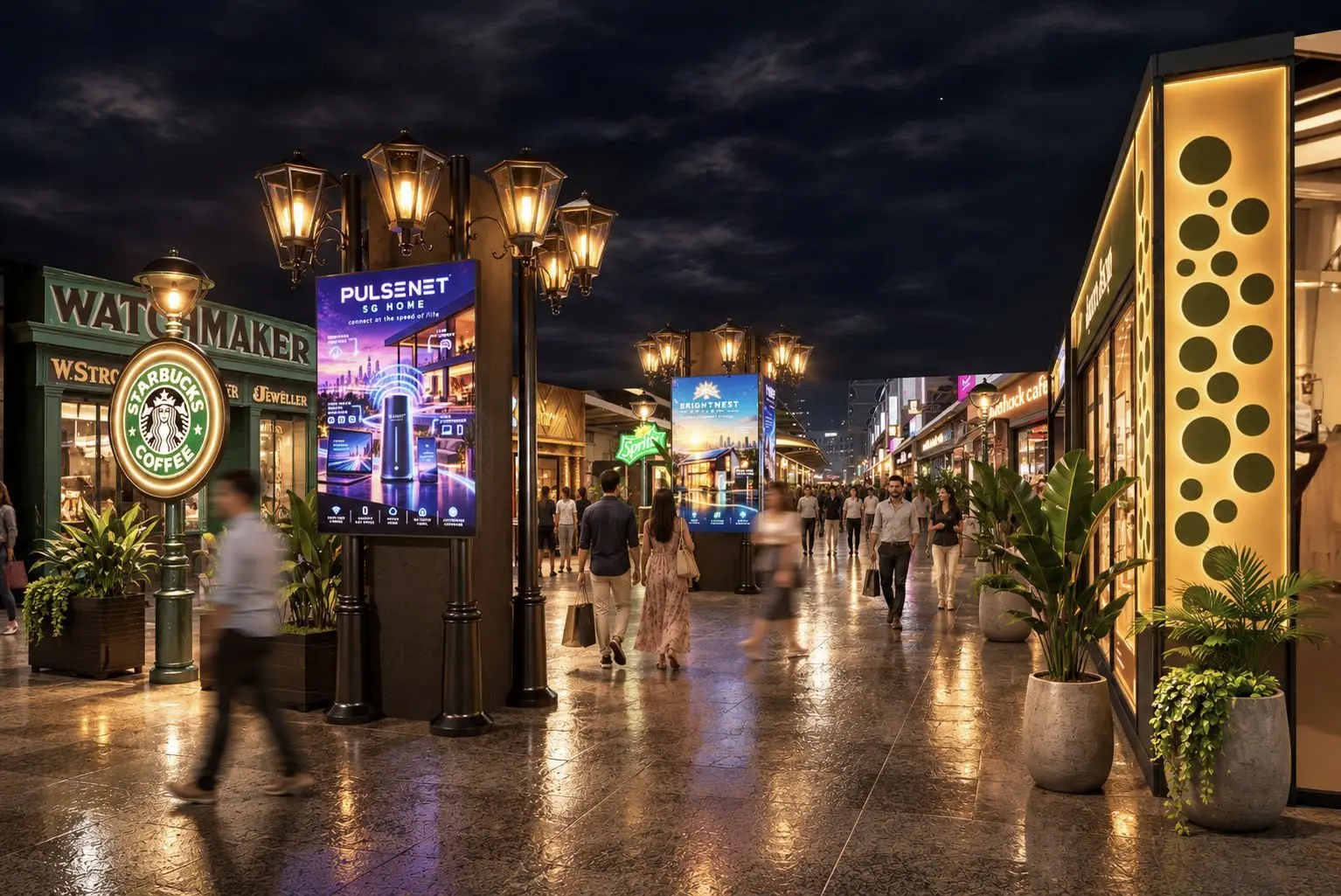
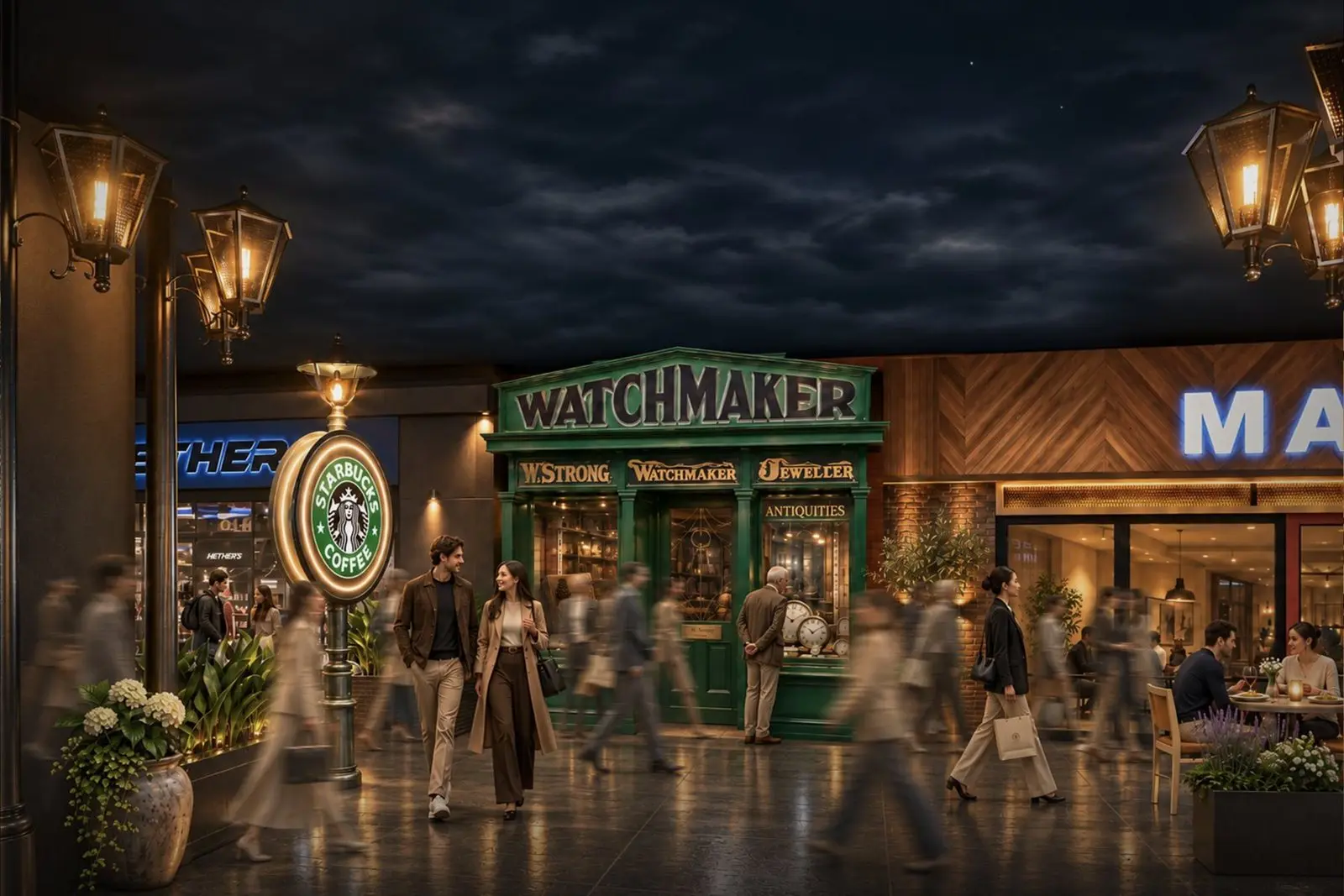
You walk into a bustling Cyberhub, a contemporary city street of shops, restaurants, digital advertisements and street furniture. Trompe l'oeil graphics stretch the avenue into the distance, while traffic sounds, music and crowds fill the air. Vivaan is immediately drawn to the luxury goods and advertisements, while Leonardo tries to keep him moving as their story unfolds.
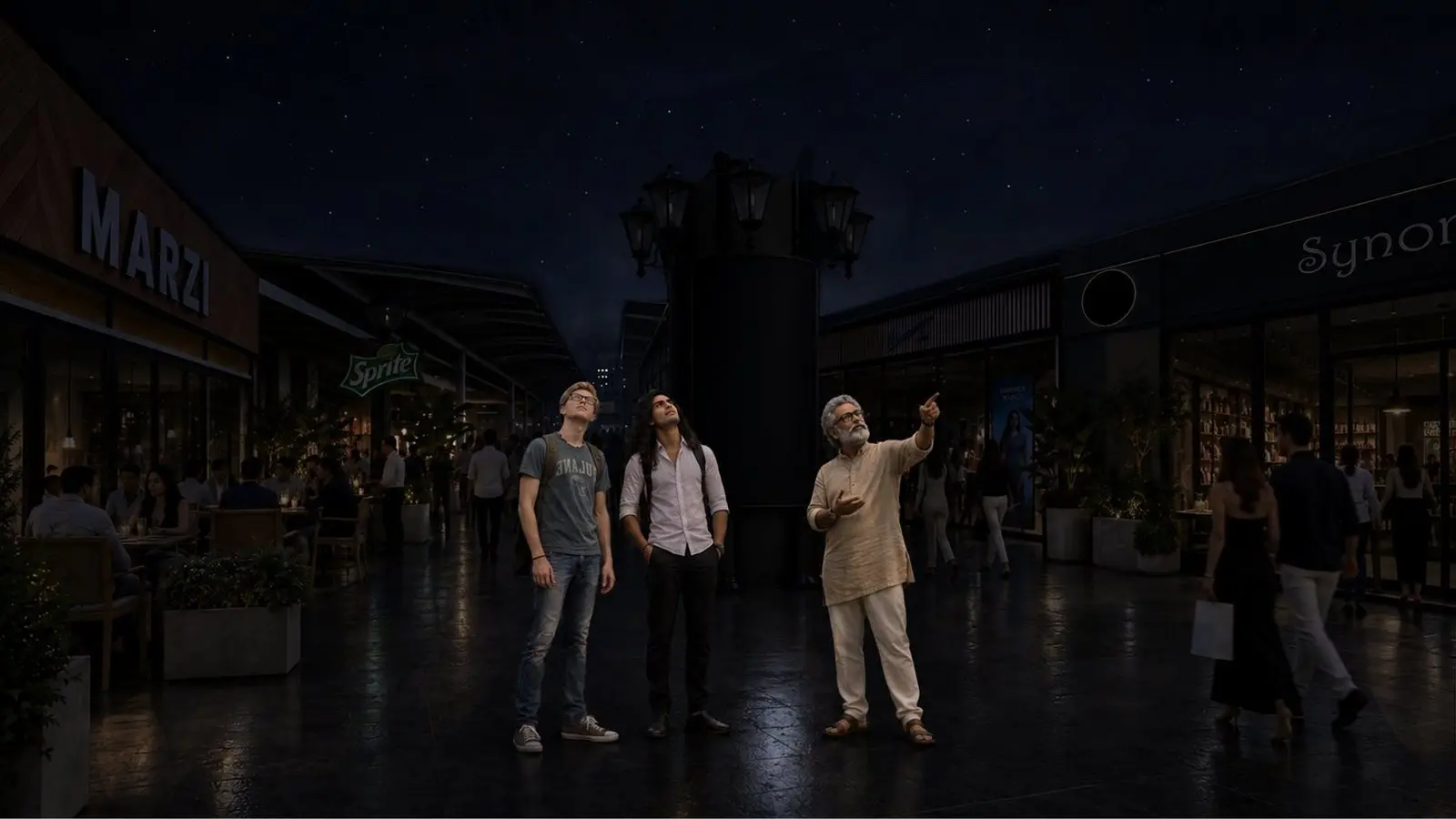
As you move along, the lights, sounds and animated displays grow more and more intense. Then the power fails. Shop lights, screens and city sounds shut down, and in the sudden darkness a few stars appear overhead. More and more follow, until Vivaan, Leonardo and everyone around them are looking up at the night sky.
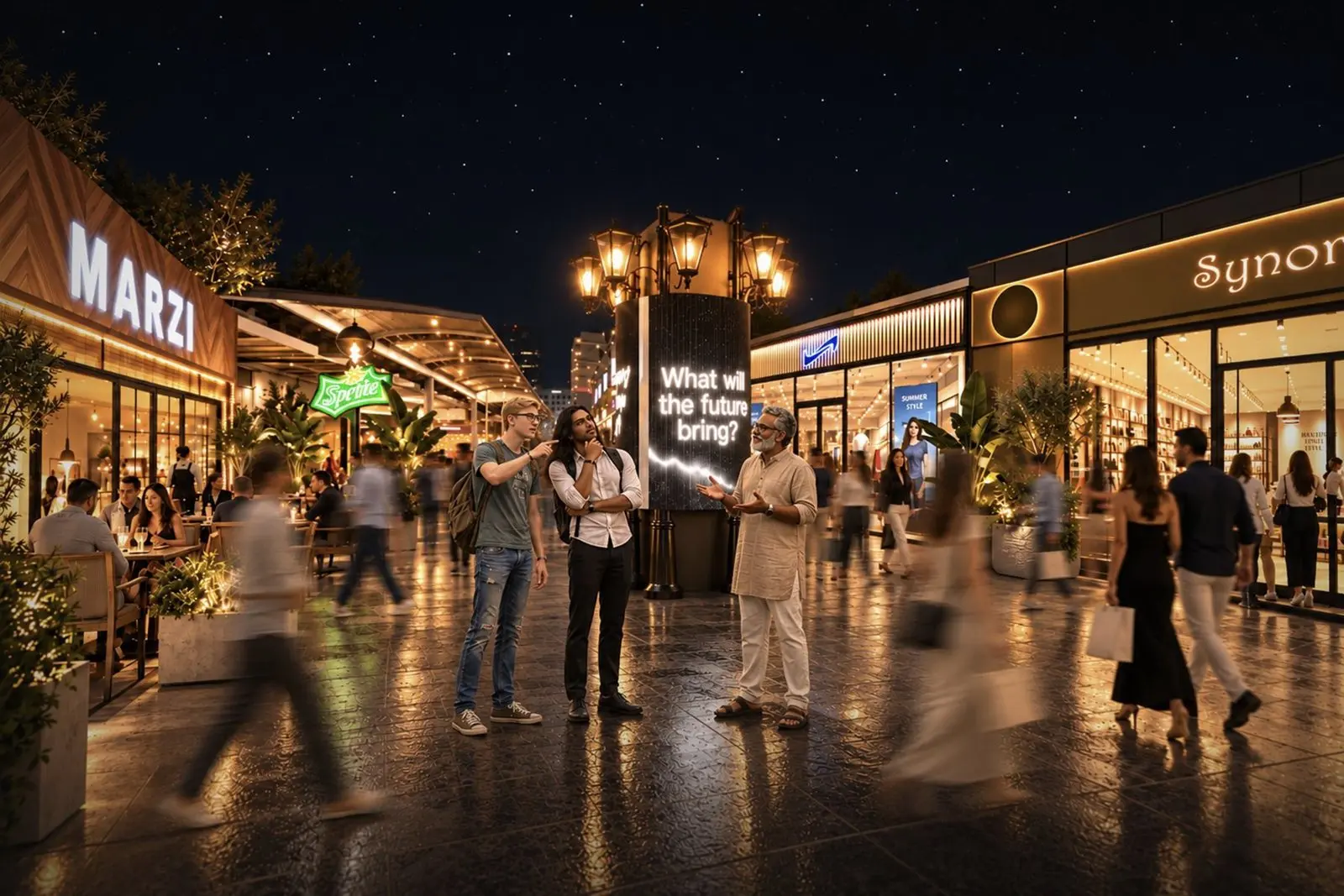
When the power returns, the advertising screens have changed. Instead of selling, they now carry questions such as: What will the future bring? The mood of the street shifts. At its far end you reach an antique watchmaker's shop where the clocks run backwards, and Devarshi reappears to lead you on into the dome.
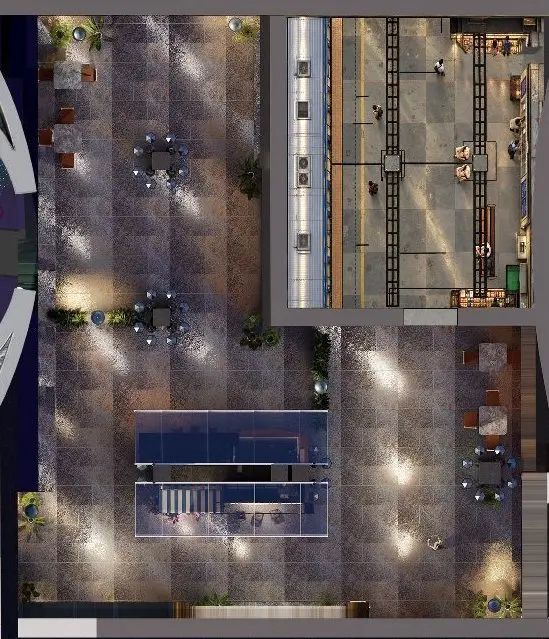
You enter a brightly lit commercial street of shops, restaurants, advertising screens and people. Bright lights, traffic sounds and constant activity create an energetic, crowded atmosphere.
You move through the Cyberhub with Vivaan and Leonardo. Vivaan is distracted by luxury products and advertisements, while Leonardo tries to keep him moving as the street grows ever more stimulating.
Suddenly the whole Cyberhub goes dark. Screens, shop lights and city sounds shut down. In the darkness a few stars become visible overhead, then more, and everyone begins to look up at the night sky.
When the power returns, the screens show questions instead of advertisements. You continue to an antique watchmaker's shop where the clocks run backwards, and Devarshi reappears to lead you into the dome.




The big idea
The distractions of modern life can hide the questions that were always there. When the noise stops, those questions surface, and we begin to look beyond ourselves.
Questions it asks
You will come away understanding
Bring it to life
Your gift lights up this living street, its screens, sounds and sudden starry silence, creating a moment of awakening that prepares every visitor for the journey ahead.
Design Habit estimate for the gallery, including GST
Sponsor this exhibitLevel 0 · How Can I Know?The whole level: galleries and visitor spaces
Sponsor the levelAny amountEvery gift is recorded for this exhibit and for SMOVP
Donate to this exhibitEstimates from Design Habit (April 2026), shown in US dollars at ₹95 per US$1. Final costs are confirmed with each sponsor.
0.3
Recline beneath a dome and travel back to a sky our ancestors knew, exploring what we can know by seeing, by reasoning and by trusted testimony, and a fourth way of knowing beyond all three.
Discover and supportClose ×Recline beneath the dome and recover the sky our ancestors knew.
What you will experience
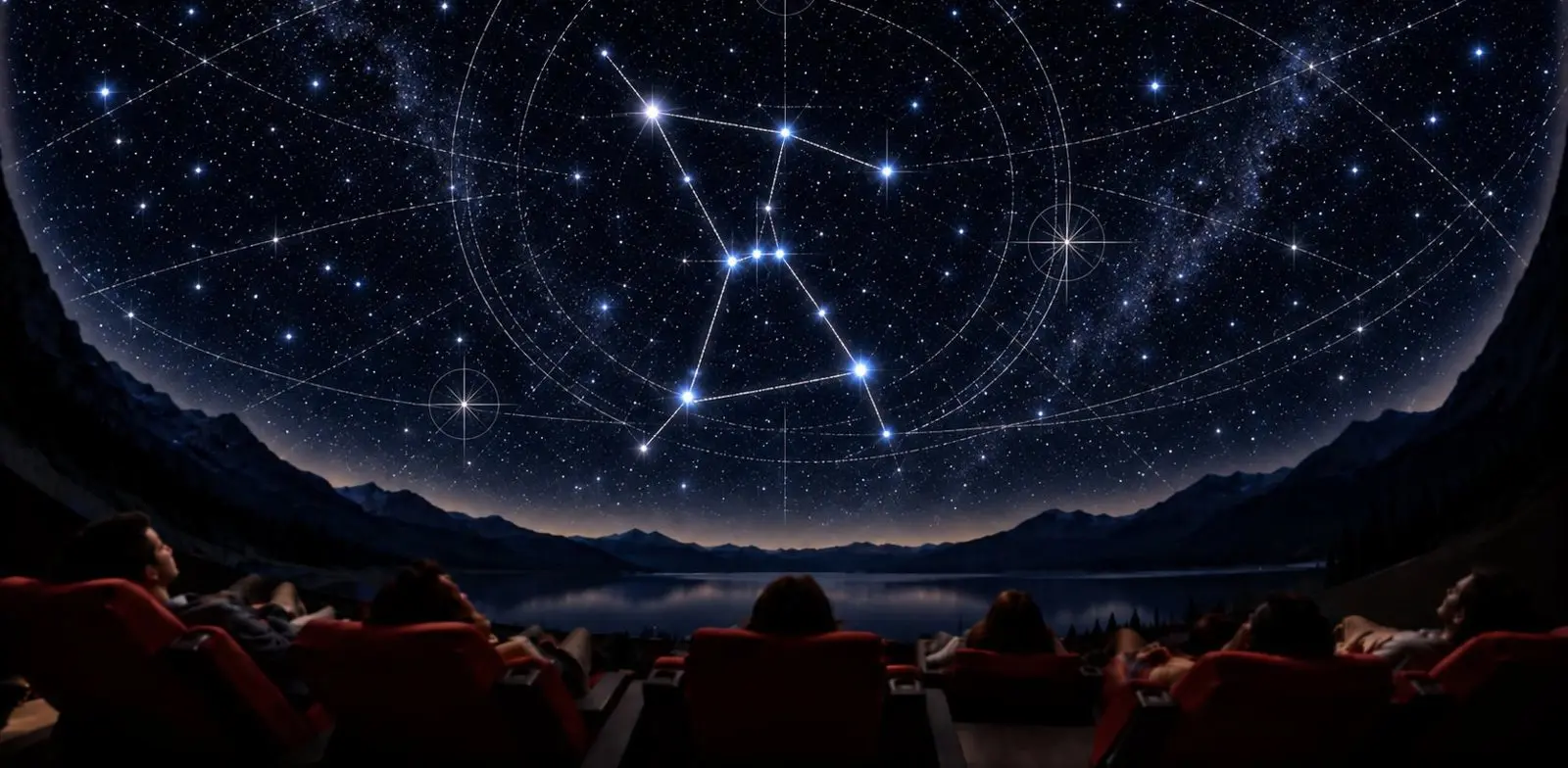
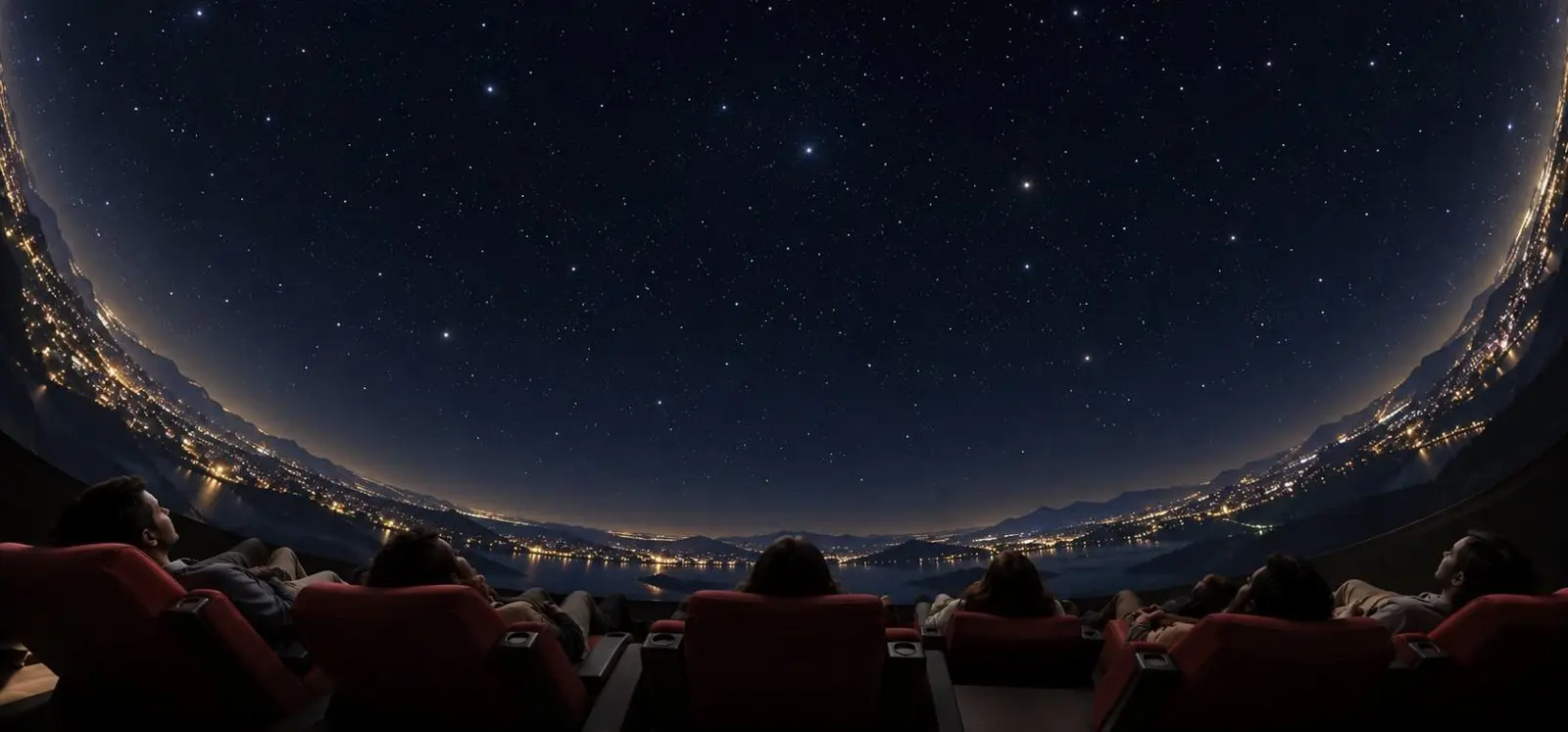
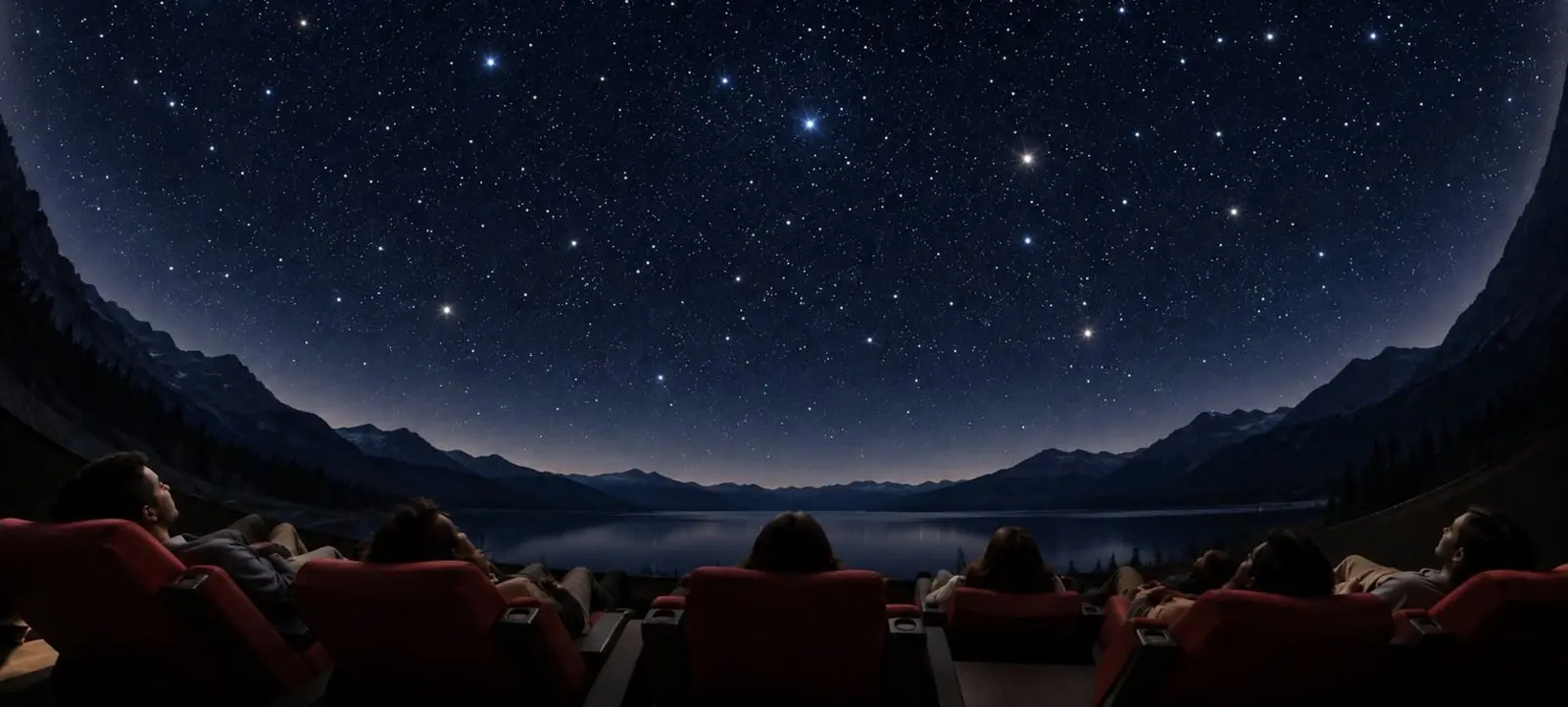
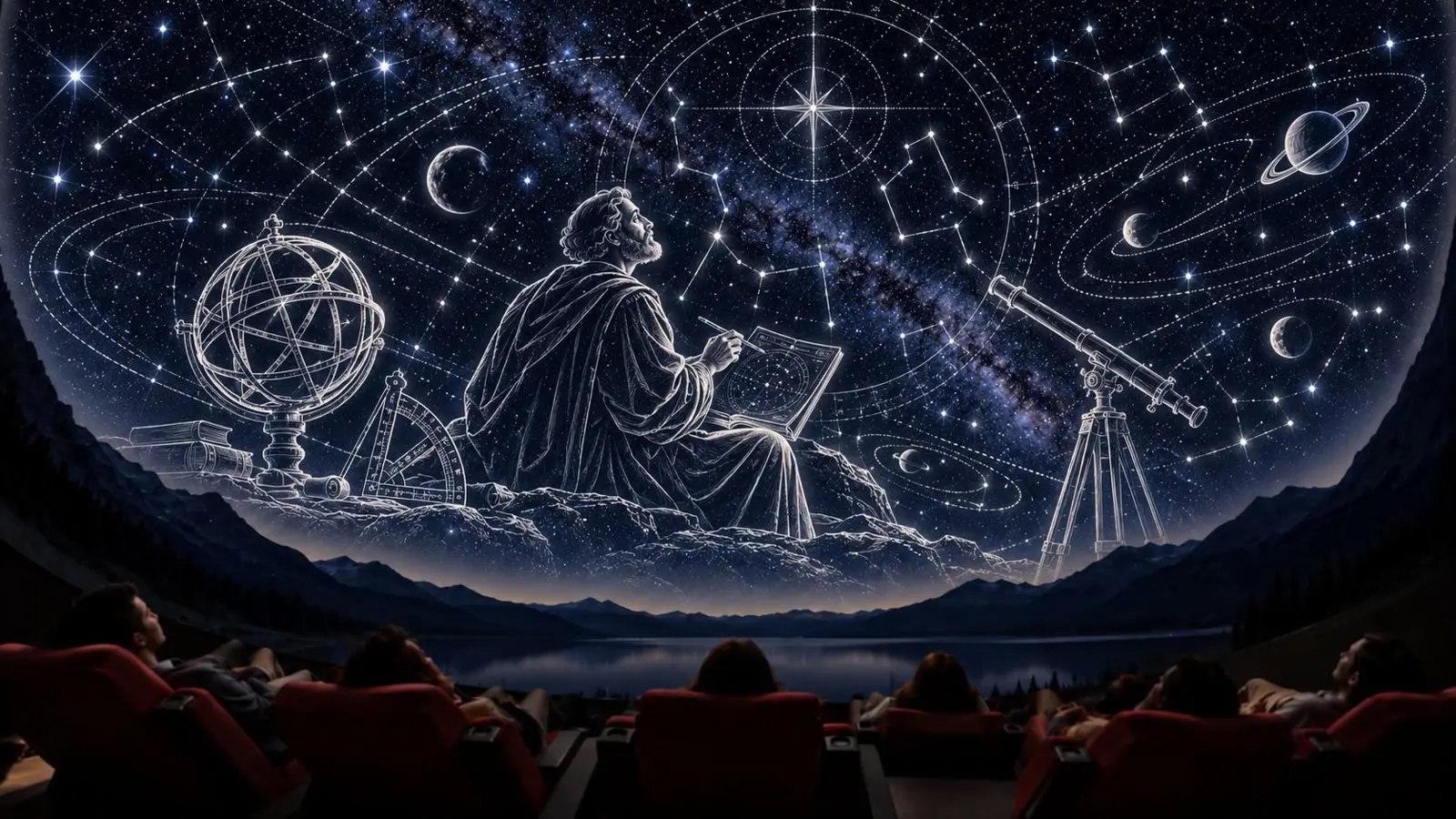
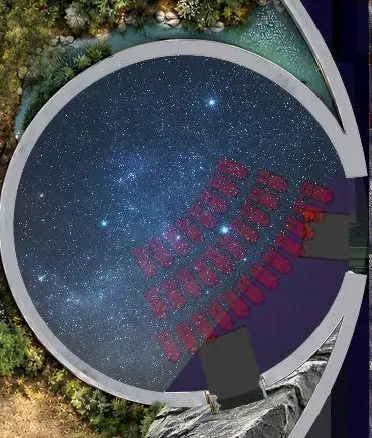
You recline beneath a dome. Above you hangs the same hazy orange glow of the city sky, now seen from open country. Then time begins to turn backward. The haze lifts, the stars multiply, and the Milky Way blazes over mountains, beaches and plains, a grandeur that was once part of every night and is now almost entirely lost.
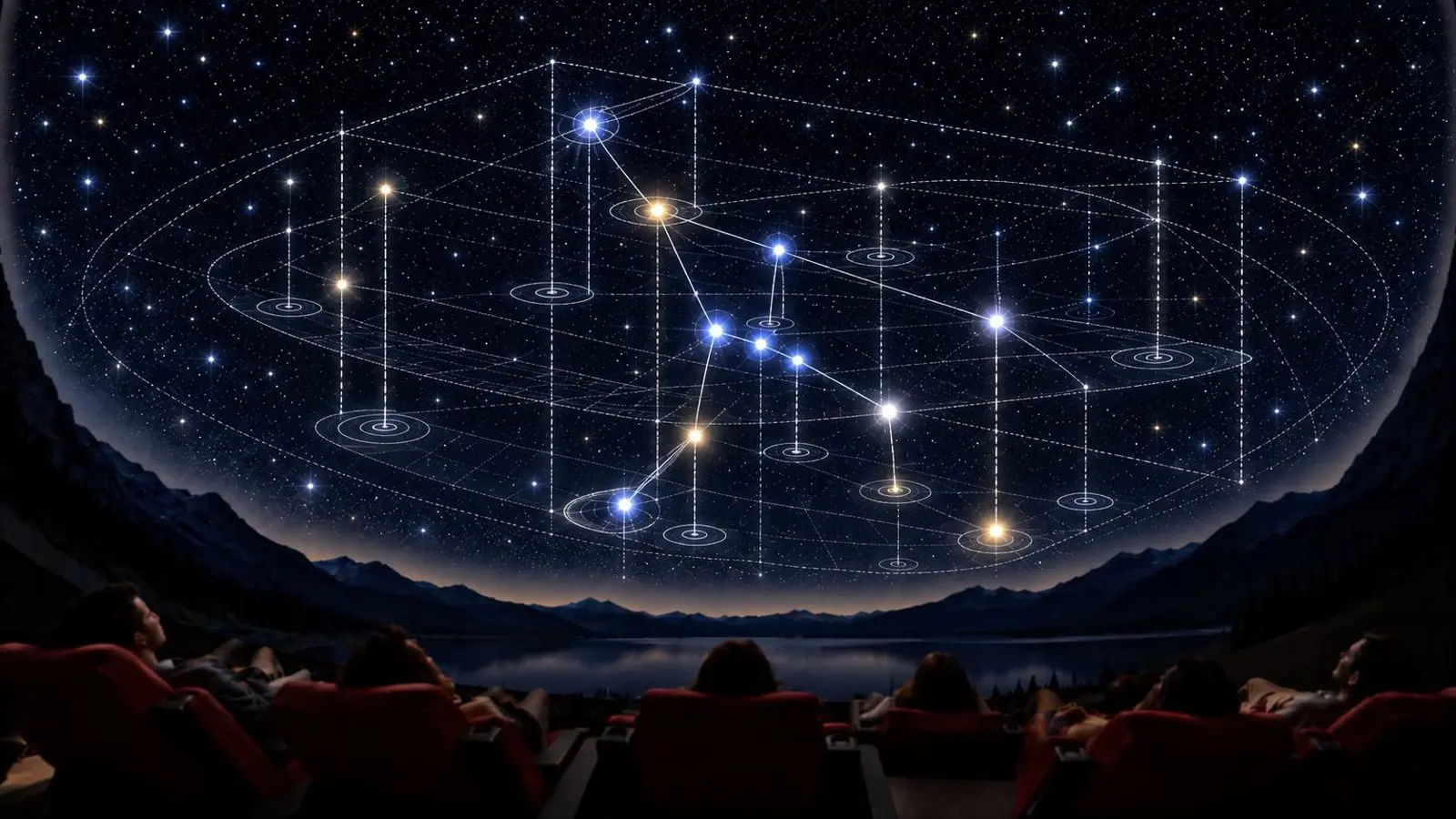
With the distractions removed, the great questions rise naturally: Who am I? Where do I belong in this immense universe? What is the purpose of it all? Using the familiar stars of Orion, known in India as Mṛga, the show explores how we come to know anything. You see Orion from Earth, then discover its true three-dimensional arrangement, and drift towards the glowing Orion Nebula.
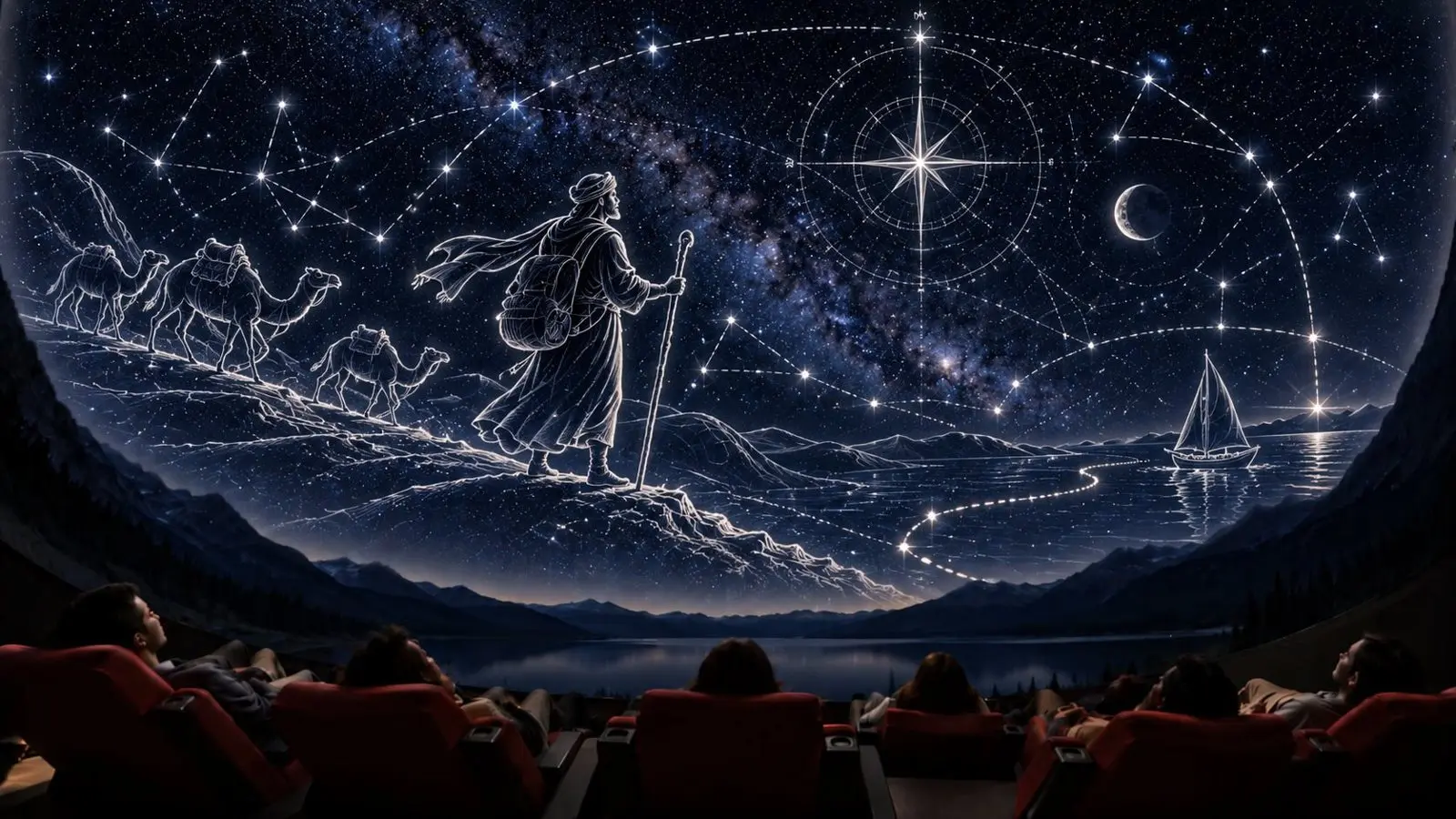
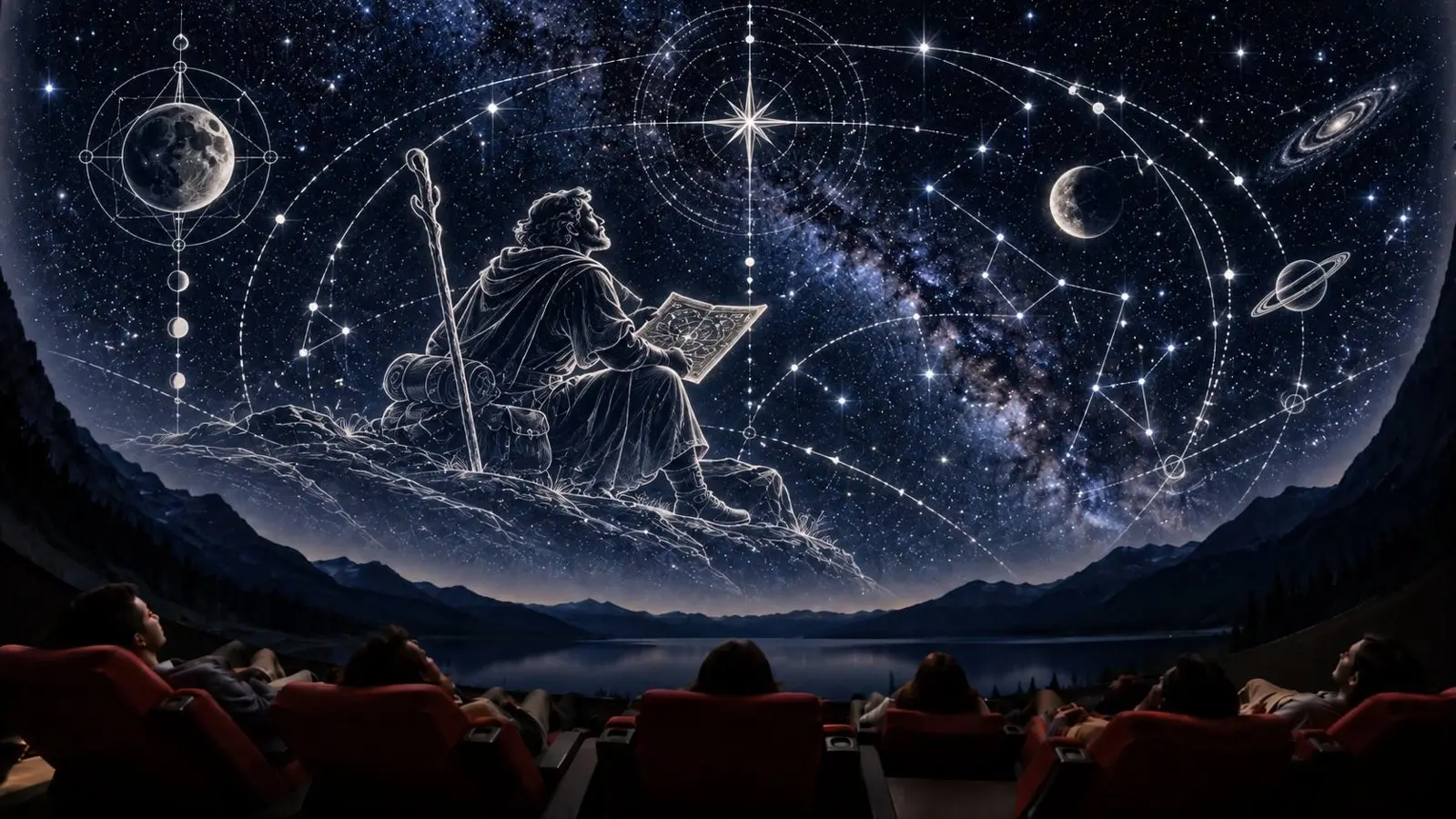
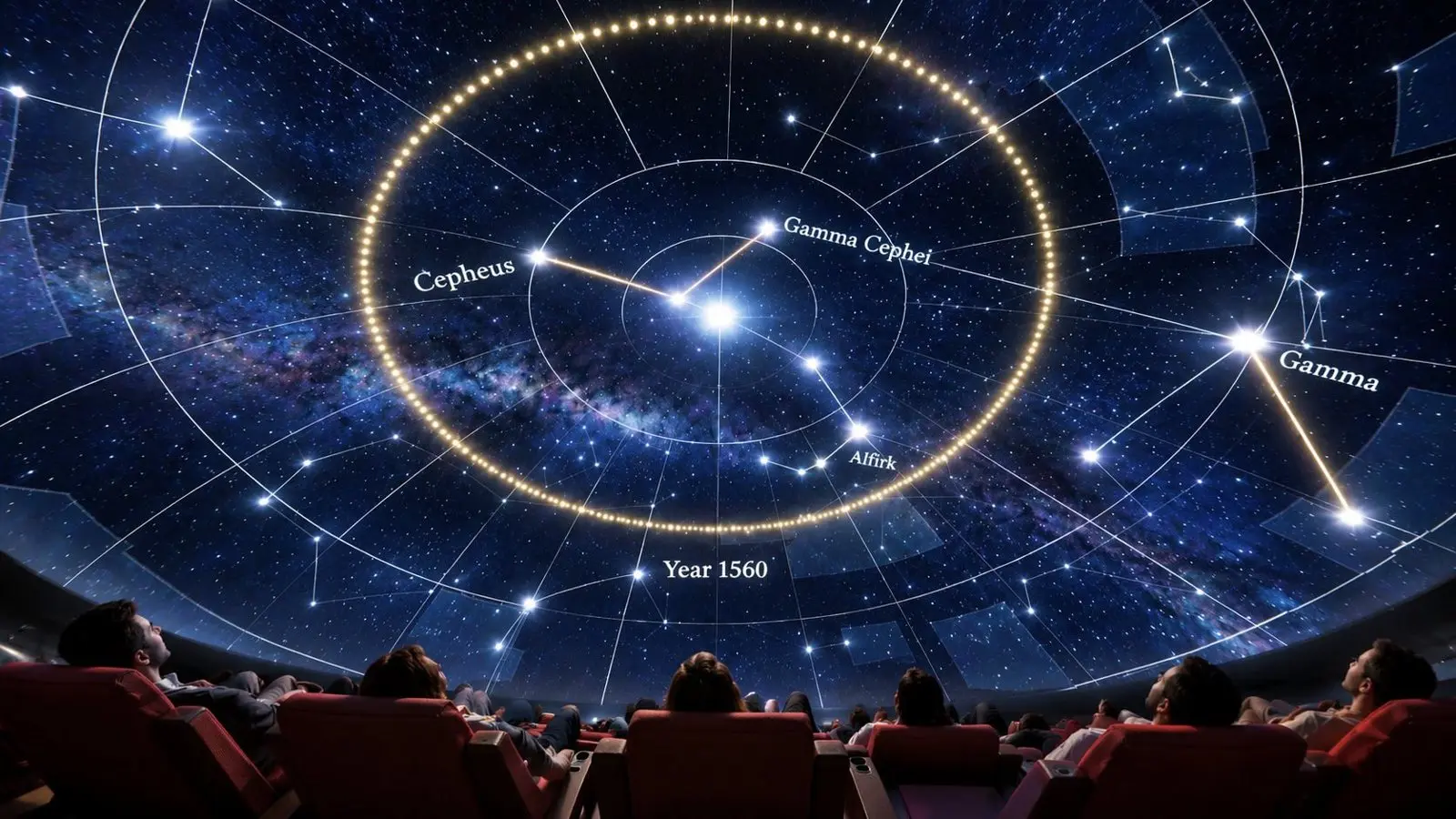
Seeing, reasoning and trusted testimony each take you so far, and then a fourth way of knowing is introduced: knowledge that is revealed rather than gained by human effort alone. A second journey through time begins. The sky rotates backward five thousand years, the Pole Star and the constellation Draco are highlighted, and you arrive at the edge of an ancient forest.
You recline beneath the dome and look up at the same hazy orange glow of the city sky, now seen from open country. Only a few faint stars break through. This is the sky most people live under today, washed out by light.
Time turns backward to the age before industry. The haze lifts, the stars multiply, and the Milky Way blazes across the dome over mountains, beaches and plains. You see the grandeur our ancestors knew every night, now almost entirely lost to modern life.
With every distraction removed, you sense what people once felt beneath such a sky. Questions rise naturally: Who am I? What does it mean to be alive? Where do I belong? What is the purpose of it all? The show lets them linger above you.
You find the familiar stars of Orion as seen from Earth, with illustrated overlays of the Greek hunter Orion and the Indian Mṛga. Then the stars separate into their true three-dimensional arrangement, revealing their real distances, colours and nebulae, while the show explores what we can know by seeing, by reasoning and by trusted testimony.
Illustrated animations introduce observers, astronomers and teachers of the past. A fourth way of knowing is introduced: non-human testimony, knowledge revealed rather than discovered. Then a second journey back in time begins. The sky turns back five thousand years and the North Star shifts, until you reach an ancient forest.
The big idea
Our human ways of knowing are precious but limited. The Vedic tradition adds revealed knowledge as the key to understanding the bigger picture of life.
Questions it asks
You will come away understanding
Words to know
direct perception
logical inference
authoritative testimony
non-human, revealed testimony; Vedic knowledge
Bring it to life
Your support fills this dome with a restored night sky, giving every visitor the awe our ancestors felt and the questions that awe inspires.
Design Habit estimate for the gallery, including GST
Sponsor this exhibitLevel 0 · How Can I Know?The whole level: galleries and visitor spaces
Sponsor the levelAny amountEvery gift is recorded for this exhibit and for SMOVP
Donate to this exhibitEstimates from Design Habit (April 2026), shown in US dollars at ₹95 per US$1. Final costs are confirmed with each sponsor.
0.4
Enter an ancient forest before dawn, hear Sūta Gosvāmī recount how the Śrīmad-Bhāgavatam was spoken, and watch the forest fill with light as the sages chant.
Discover and supportClose ×Enter an ancient forest before dawn, where sages gather to receive and preserve timeless wisdom.
What you will experience
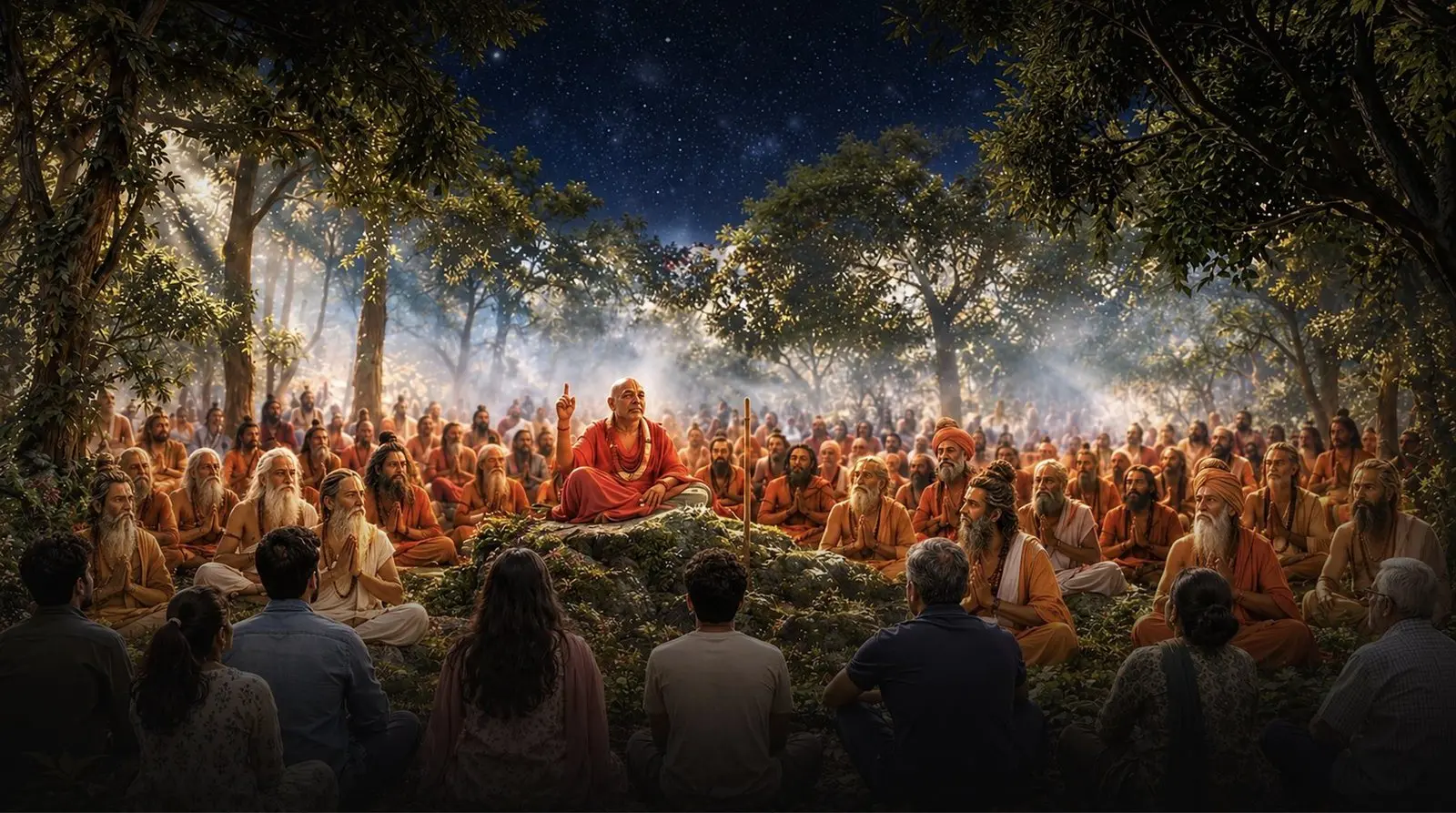
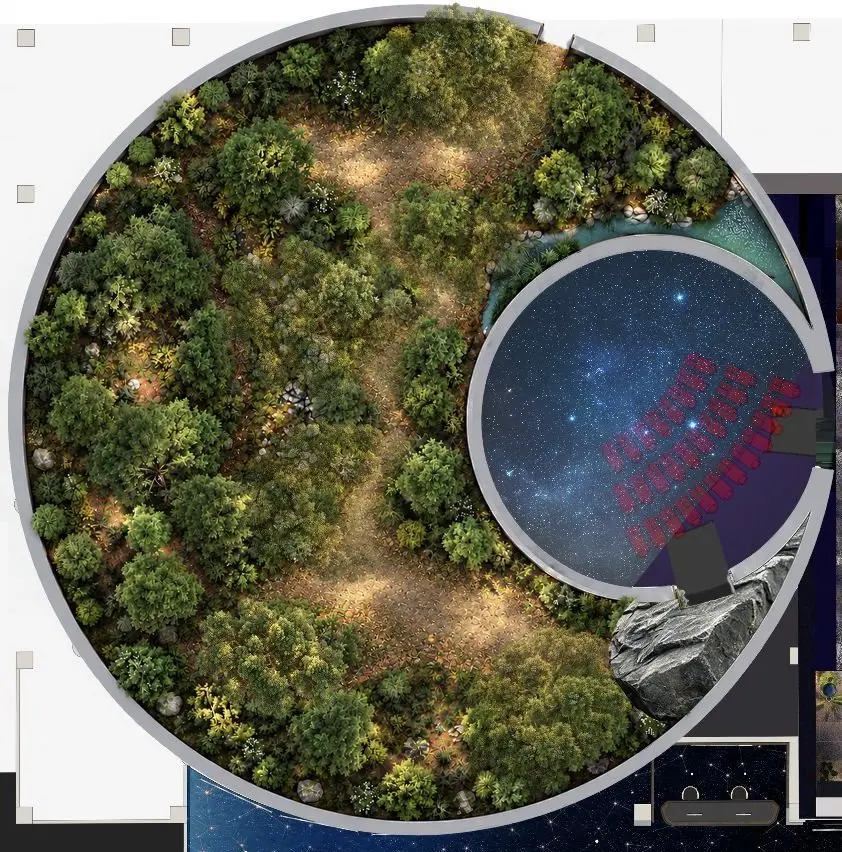
A narrow pathway leads you into an ancient forest before dawn. Among realistic trees and drifting mist, sages meditate, practise yoga and go about their daily work. You take your seat within the landscape, facing a clearing where sages sit around a fire discussing the future of humanity. Along the forest horizon, projections show humanity's achievements in architecture, art, medicine, education and science, then turn into scenes of conflict, environmental destruction, exploitation and isolation.
Sūta Gosvāmī arrives after a long journey, and the sages turn to listen. He recounts the events at Shukratal: King Parīkṣit's encounter with a meditating sage, the curse that followed, and his meeting with Śukadeva Gosvāmī on the banks of the Ganges, where the Śrīmad-Bhāgavatam was spoken. Projected scenes bring each moment to life as the assembly prepares to receive and preserve these teachings.
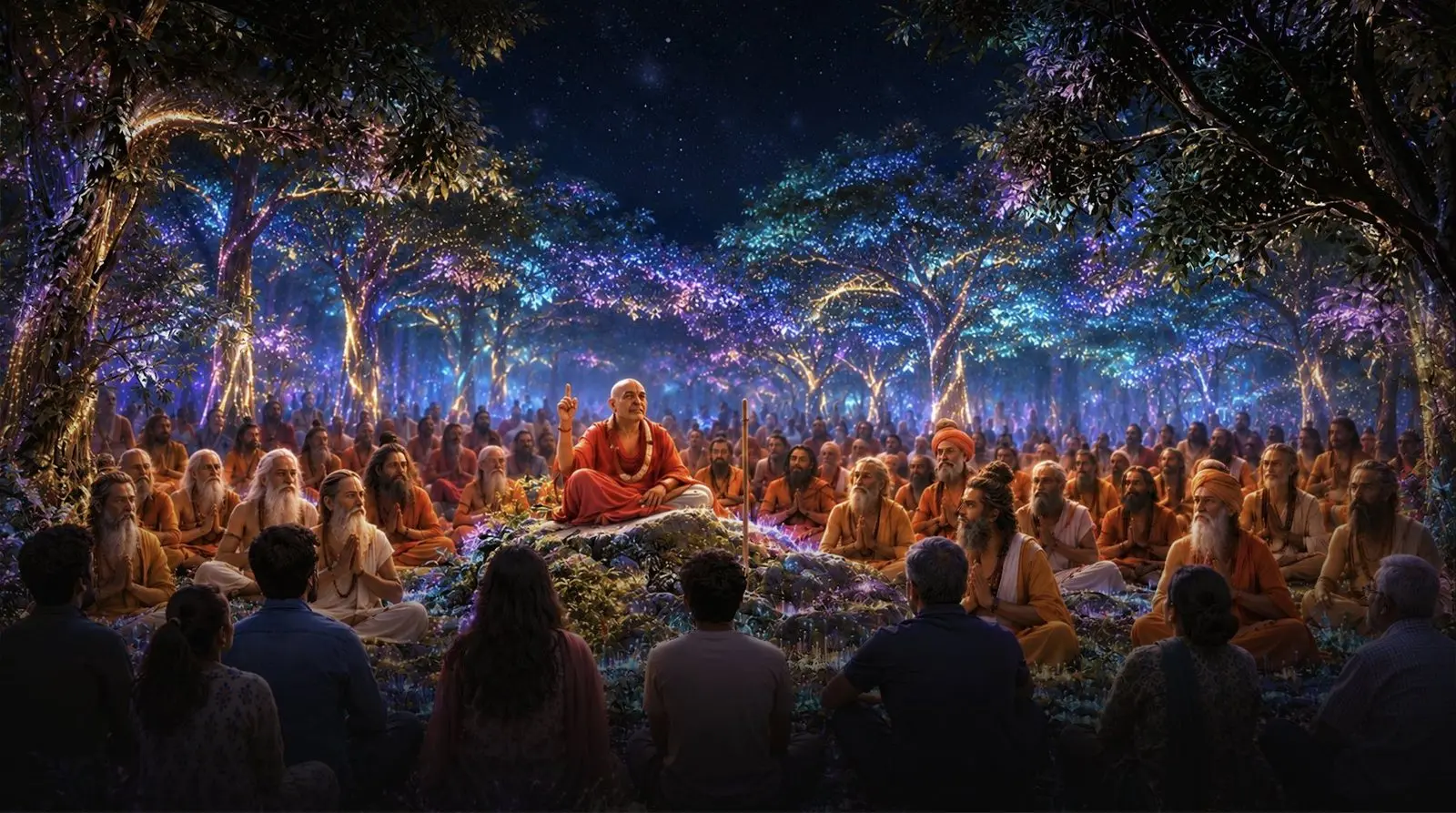
The sages make offerings into the sacred fire as Sanskrit chanting begins. Through time-lapse projection, daylight, seasons and centuries pass, and the gathering grows from a small assembly into thousands of sages. As Sūta Gosvāmī leads the recitation and Devarshi explains its meaning, points of light appear at the roots of the trees and spread through trunks and branches until the whole forest glows, before the scene turns to dawn.
A narrow pathway leads you into an ancient forest before dawn. Sages meditate, practise yoga and go about their daily activities among the trees. You take a seat within the landscape, facing a central clearing.
Sages gather around a fire to discuss the future of humanity. On the forest horizon, images of human achievement give way to conflict, environmental destruction, exploitation and isolation, as light, sound and music intensify.
Sūta Gosvāmī arrives after a long journey and recounts the events at Shukratal. Projected scenes show King Parīkṣit's encounter with a meditating sage, the curse that followed and his meeting with Śukadeva Gosvāmī beside the Ganges.
The sages make offerings into the sacred fire as Sanskrit chanting begins. Time-lapse projections show daylight, seasons and centuries passing, while the gathering grows from a small assembly into thousands of sages across the forest.
Sūta Gosvāmī leads the recitation of Sanskrit verses and Devarshi explains their meaning. Points of light appear at the roots of the trees and spread through trunks and branches, until flowing light surrounds you and the forest turns to dawn.
The big idea
Vedic knowledge is revealed wisdom, preserved through sacred gathering and recitation, inviting human life to align with the cosmic order through contemplation, stillness and attunement.
Questions it asks
You will come away understanding
Words to know
revealed wisdom, not of human origin
a sacred gathering in which sages chant
the ripened fruit of the Vedas
connection; intentional attunement
Bring it to life
Your gift brings this forest gathering to life, from the predawn mist and the sacred fire to a forest filled with light, so every visitor can witness how timeless wisdom was preserved for us.
Design Habit estimate for the gallery, including GST
Sponsor this exhibitLevel 0 · How Can I Know?The whole level: galleries and visitor spaces
Sponsor the levelAny amountEvery gift is recorded for this exhibit and for SMOVP
Donate to this exhibitEstimates from Design Habit (April 2026), shown in US dollars at ₹95 per US$1. Final costs are confirmed with each sponsor.
0.5
In a mango grove, ripe fruit passes from hand to hand, then a timeline of teachers leads from ancient India to Srila Prabhupada in 1960s New York.
Discover and supportClose ×In a mango grove, see how timeless knowledge passes from hand to hand across the generations to reach you.
What you will experience
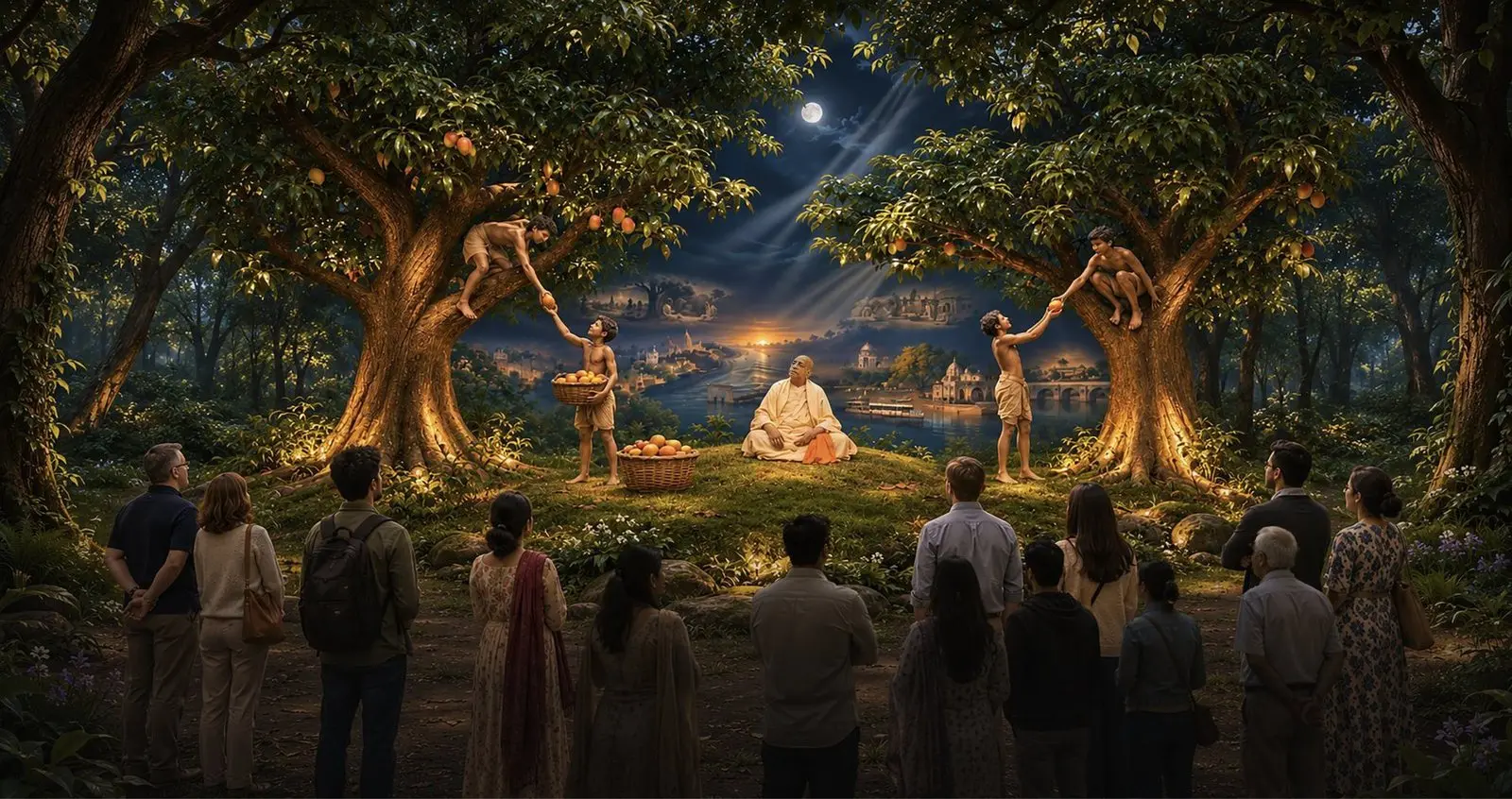
You enter an immersive mango grove of large trees, dense vegetation and a layered landscape. Holographic figures of Devarshi, Vivaan and Leonardo appear among the trees. Bronze figures perched at different heights harvest ripe mangoes and pass them carefully from person to person until they reach the ground.
Devarshi explains the meaning of this human chain: like the fruit, knowledge is handed carefully from one generation to the next so that it arrives whole. Then the grove becomes a timeline. Projected representations of prominent spiritual teachers appear one by one, each against animated backgrounds of their own period and place.
The sequence culminates with Srila Prabhupada, his arrival in New York in the 1960s and the founding of ISKCON, connecting the ancient lineage to the modern world. Devarshi, Vivaan and Leonardo reappear as the historical imagery fades. Mist fills the grove, and Devarshi leads everyone towards the lift and the journey to Level 1.
You enter a grove of large mango trees and layered landscape. Holographic figures of Devarshi, Vivaan and Leonardo appear among the trees as the scene begins.
Figures high in the trees harvest ripe mangoes and pass them from person to person until they reach the ground. Devarshi explains that knowledge travels between generations in just this way.
The grove transforms as projected representations of prominent spiritual teachers appear one after another, each set against animated backgrounds of their historical period and place.
The sequence culminates with Srila Prabhupada, shown with images of New York in the 1960s, connecting the lineage of teachers to the modern world and the founding of ISKCON.
Devarshi, Vivaan and Leonardo reappear as the imagery fades and mist fills the grove. Leading everyone towards the lift, Devarshi leaves you with a question: if you want to understand life, start by understanding yourself. Who are you? What does it mean to be you?
The big idea
The paramparā keeps the essence of the Vedas authentic, accessible and adapted to each generation, so that timeless knowledge remains relevant and applicable today.
Questions it asks
You will come away understanding
Words to know
disciplic succession; the lineage of teachers and students
Bring it to life
Your support plants this grove of mango trees and lights its living timeline, showing every visitor how wisdom has been carried, hand to hand, all the way to them.
Design Habit estimate for the gallery, including GST
Sponsor this exhibitLevel 0 · How Can I Know?The whole level: galleries and visitor spaces
Sponsor the levelAny amountEvery gift is recorded for this exhibit and for SMOVP
Donate to this exhibitEstimates from Design Habit (April 2026), shown in US dollars at ₹95 per US$1. Final costs are confirmed with each sponsor.
Level 1
Mirrors that come alive, a room without colour, a spark of light: a journey inward to the conscious self.
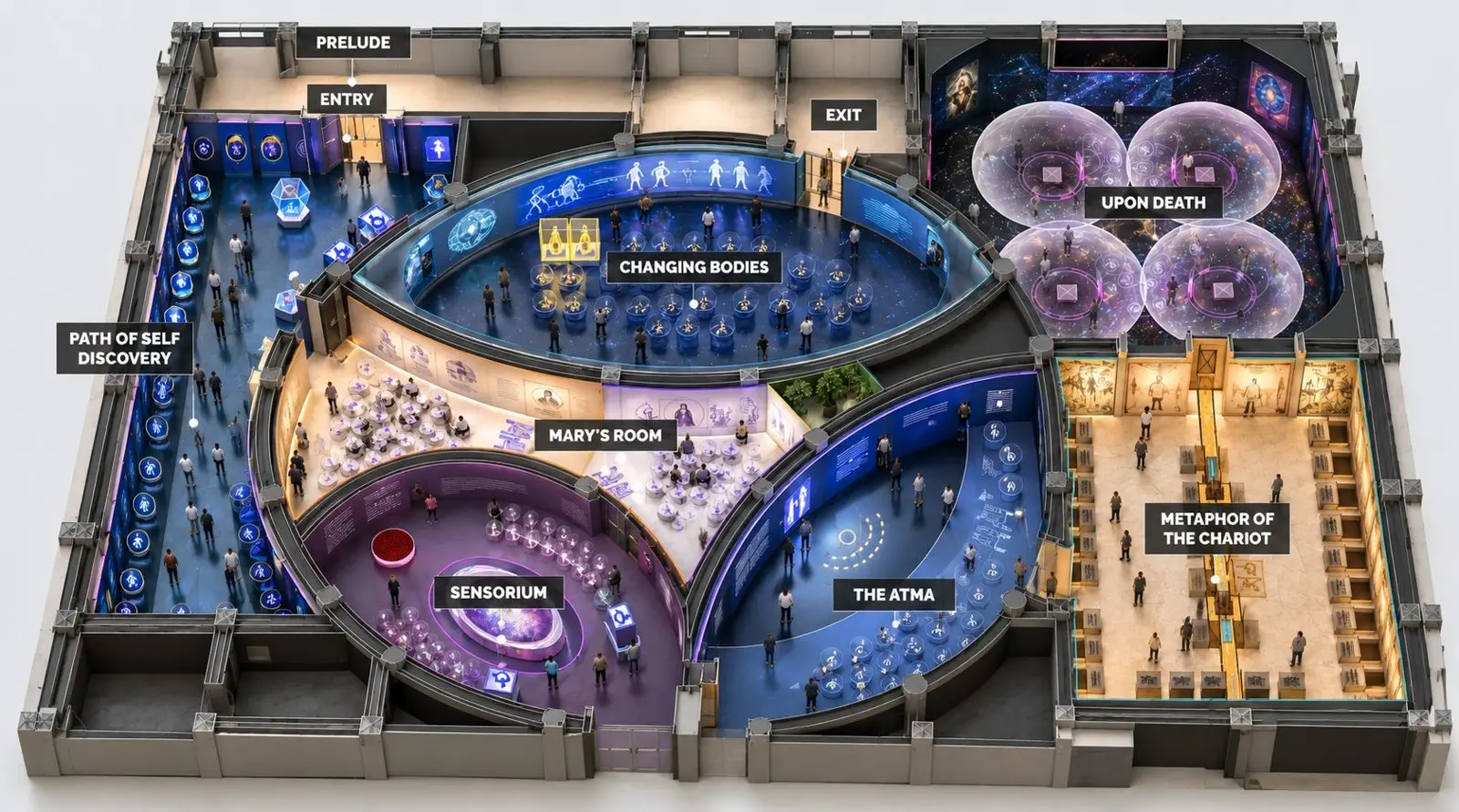
This level invites you on a profound journey inward. It addresses a perplexing question: am I this body? As the level unfolds, it answers with timeless clarity. The exploration starts with the simplest certainty: I exist. From this truth, the museum guides you through sensory experiences and the mysteries of the brain, and then, in the Sensorium, the story confronts the intractable problem of explaining conscious experience solely in terms of brain activity.
Drawing on Vedic wisdom, the level reveals the atma, a spark that is eternal, conscious and full of desire and agency. Through engaging interactives, metaphors and testimonies of near-death experiences, you come to consider that the true self never dies. Reincarnation, karma and the continuity of desire are vividly illustrated in a dynamic journey of changing bodies, leaving you with a heightened sense of wonder and calm.
1.1
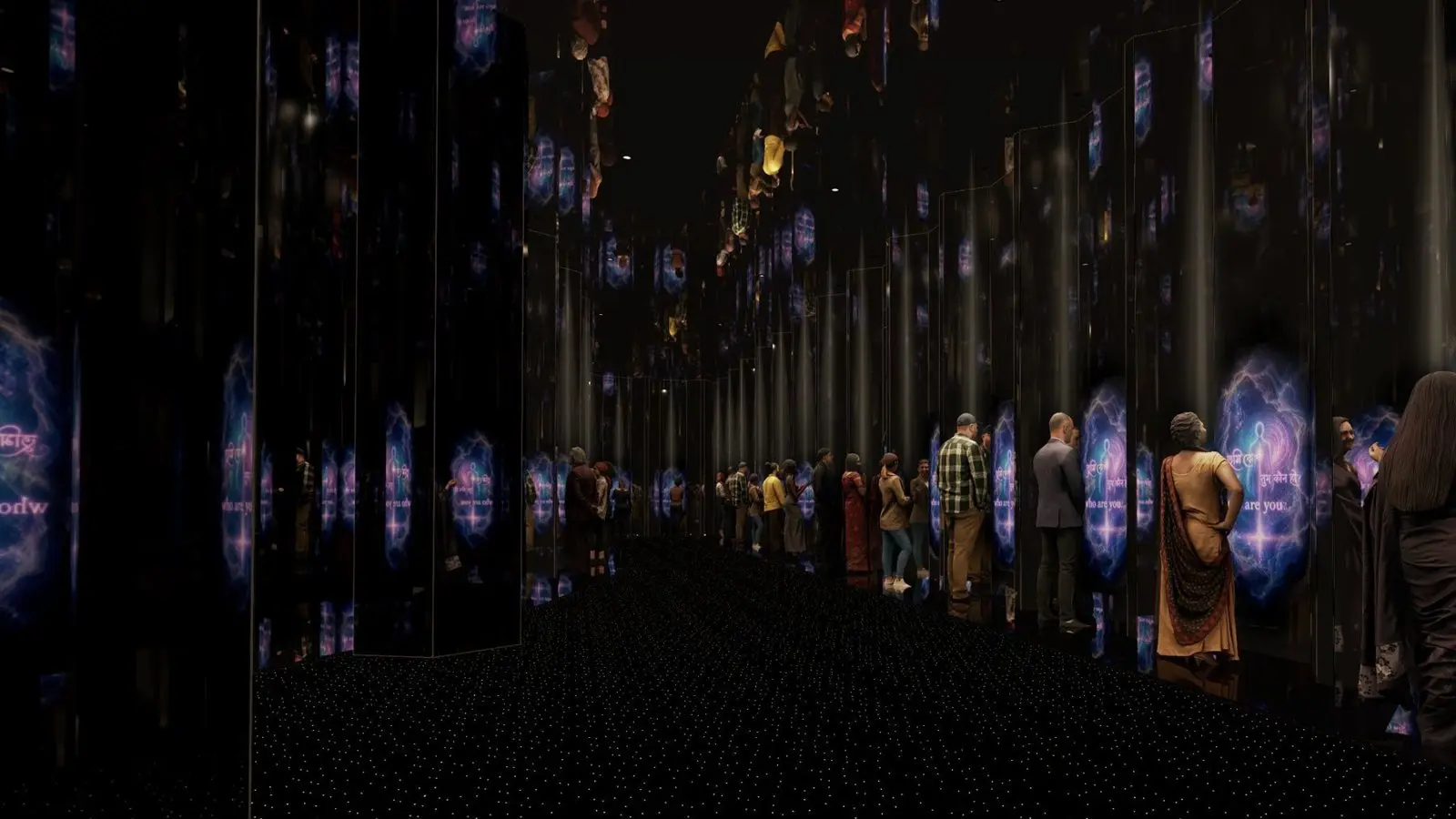
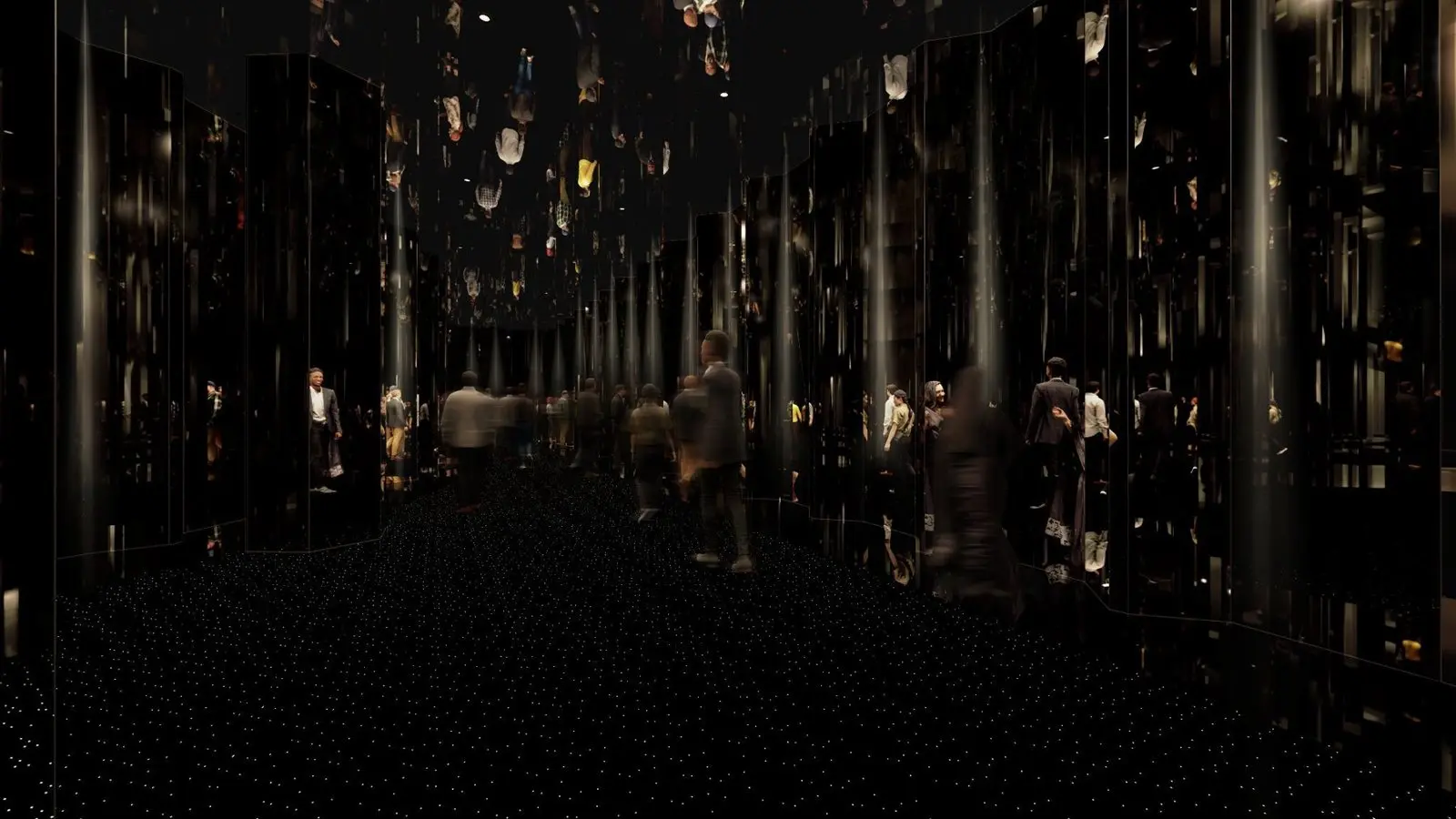
A meditative mirror maze where smart mirrors create a digital double of you, then morph it through ages and forms. Where, exactly, is the one who is aware?
Discover and supportClose ×In a maze of mirrors, discover the one certainty you have: you are aware.
What you will experience
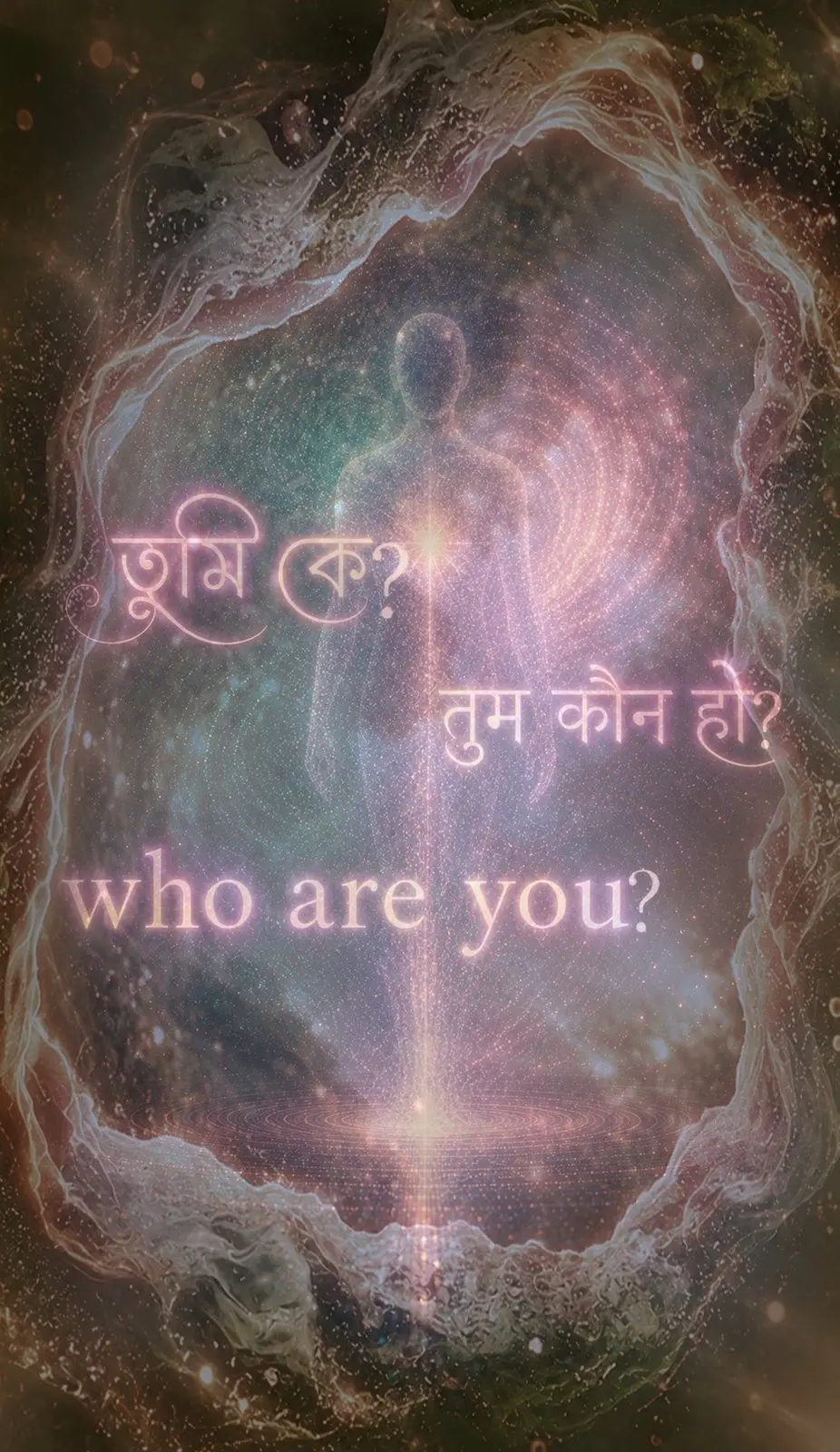
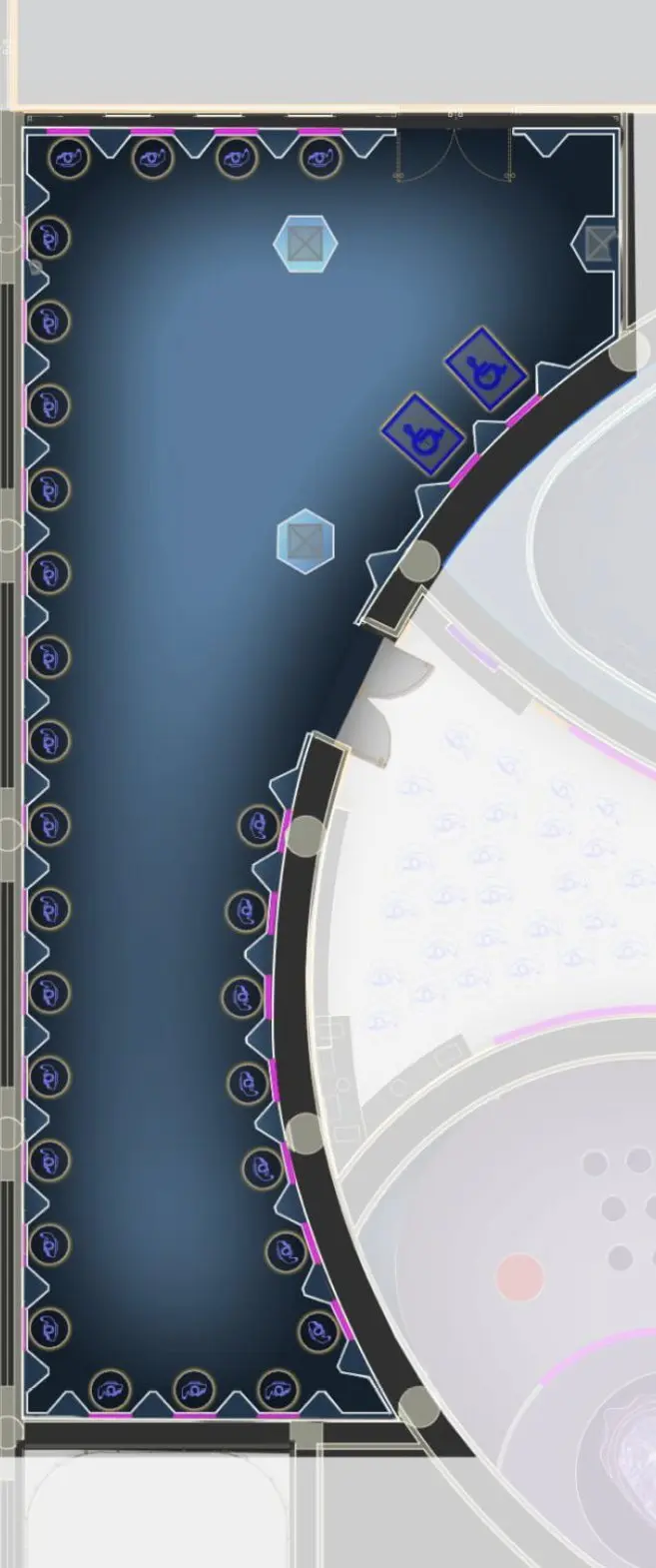
You enter a mirror maze that seems to go on forever, quiet and meditative. Narration and light guide you through the endless reflections, inviting you to look at yourself, until you reach your own station among the mirrors.
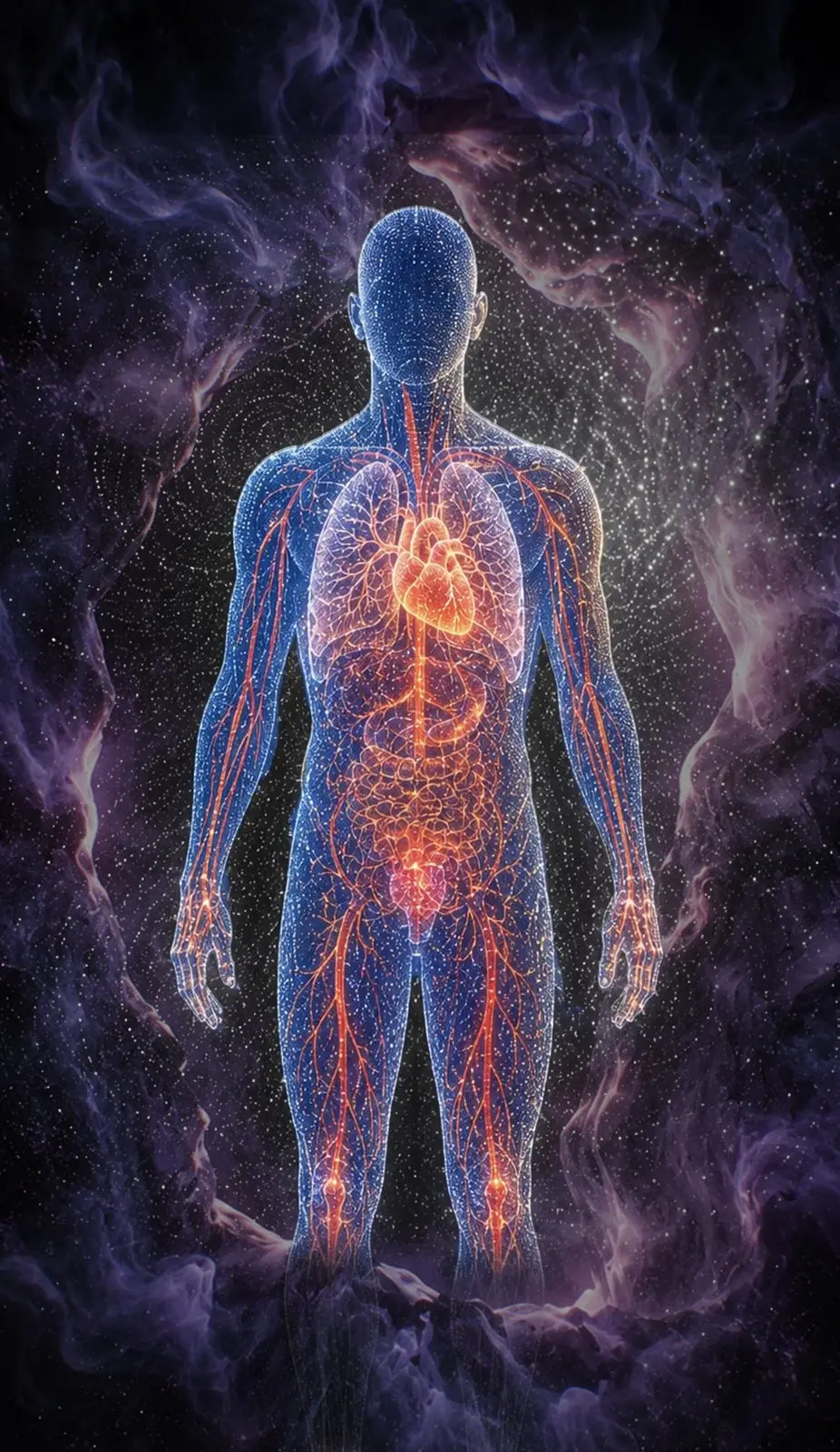
Smart mirrors hidden in the maze capture your image and turn it into a near-lifelike digital copy that follows every movement you make. As you play with your digital double, you begin to notice something simple and certain: you know you exist because you are aware.
A series of meditative observation exercises follows. Then the installation morphs your image through different ages, genders and ethnicities, showing how changeable and temporary the physical form is. The session closes with a question to carry with you: is consciousness in the brain, in the body, or beyond both?
You step into a seemingly infinite maze of mirrors. Narration and lighting guide you gently through the reflections towards your own station.
A smart mirror captures your image and creates a near-lifelike copy that mirrors every move you make. Playing with it, you realise that your certainty of existing comes from being aware.
Meditative exercises invite you to watch, and then to notice yourself watching. Whatever you observe, you are the one who sees.
Your image morphs through different ages, genders and ethnicities. If the form can change so completely, where is your self: in the brain, in the body, or beyond both?
The big idea
The one certainty we have is that we are aware. The body is changing and impermanent, but you are the conscious observer who experiences it.
Questions it asks
You will come away understanding
Bring it to life
Your gift builds this endless mirror maze and its living reflections, giving every visitor a playful and profound first encounter with their own awareness.
Design Habit estimate for the gallery, including GST
Sponsor this exhibitLevel 1 · Who Am I?The whole level: galleries and visitor spaces
Sponsor the levelAny amountEvery gift is recorded for this exhibit and for SMOVP
Donate to this exhibitEstimates from Design Habit (April 2026), shown in US dollars at ₹95 per US$1. Final costs are confirmed with each sponsor.
1.2
Mary, a neuroscientist who knows every fact about colour, steps out of her black and white room into a garden of colour, and reveals the Hard Problem of Consciousness.
Discover and supportClose ×Mary knows everything about colour, except what it is like to see it.
What you will experience
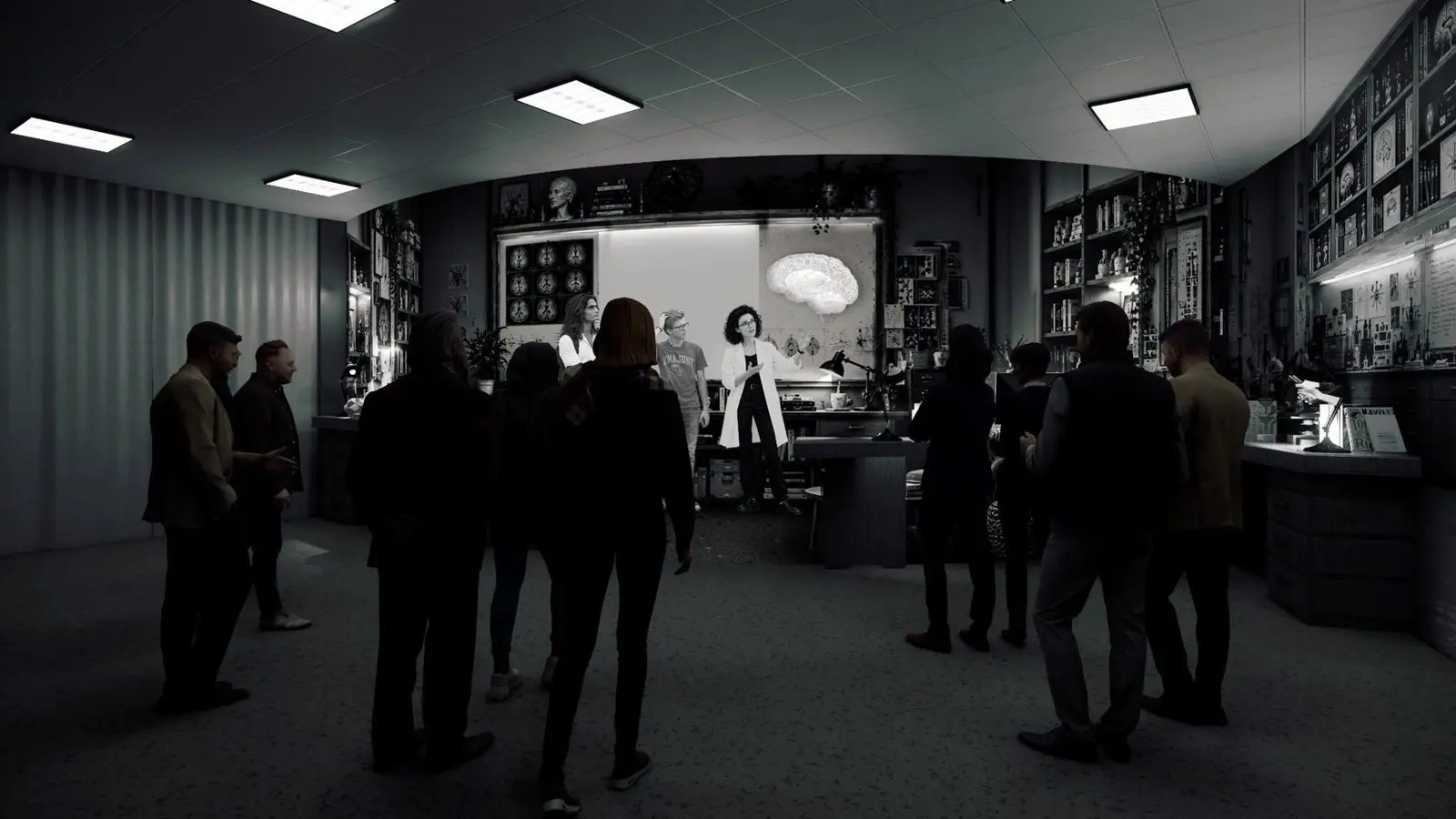
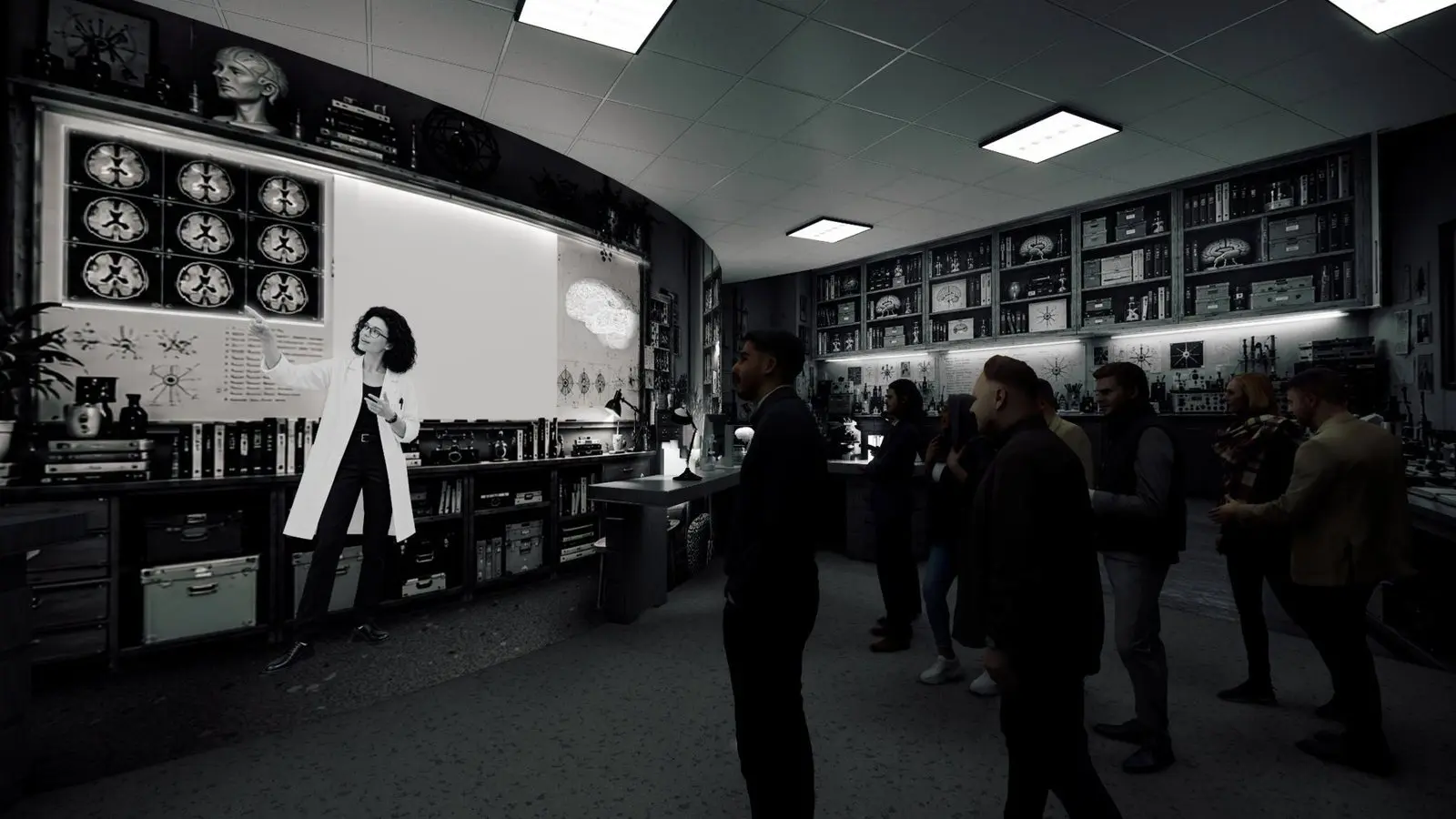
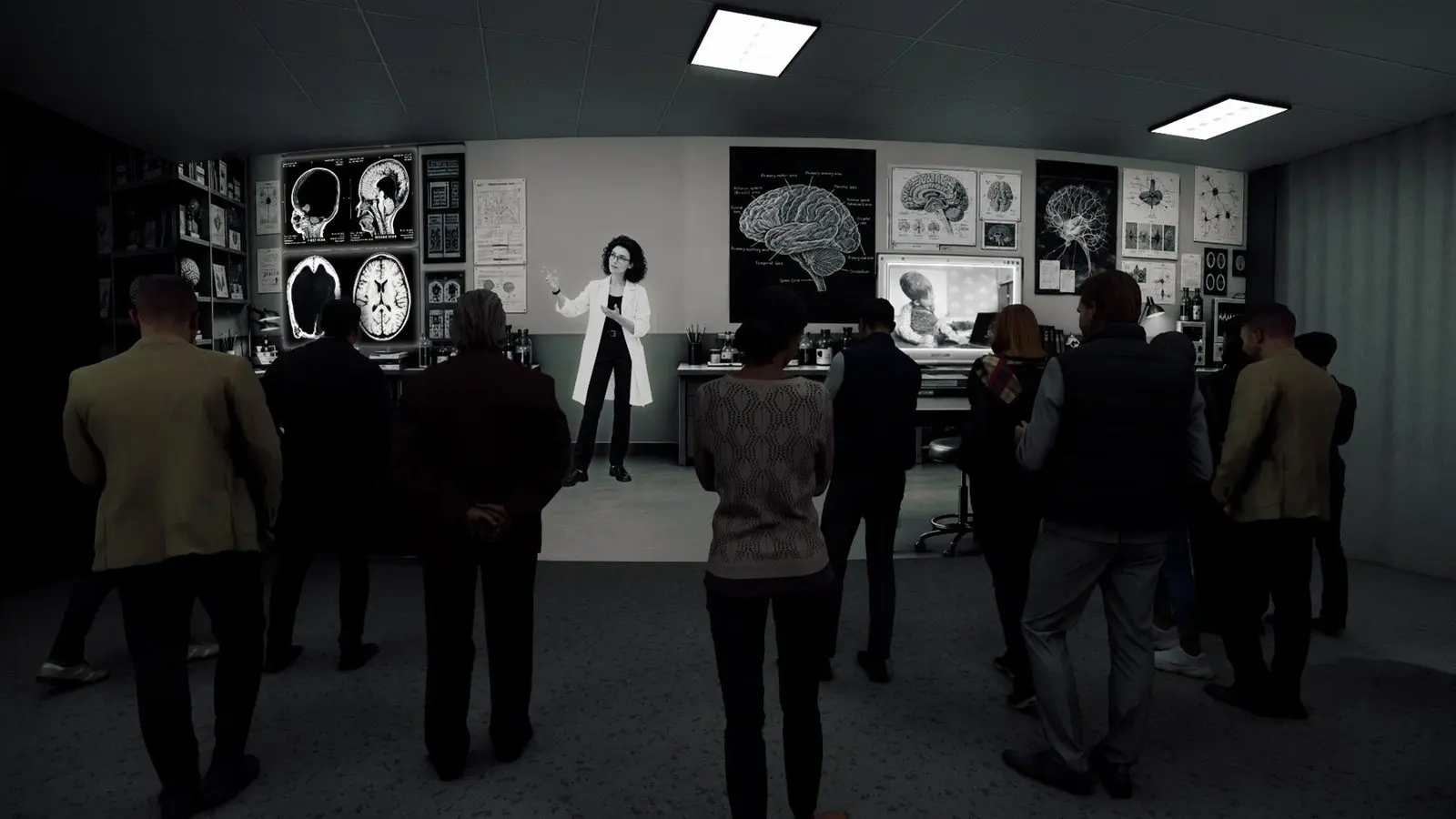
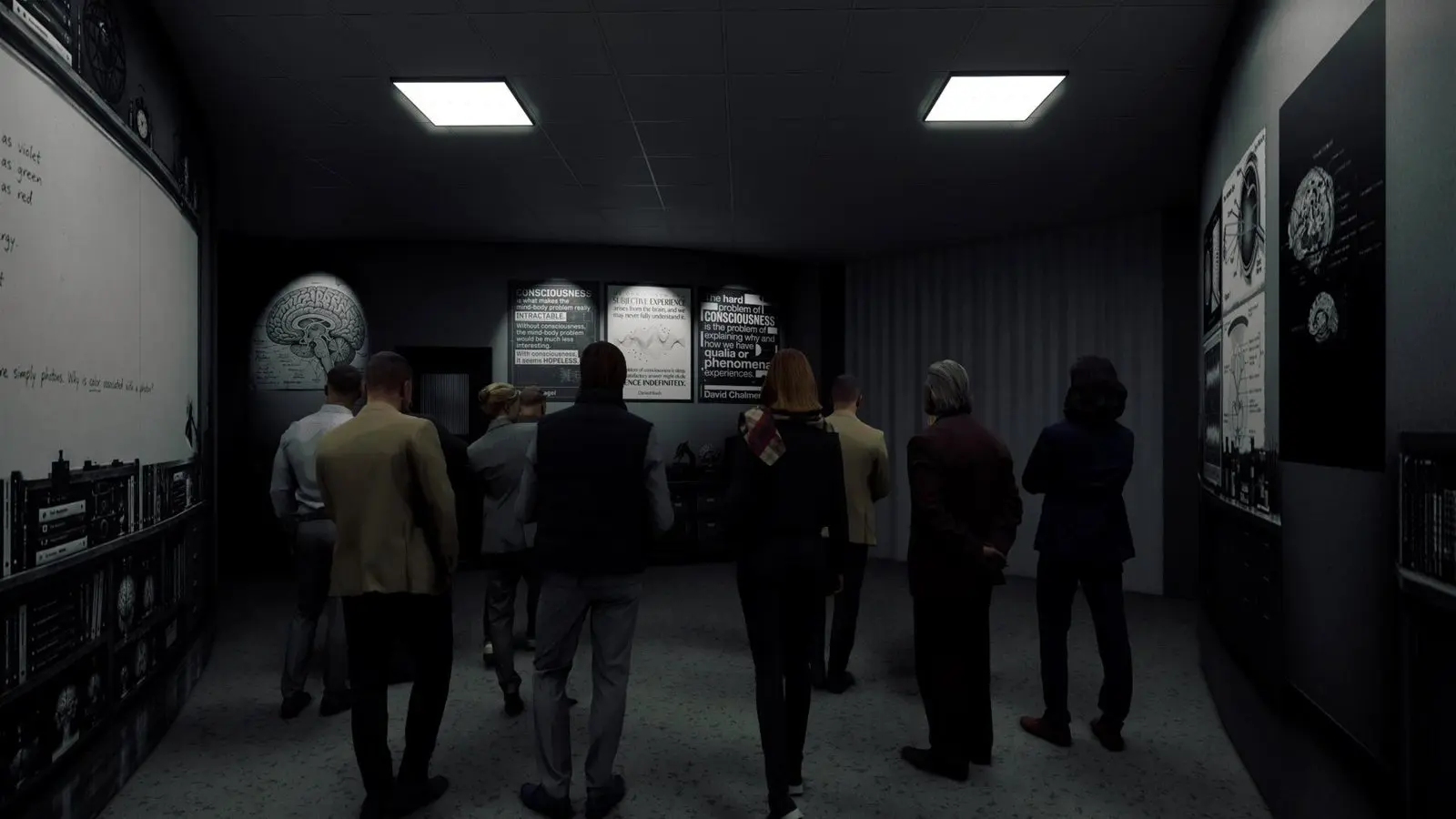
Mary, a neuroscientist, has spent her life in a black and white room, learning everything science can say about colour. Her lab is full of brain scans, diagrams and books. Now she appears before you on a screen and tells you what happened when she finally stepped outside and saw colour for the first time.
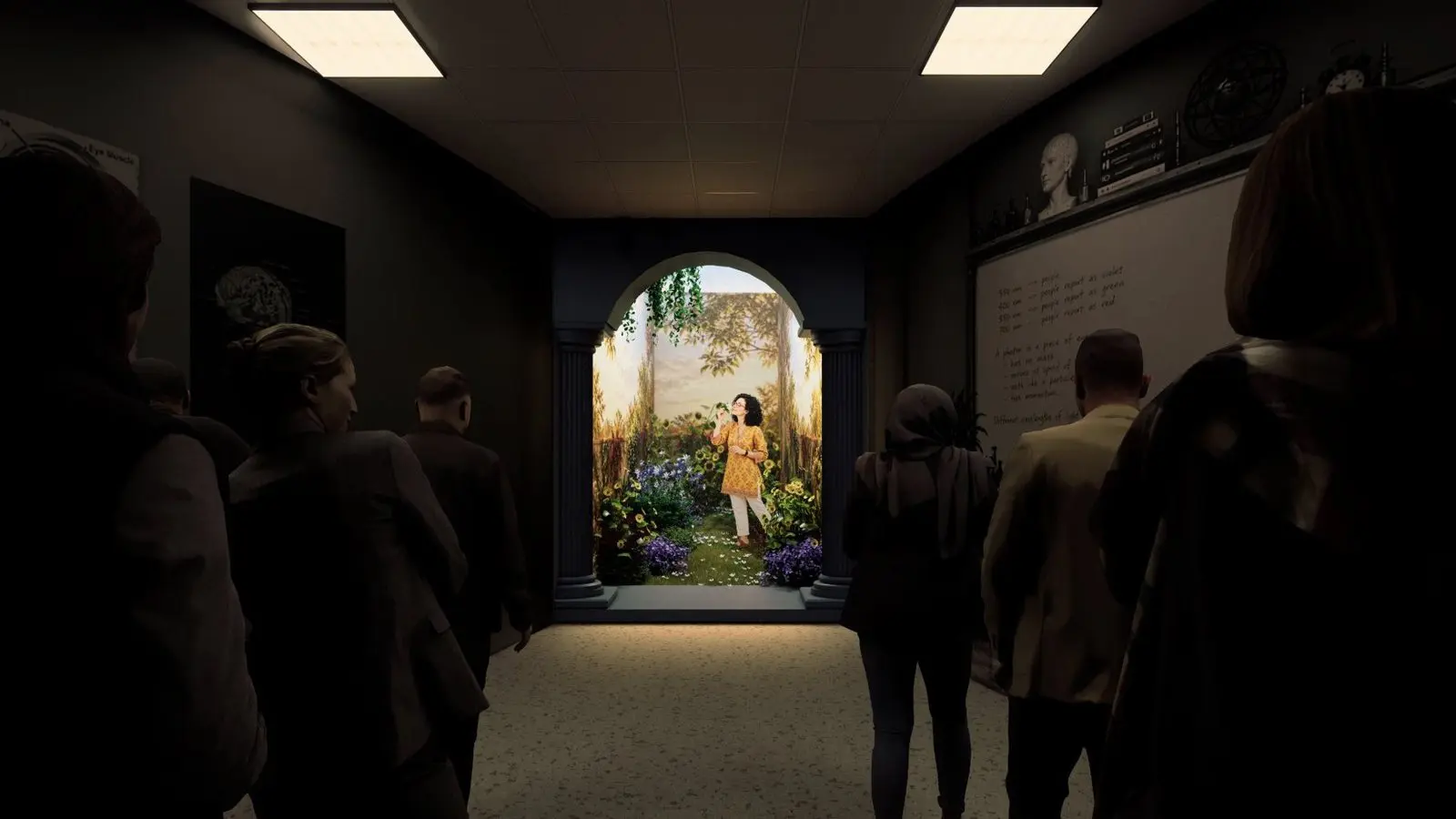
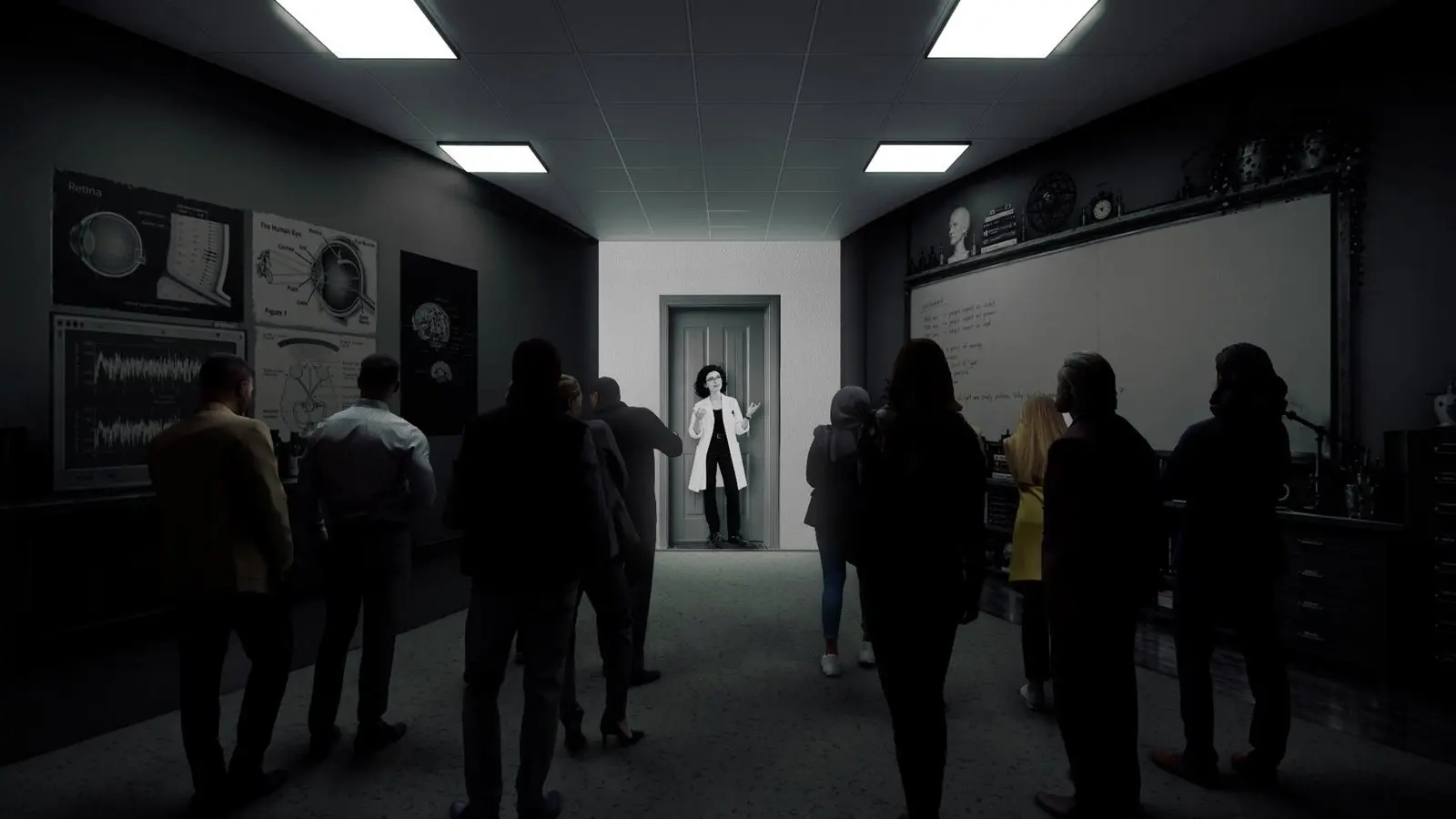
As she walks through the door in the projection, a magical garden is revealed behind the screen, and you watch a holographic Mary exploring a world of colour. She returns to explain the overwhelming difference between knowing about colour and actually experiencing it.
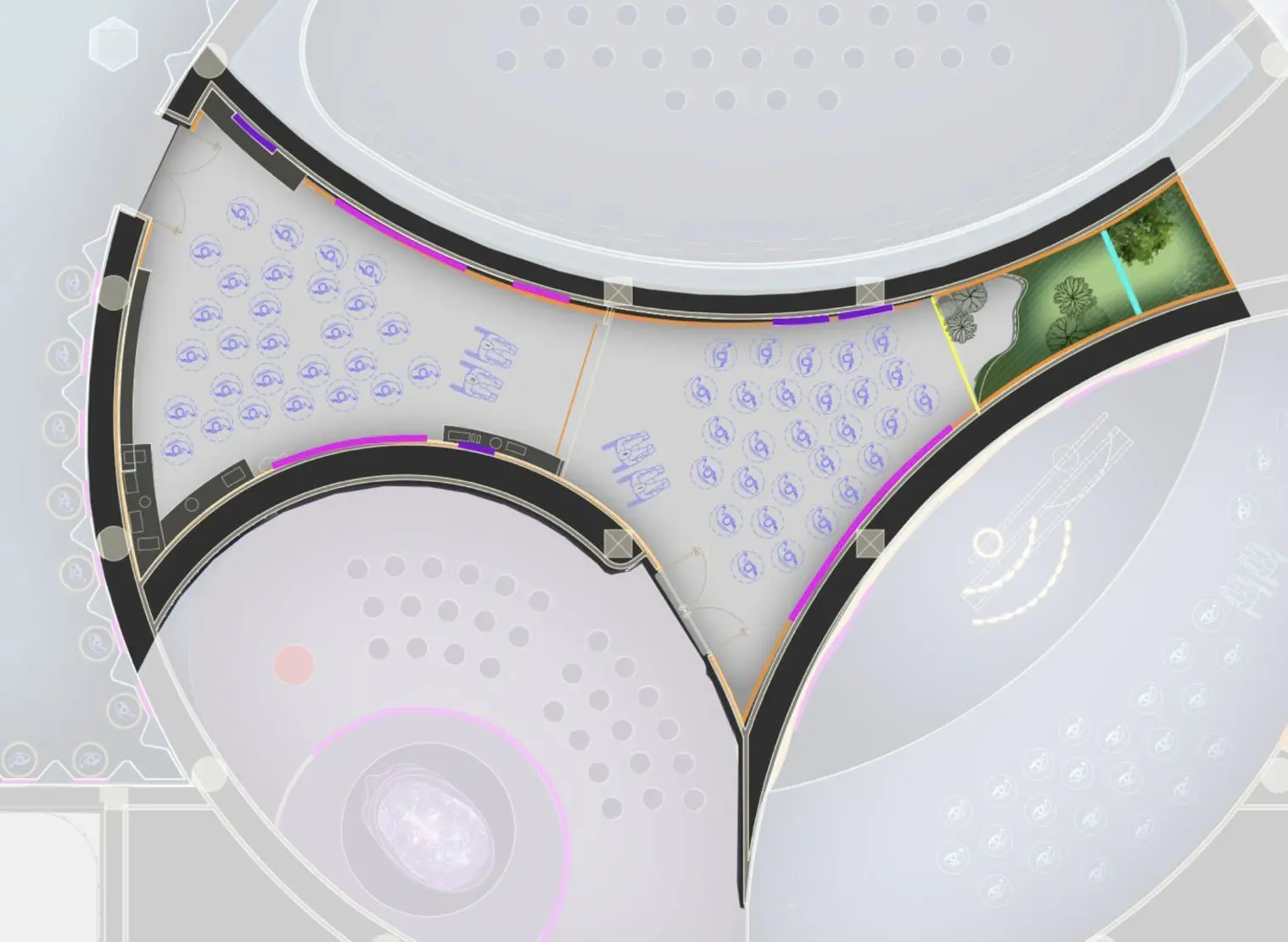
Mary recounts her research: she scanned the brains of people looking at red and blue, and could tell which scan belonged to which colour, yet the data never revealed what it feels like to see red. As the screen rolls up, she leads you into the second room, where she names this gap: the Hard Problem of Consciousness. Why do we see colours, hear sounds and taste at all?
You stand in Mary's monochrome laboratory of brain scans, diagrams and books, where she learned every fact about colour without ever seeing it.
Mary walks through the door on the projection and a magical garden appears behind the screen. A holographic Mary explores it, seeing colour for the first time.
Mary explains that she could match brain scans to the colours people were seeing, yet the scans never showed what it feels like to see red or blue.
The screen rolls up and Mary leads you on. Science can explain brain processes, she says, but not yet subjective experience: why we see colours, hear sounds and taste at all.
The big idea
Science can explain brain processes, but not yet why they are accompanied by felt experience. This is the hard problem of consciousness, and it points to something more than the brain.
Questions it asks
You will come away understanding
Bring it to life
Your support creates Mary's monochrome world and the magical garden beyond it, letting every visitor feel the wonder of colour as if for the first time.
Design Habit estimate for the gallery, including GST
Sponsor this exhibitLevel 1 · Who Am I?The whole level: galleries and visitor spaces
Sponsor the levelAny amountEvery gift is recorded for this exhibit and for SMOVP
Donate to this exhibitEstimates from Design Habit (April 2026), shown in US dollars at ₹95 per US$1. Final costs are confirmed with each sponsor.
1.3
Sit around a giant translucent cranium and watch a red ball travel from eye to brain to mind, then ask who is watching the projection.
Discover and supportClose ×Follow a red ball into the brain and ask: who is watching the show?
What you will experience
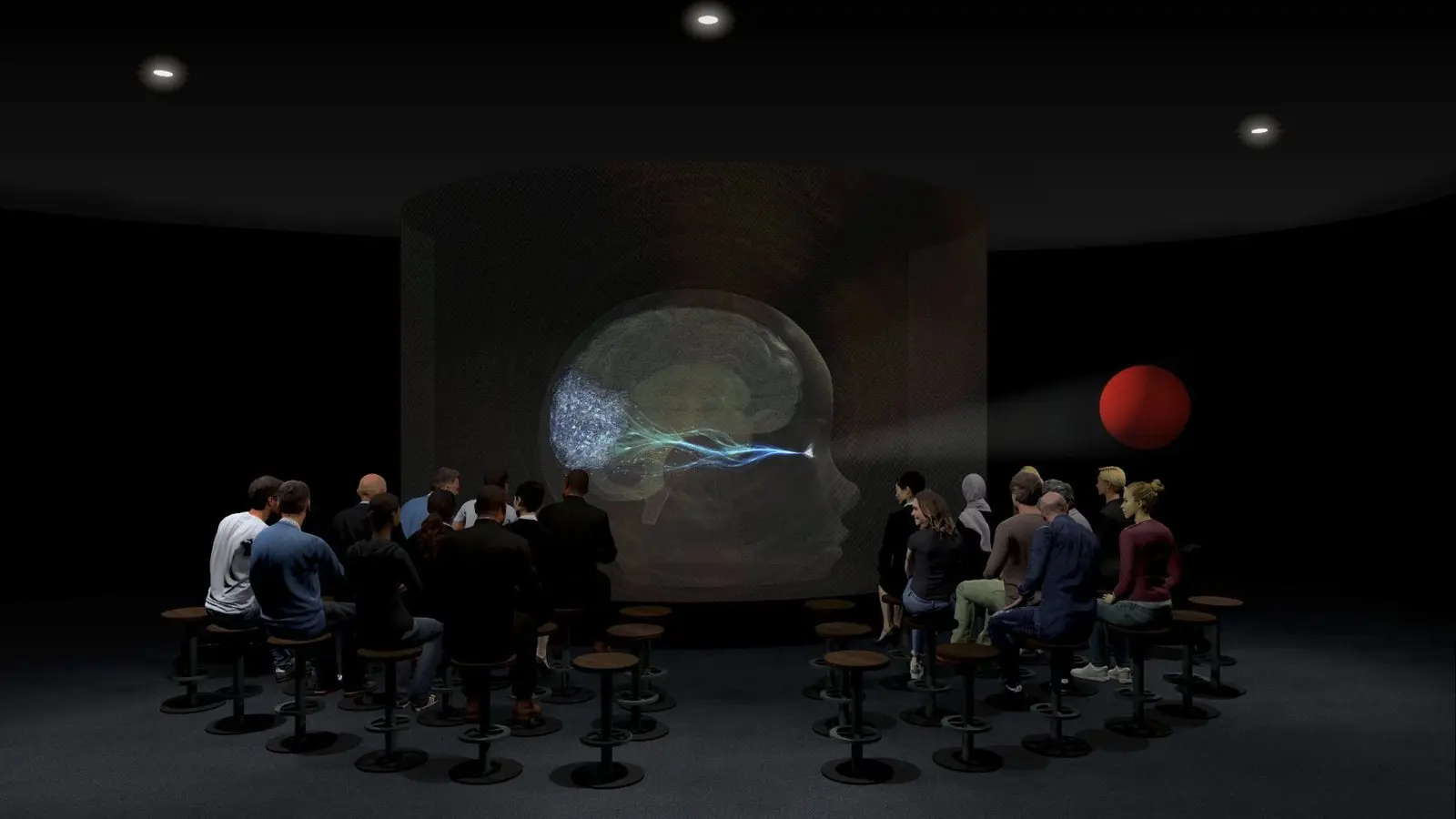
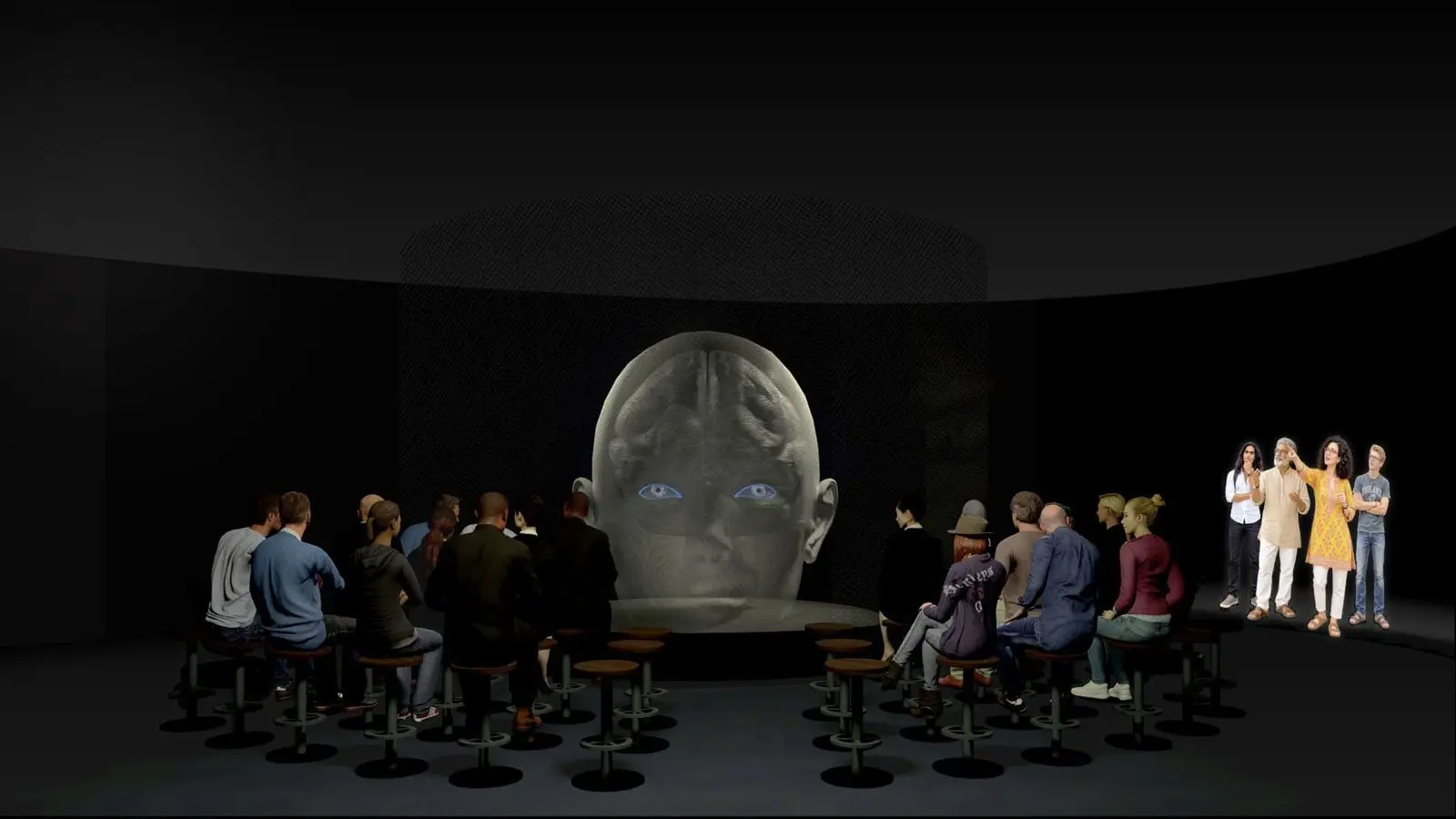
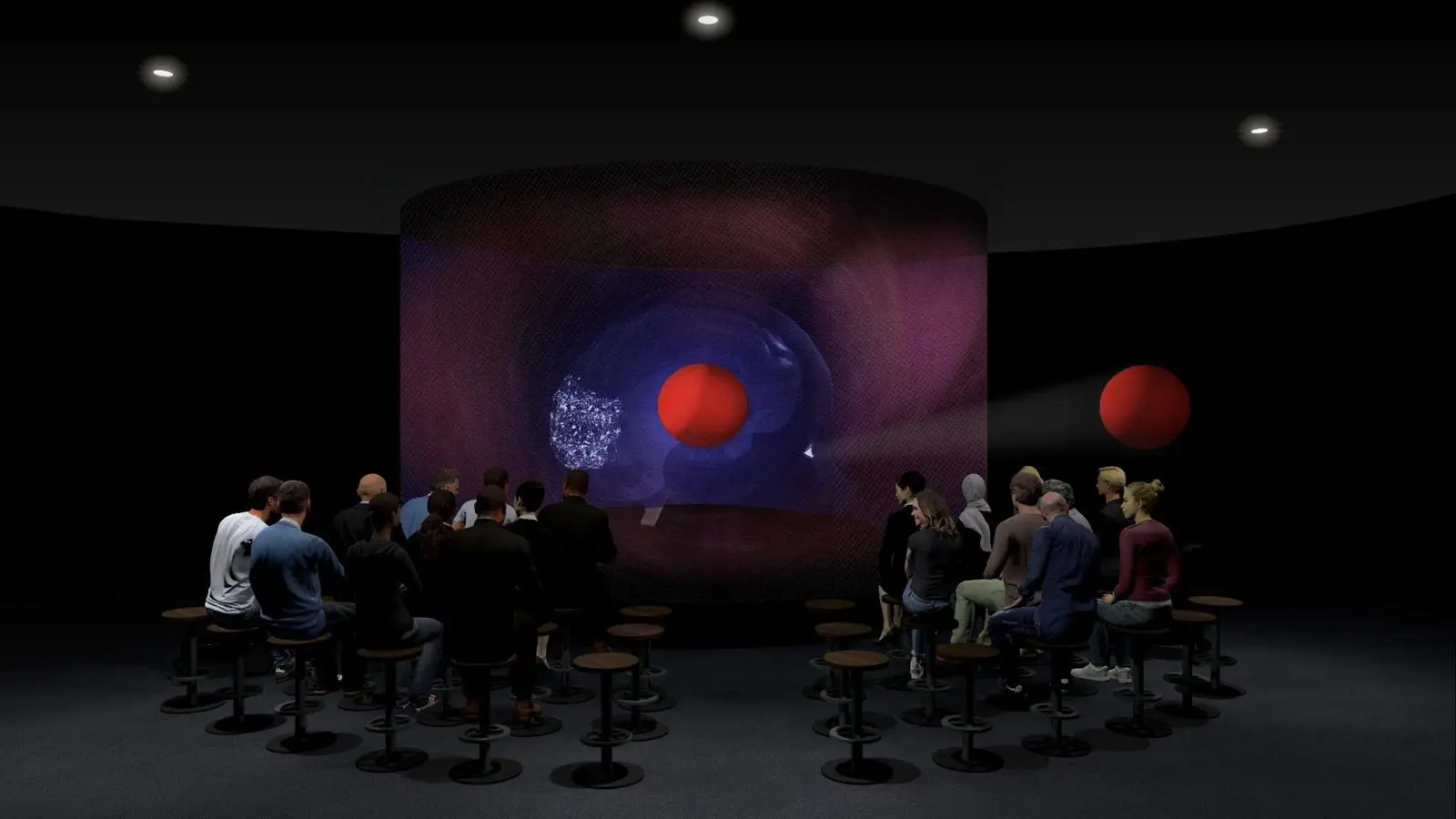
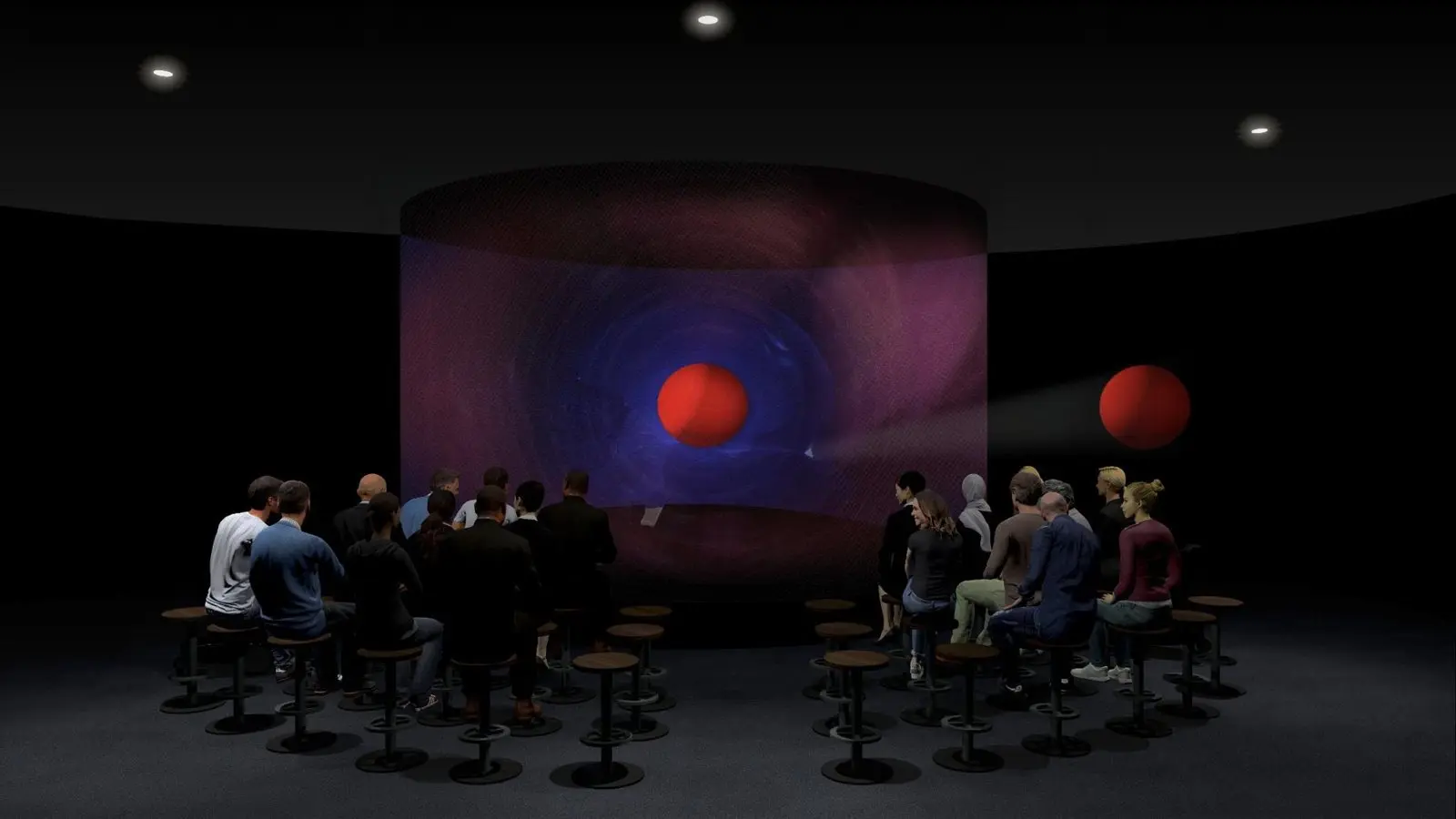
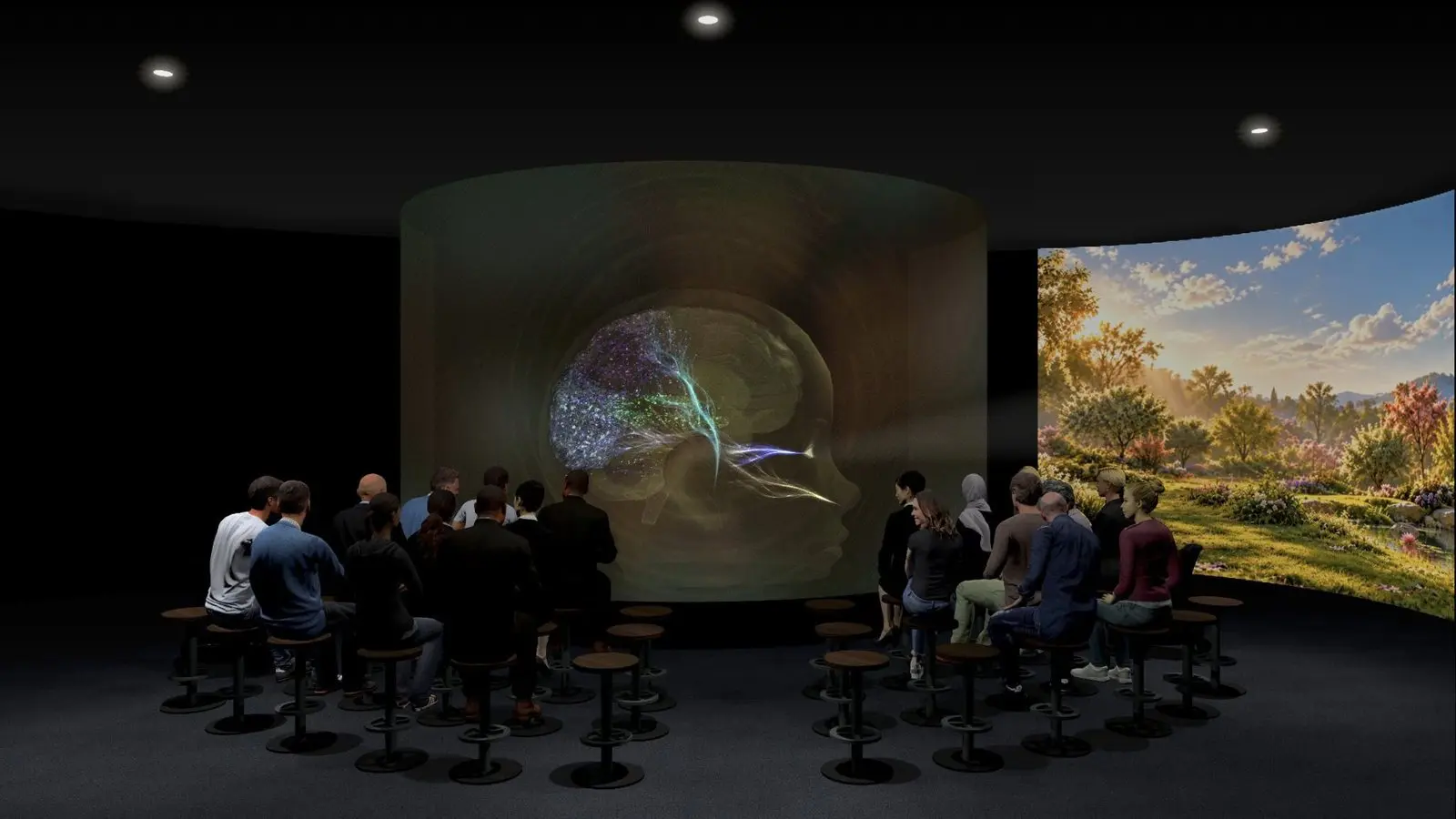
Guided by Mary and the three narrators, you take your seat in two circles around a giant translucent human cranium. Inside it, a mesh brain glows with fibre optics and LED nodes, and the whole installation turns slowly on a turntable to reveal its profile as the story unfolds.
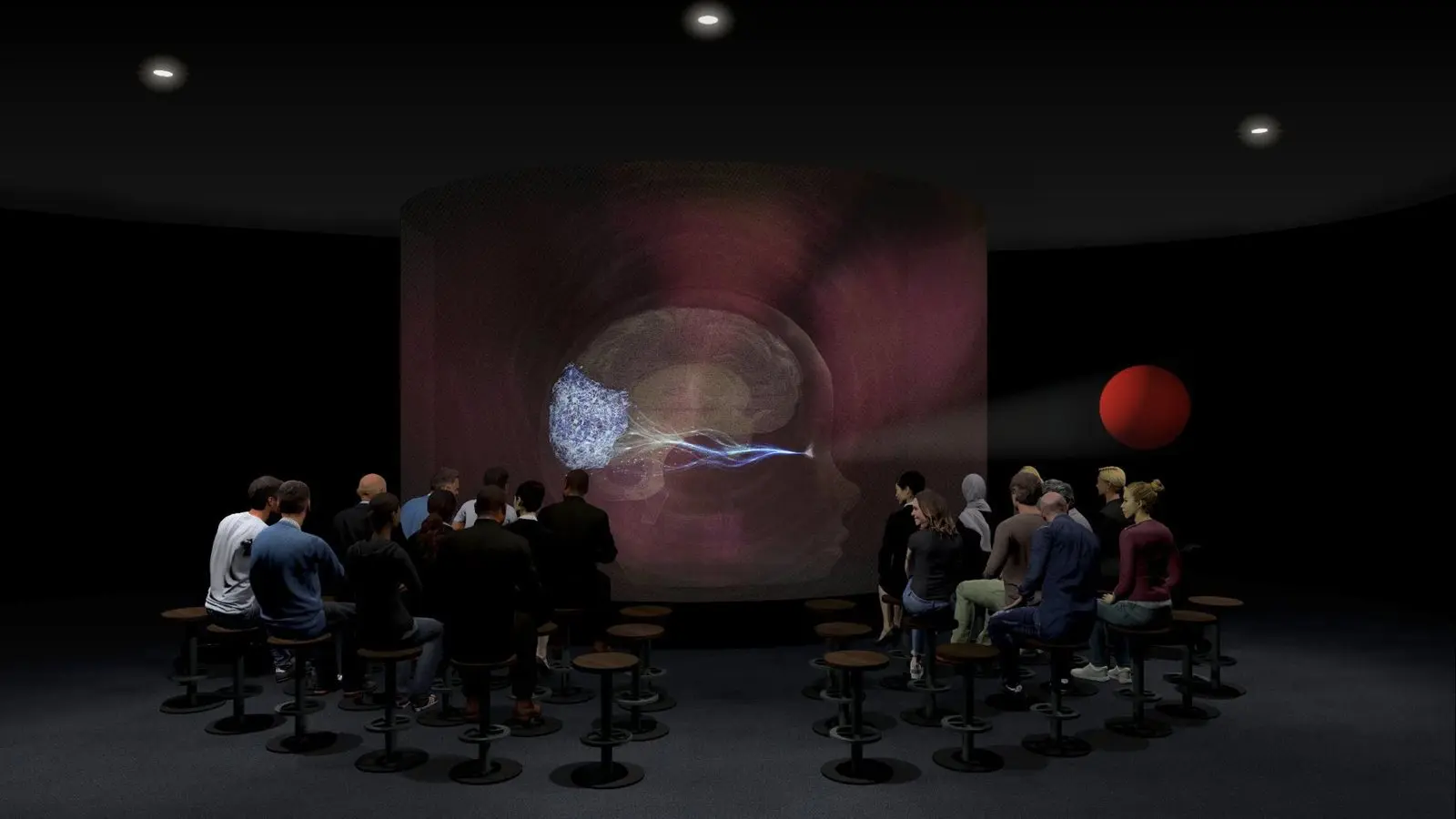
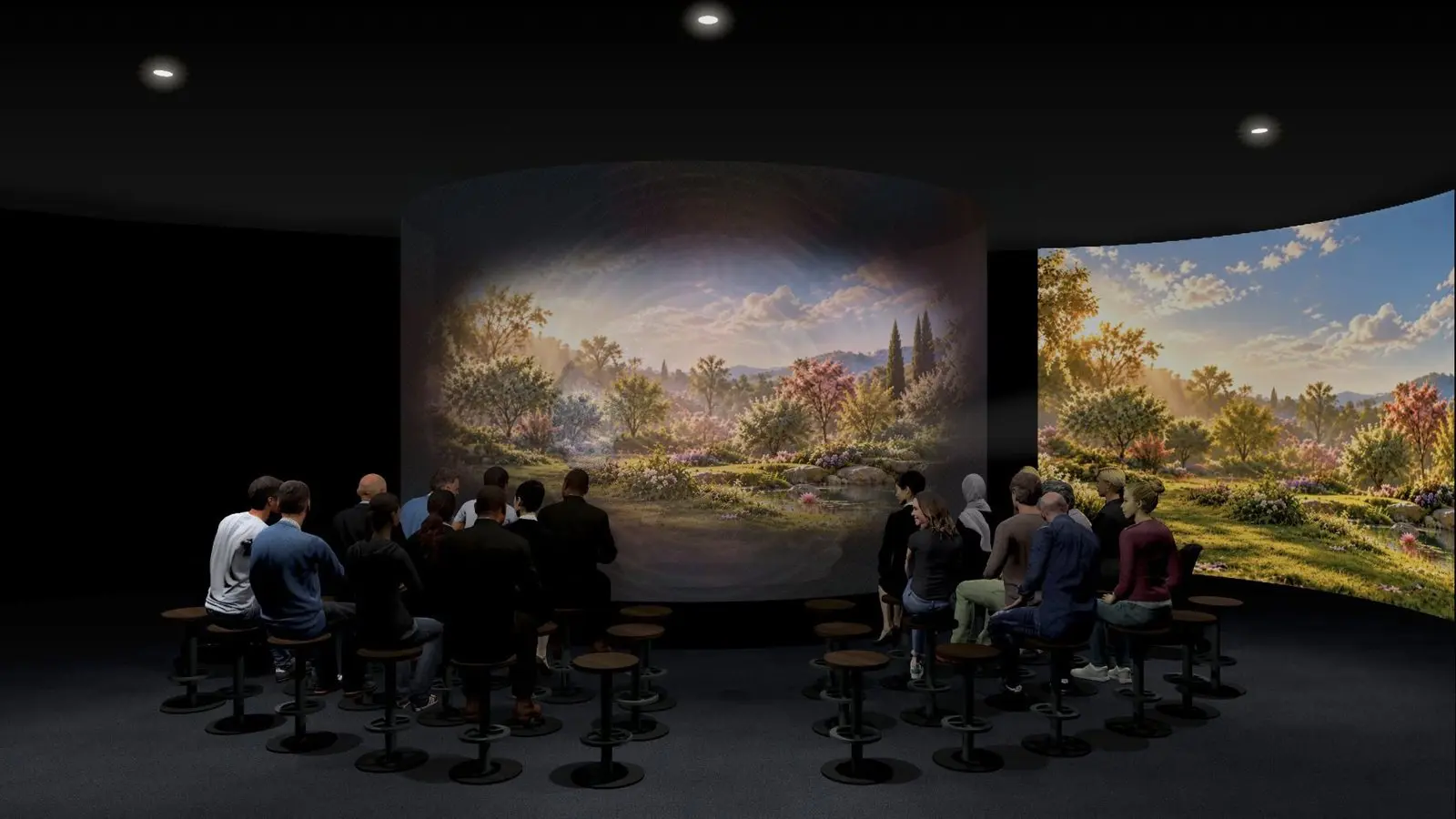
A red ball moves slowly up and down in front of the cranium. First the object appears. Then the eye sees it, and electrical signals travel from the eye into the brain along glowing pathways. Only after this short delay does the image of the red ball appear on the screen in front of the cranium. The same sequence then follows for all five senses, with stimuli released towards the audience as each region of the brain lights up.
This is the puzzle of qualia: the redness, roundness and motion you experience cannot be found in the brain itself. They are present in your mind. So who is the audience for this inner projection? Mary leaves you to tell apart body, brain, mind and consciousness, and to recognise the conscious self as the one who observes.
You sit in two circles around a giant transparent head. A mesh brain glows inside, and the installation slowly turns to show its profile.
A red ball moves in front of the cranium. The eye sees it, signals travel along glowing pathways into the brain, and only then does its image appear on the screen.
The brain becomes the source of sensory triggers released towards you. Each time, a region of the brain lights up, and moments later the experience appears as a projection.
Redness and roundness are not in the brain, yet they are in your mind. Mary asks who is watching the projection, and guides you to tell apart body, brain, mind and consciousness.
The big idea
The felt qualities of experience cannot be located in brain activity alone. The mind interprets what the brain processes, and consciousness is the one who experiences it.
Questions it asks
You will come away understanding
Bring it to life
Your gift lights up this glowing brain and its five-sense show, turning one of the deepest questions in science into an experience every visitor can feel.
Design Habit estimate for the gallery, including GST
Sponsor this exhibitLevel 1 · Who Am I?The whole level: galleries and visitor spaces
Sponsor the levelAny amountEvery gift is recorded for this exhibit and for SMOVP
Donate to this exhibitEstimates from Design Habit (April 2026), shown in US dollars at ₹95 per US$1. Final costs are confirmed with each sponsor.
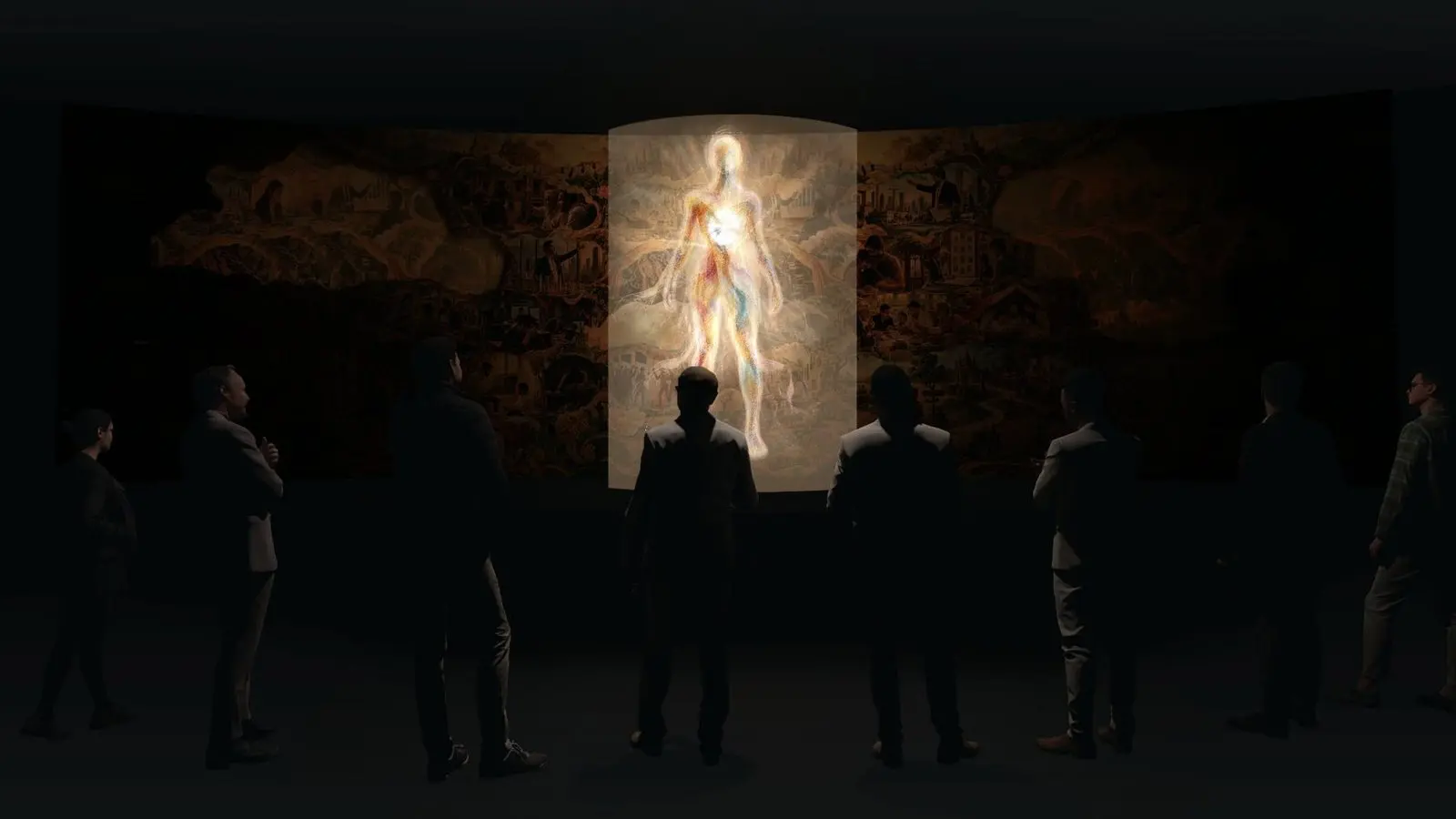
1.4
A crystal of light descends, rings for the mind and body settle around it, and a complete human form appears: the atma, the conscious self within.
Discover and supportClose ×This is you: a timeless spark of consciousness, wrapped in mind and body.
What you will experience
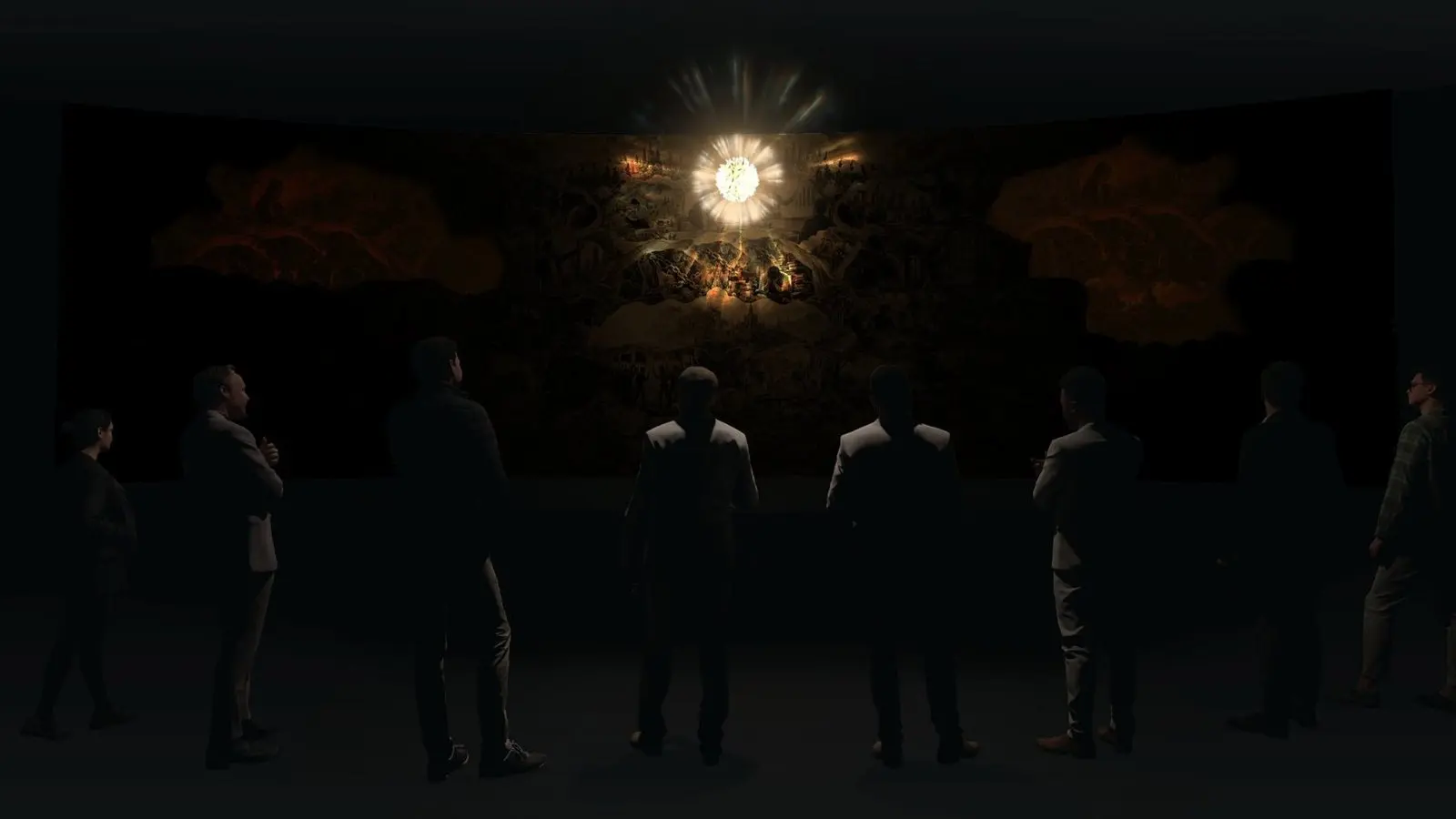
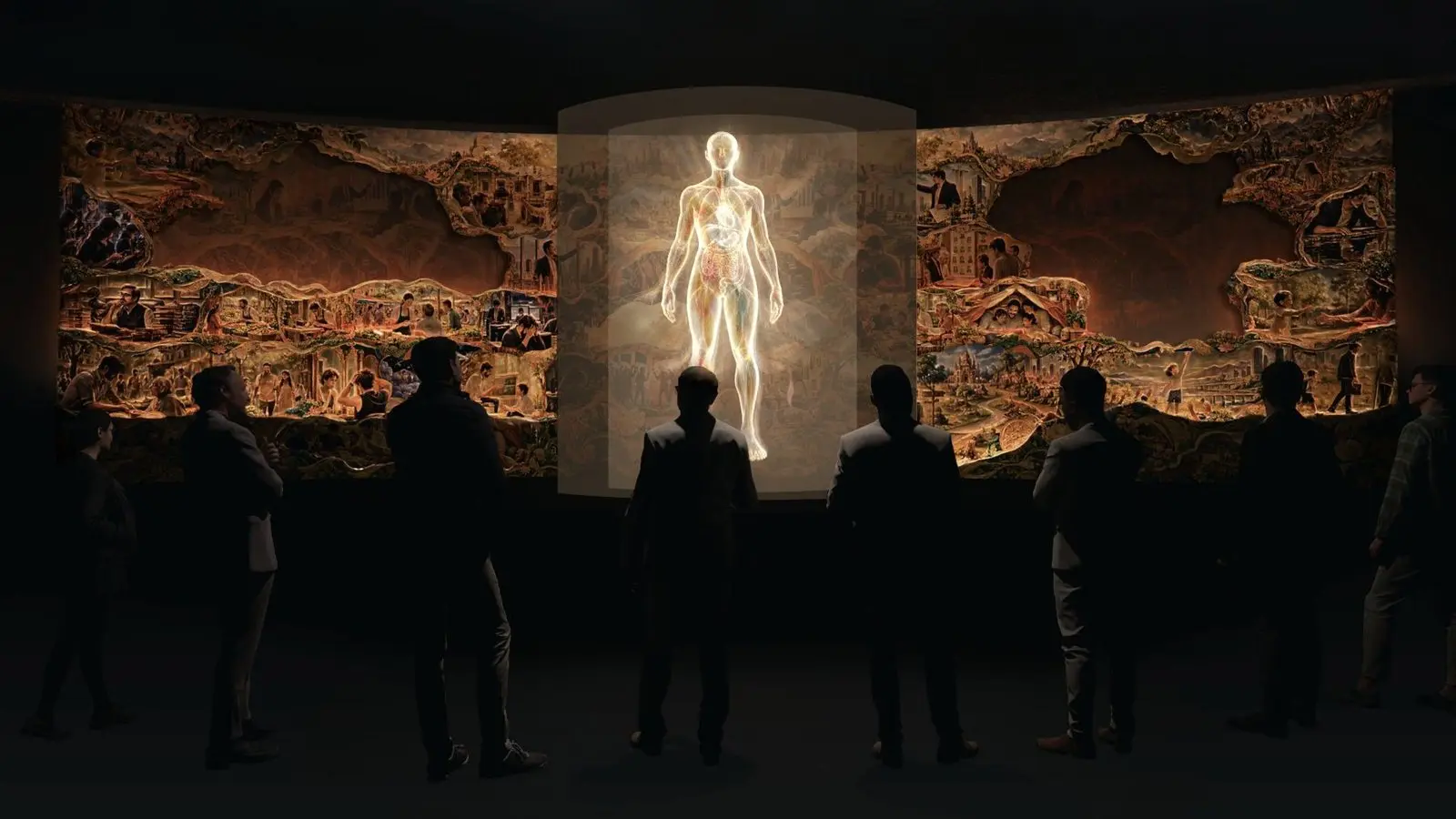
You enter a quiet, contemplative space. Above you hangs an organic crystal form, warm white light pulsing gently from within. It descends slowly along a track and stops just above eye level, inviting you to look up. Devarshi asks you to consider yourself not as the body, nor even as the thinking mind, but as the atma: the conscious self.
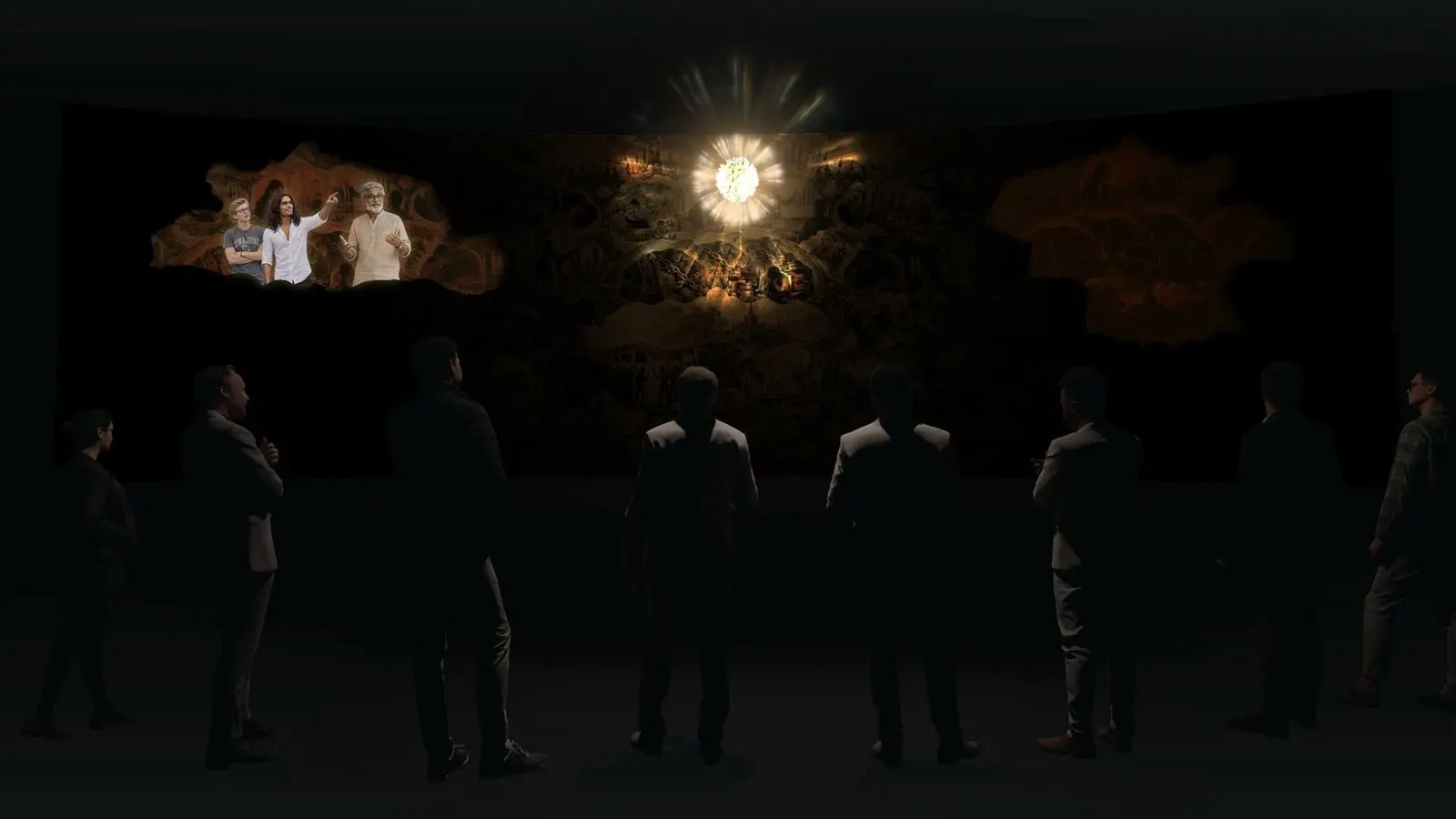
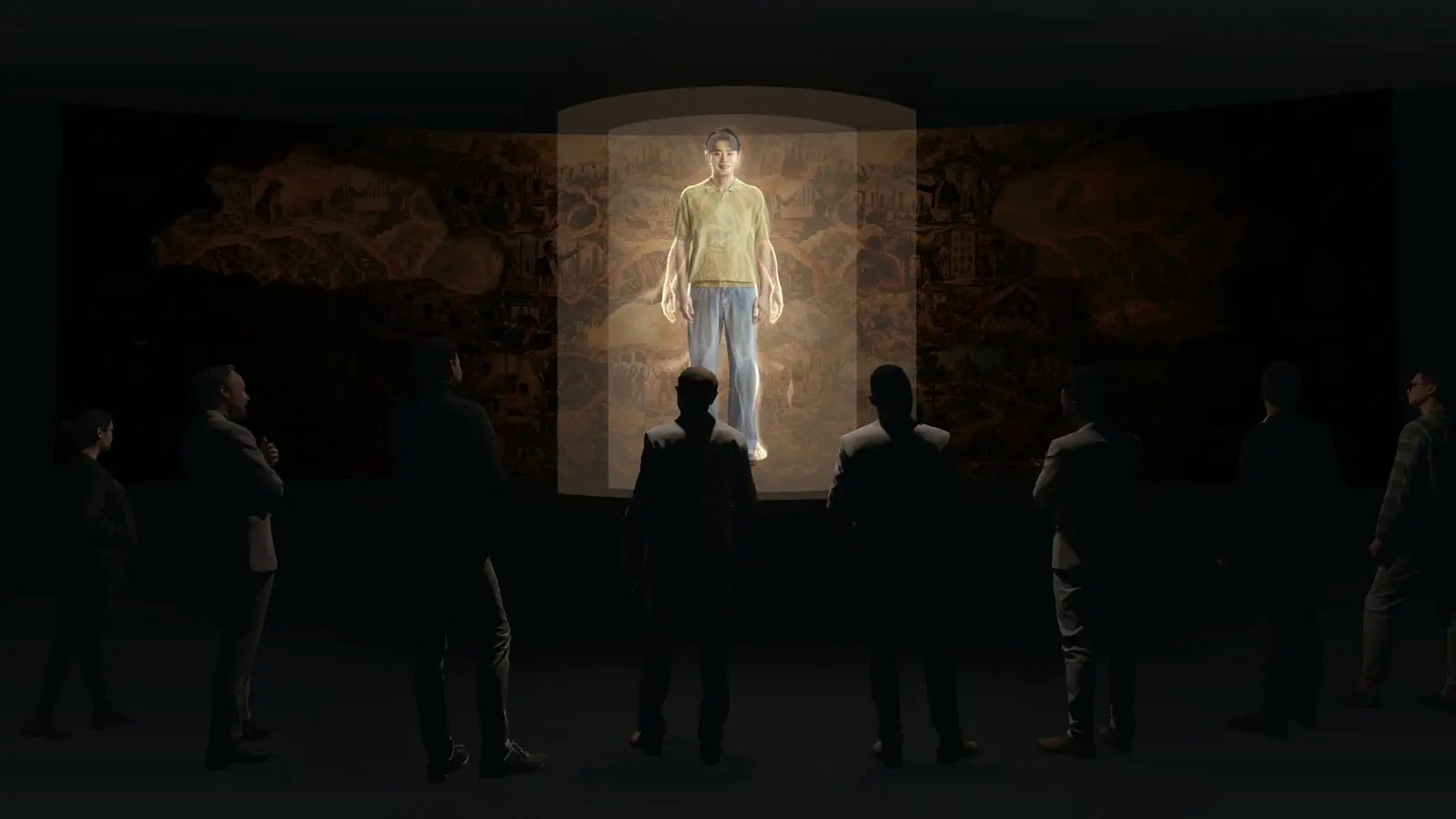
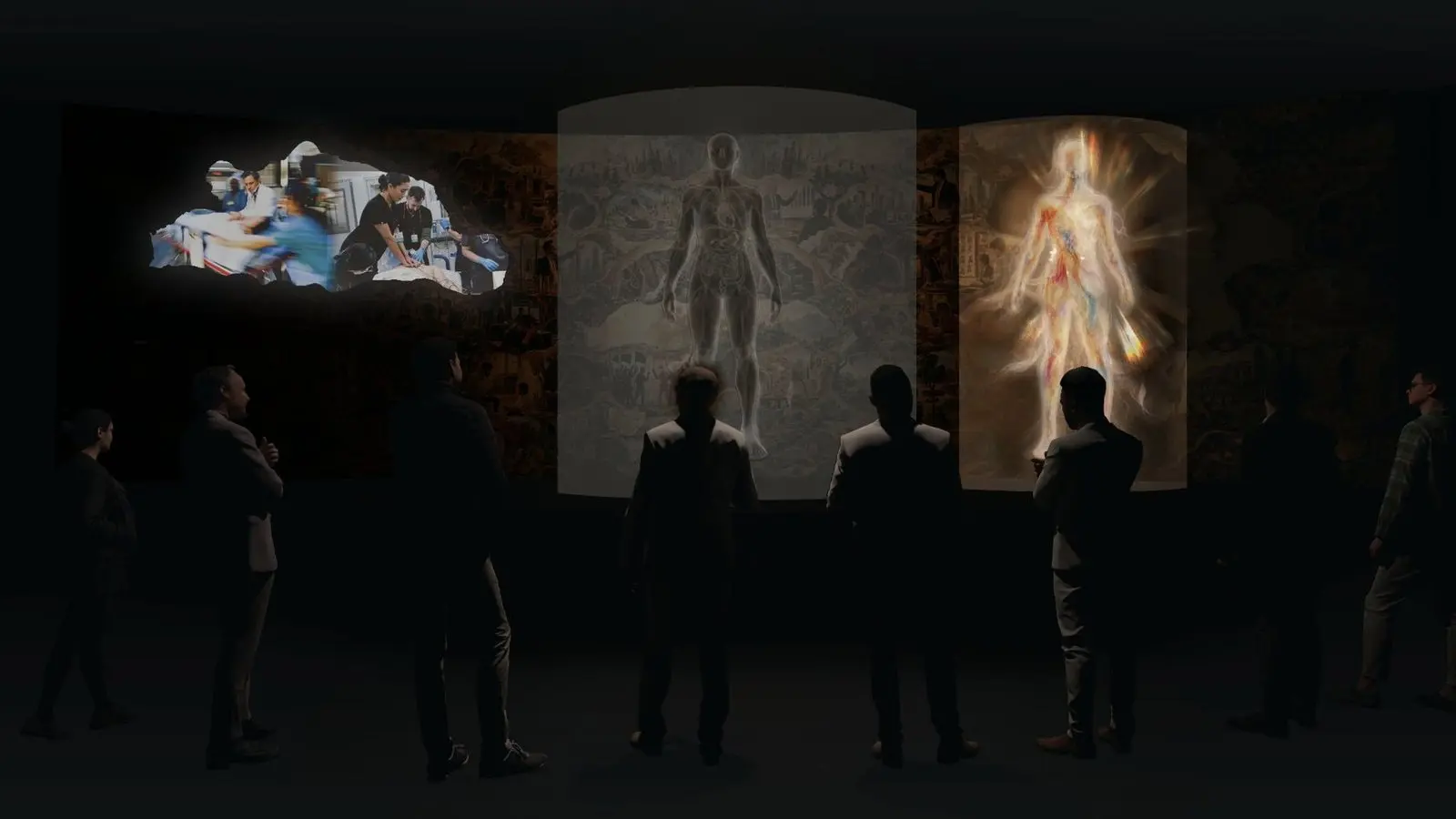
A first ring of translucent fabric descends around the crystal: the subtle body, or mind, illustrated, embroidered and brought alive with light. Behind it, two curved walls hold a layered mural whose hidden scenes light up as the story unfolds. A second ring descends for the physical body, and from where you stand the three layers align into one complete human form.
With each quality of the atma that is described, the crystal core grows brighter. Verified near-death and out-of-body cases, and other scientific studies, suggest that consciousness can operate independently of the brain and body. To show this, the atma and the subtle body move together along the track, away from the physical body. You leave knowing your true identity: the eternal atma that gives life to body and mind.
A crystal of warm, pulsing light descends from above and stops just over your head. Devarshi introduces it as the atma, the conscious self.
A ring of translucent fabric, embroidered and lit from within, descends around the crystal to represent the mind. Behind it, scenes in the curved mural light up one by one.
A second ring descends for the physical body. Seen from where you stand, atma, subtle body and body align into a single human figure.
Real near-death and out-of-body cases are presented as the atma and subtle body glide away from the physical body, showing consciousness apart from the brain.
The big idea
We are neither merely a physical body nor a thinking mind. We are the atma, eternal, conscious and full of bliss, possessing free will and influenced by the three gunas.
Questions it asks
You will come away understanding
Words to know
the conscious self
eternity, knowledge and bliss: the nature of the atma
the three forces of nature that influence the subtle body
the three gunas: goodness, passion and ignorance
Bring it to life
Your support brings the descending crystal atma and the great living mural to life, offering every visitor a luminous picture of who they really are.
Design Habit estimate for the gallery, including GST
Sponsor this exhibitLevel 1 · Who Am I?The whole level: galleries and visitor spaces
Sponsor the levelAny amountEvery gift is recorded for this exhibit and for SMOVP
Donate to this exhibitEstimates from Design Habit (April 2026), shown in US dollars at ₹95 per US$1. Final costs are confirmed with each sponsor.
1.5
A VR chariot ride through an ancient Indian market, steered by your gaze, until a crash lifts you out of your body. Who is really driving your chariot?
Discover and supportClose ×Climb aboard, take the reins, and discover who is really driving your chariot.
What you will experience
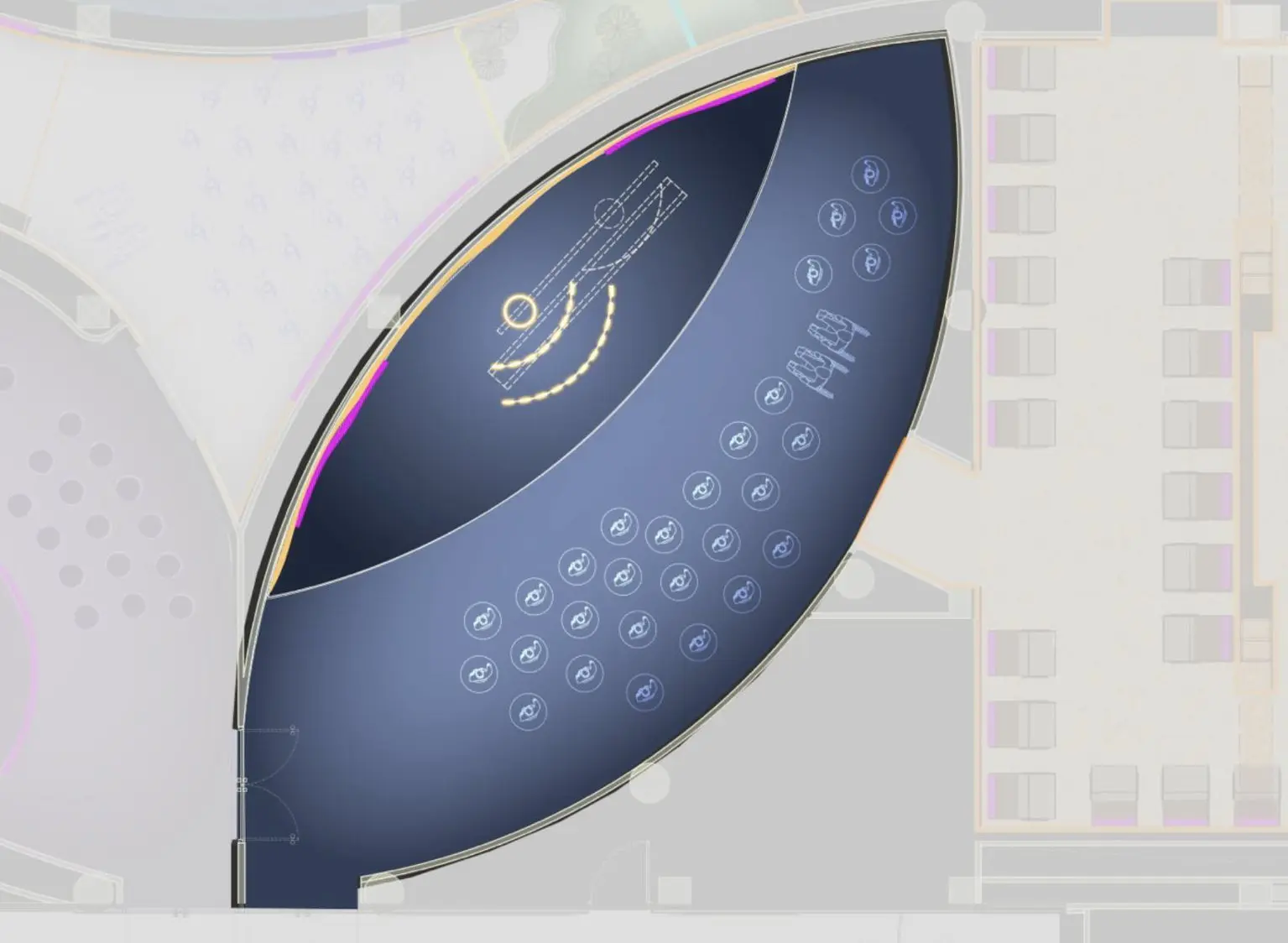
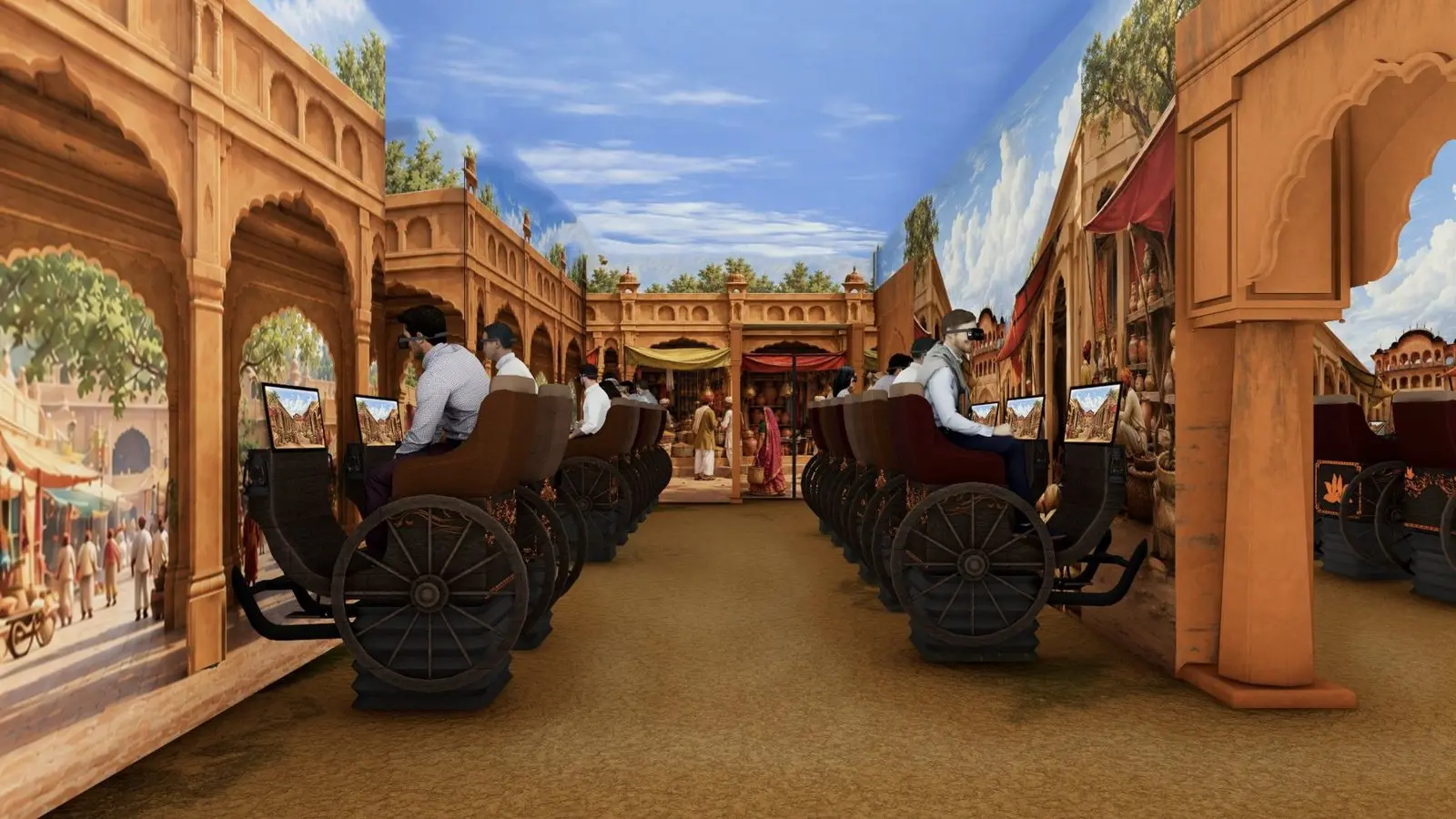
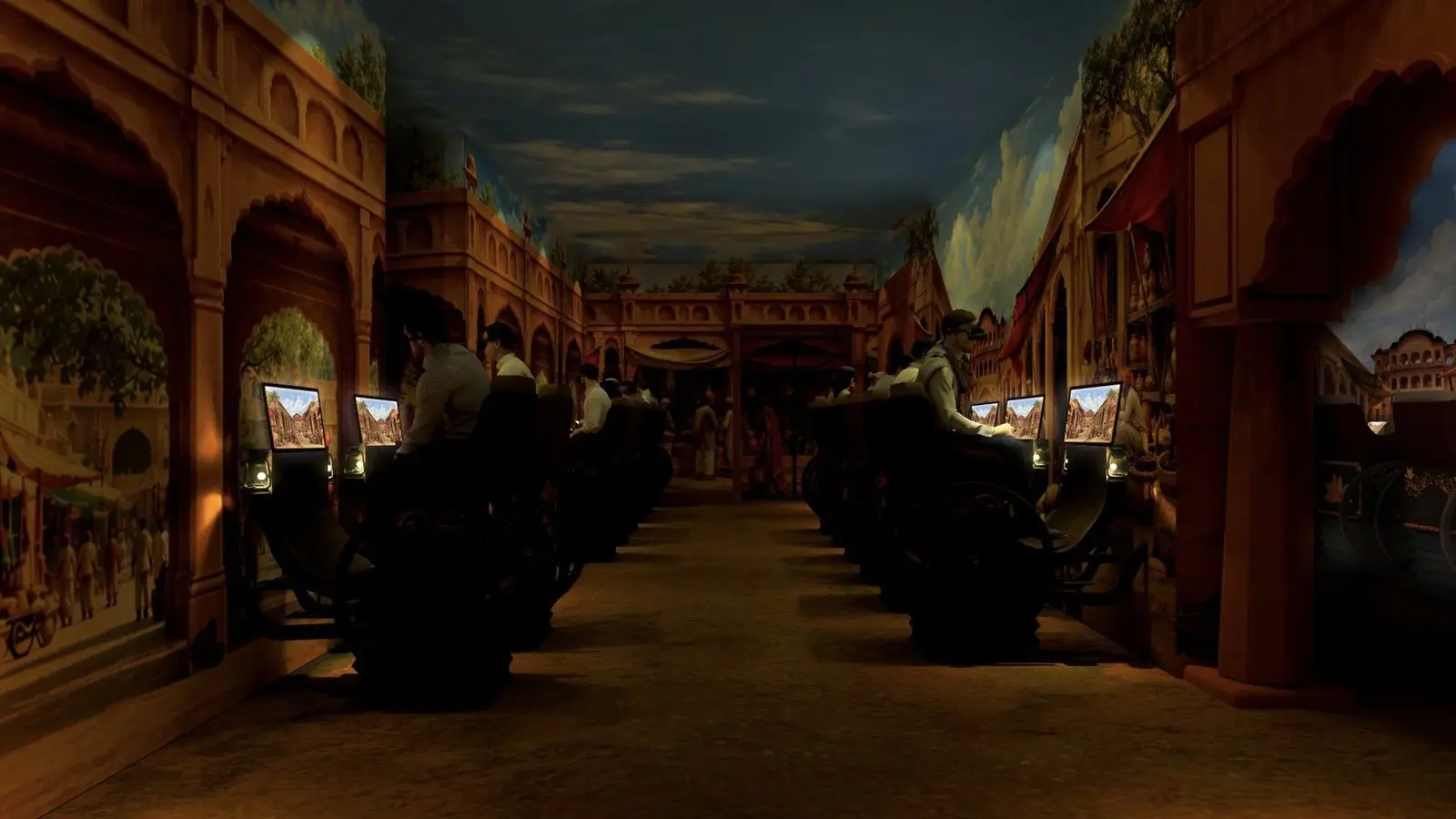
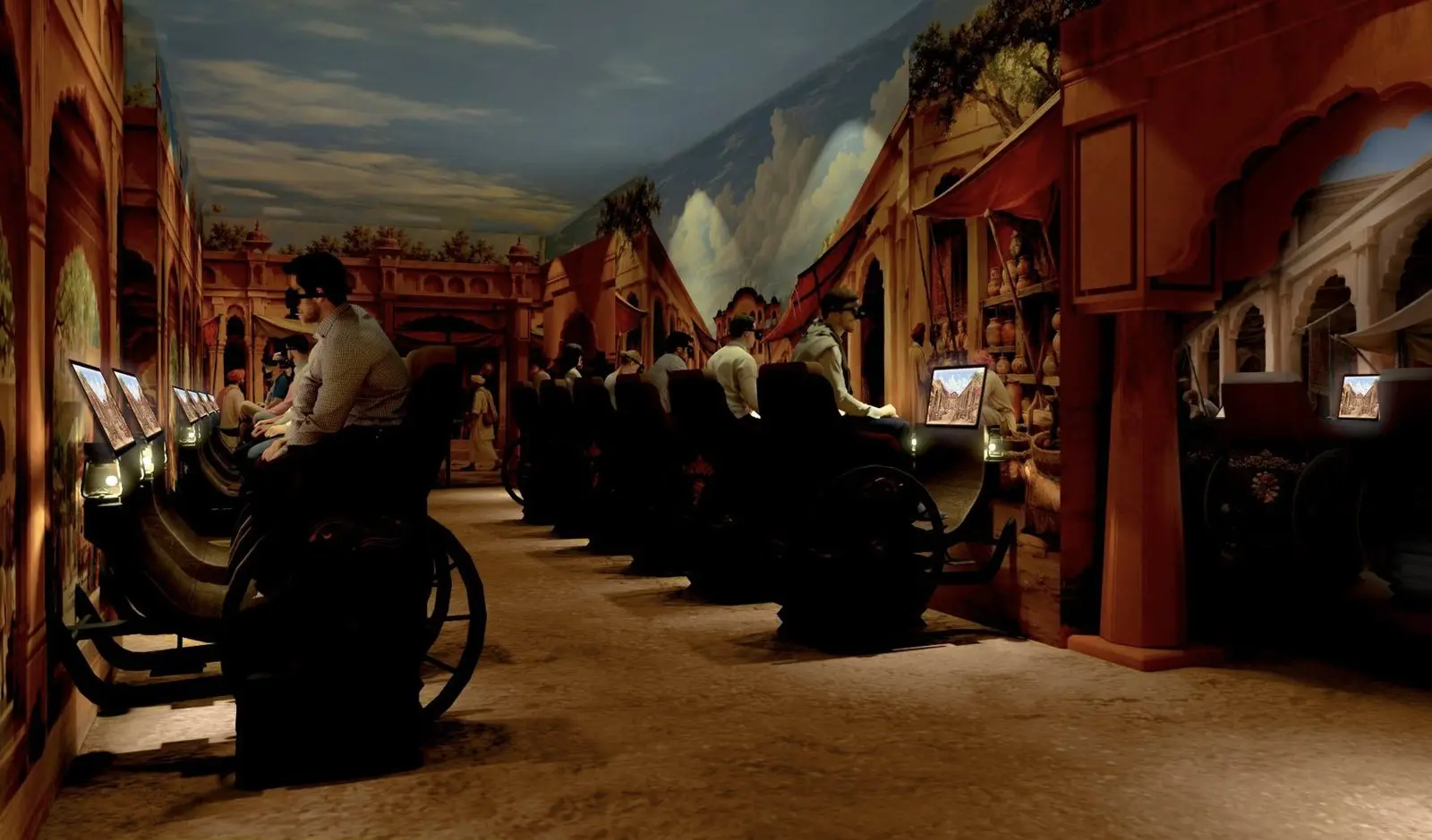
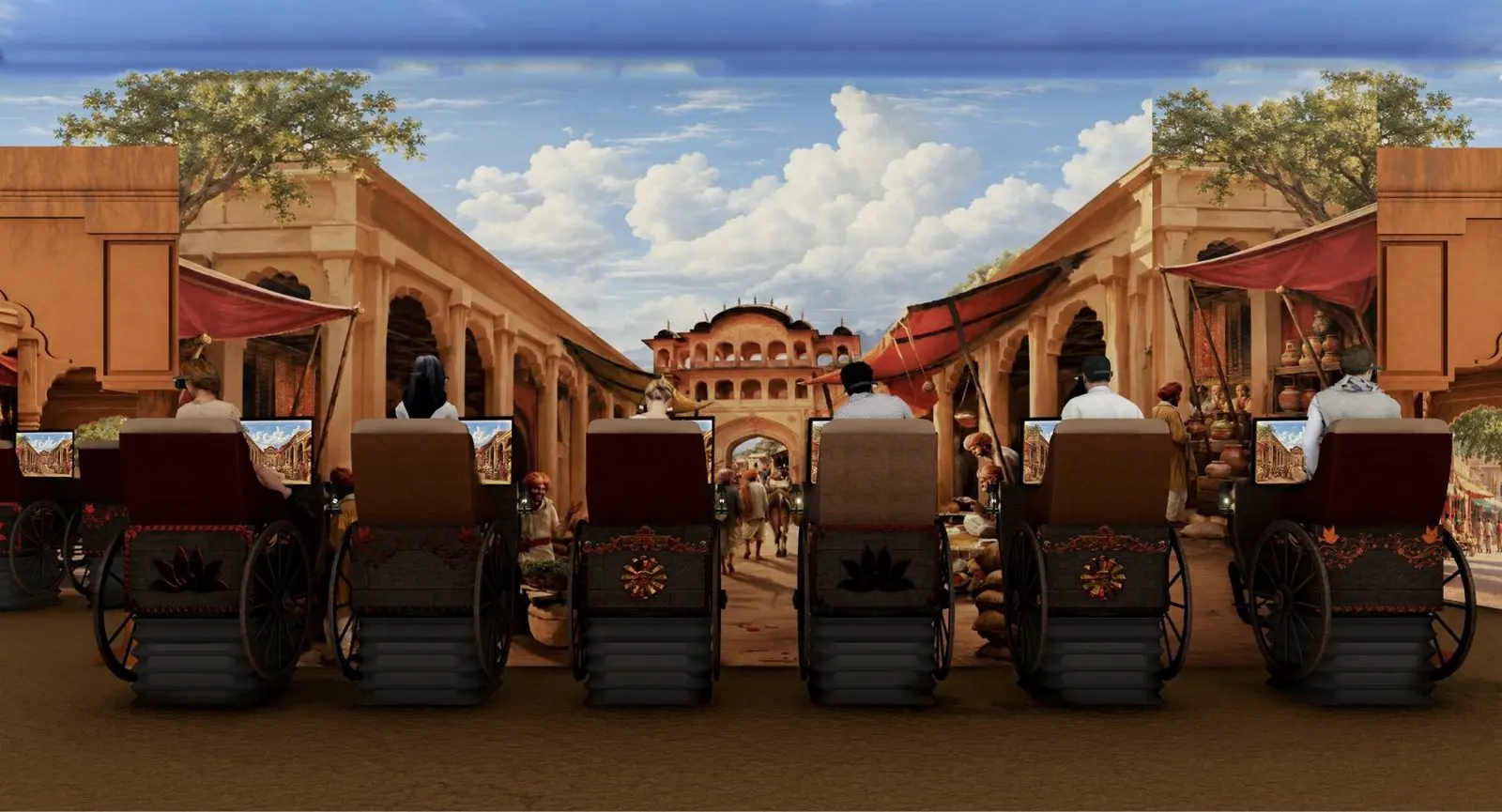
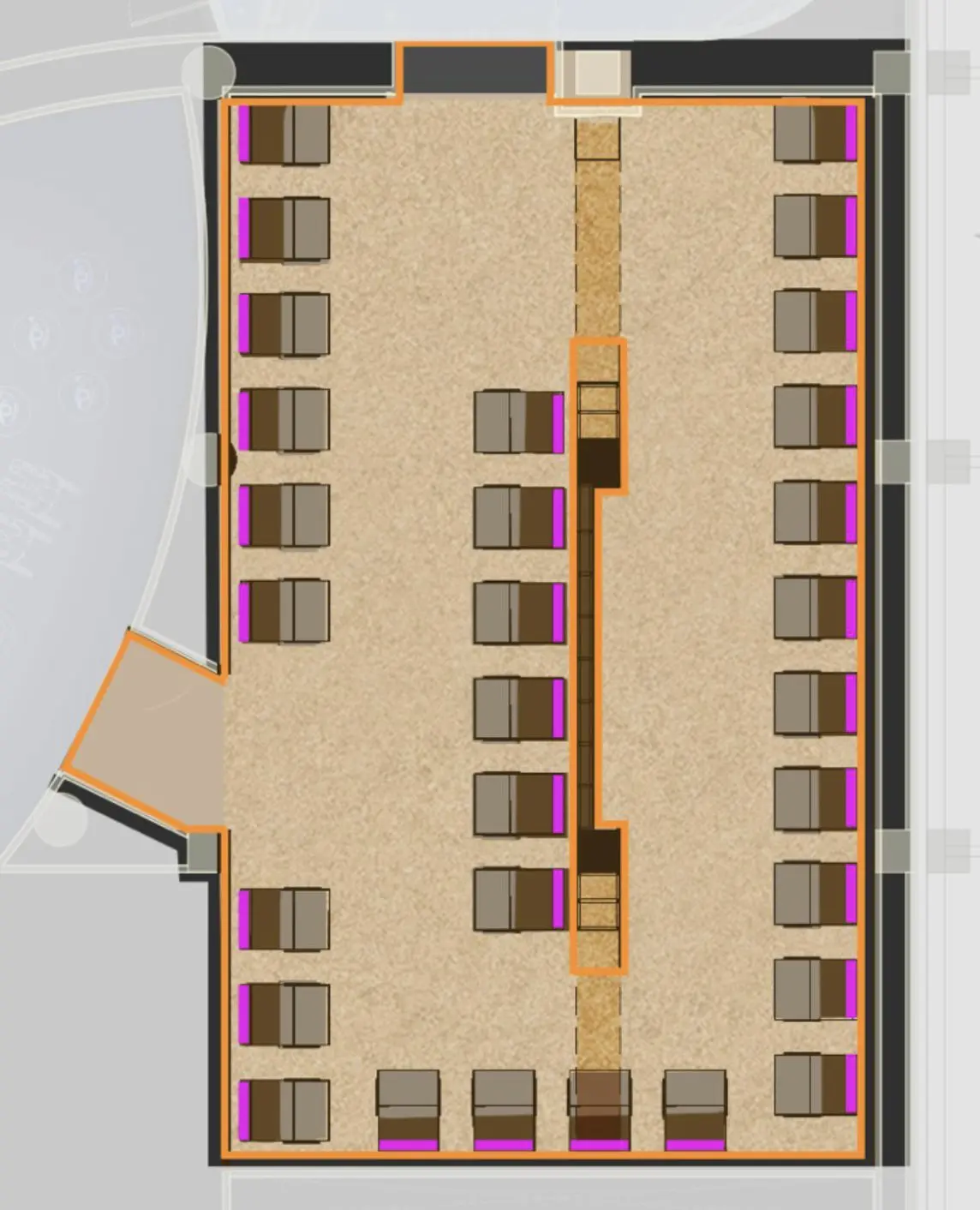
You take your seat in a chariot set among the painted arches and stalls of an ancient Indian market, and put on a virtual-reality headset. The ride begins. Your gaze and attention steer the chariot and the five horses pulling it, which represent the senses, while distractions along the path keep pulling you off course.
Little by little you feel less in control, until the ride ends in a crash. In that moment you experience a near-death, out-of-body state: you see your body from above, time seems to stop, and you sense something celestial. The voice of the Supersoul (Paramatma) is heard, though never seen, explaining the meaning of the journey.
The atma is the passenger, intelligence is the charioteer, the mind is the reins and the senses are the horses: the image of the Katha Upaniṣad and the Bhagavad-gītā. You are left with one question: who is driving my chariot? The ride ends with a gentle return to the body, and an understanding of the eternal atma and of the guidance it needs.
You sit in a chariot inside an ancient Indian market and put on your headset. The VR ride begins as the market comes alive around you.
Where you look, the chariot goes. The five horses, your senses, respond to your gaze while distractions along the way pull at your attention.
Control slips away and the ride ends in a crash. You find yourself outside your body, seeing it from above in a moment that feels timeless.
The Supersoul speaks, heard but not seen: the atma is the passenger, intelligence the charioteer, the mind the reins and the senses the horses.
You return gently to your body, carrying the question of who is really driving your chariot, and a new sense of the atma's eternal nature.
The big idea
We are the atma travelling in the chariot of the body. Intelligence must guide the mind and senses, and the Supersoul rides with us as our best friend and guide.
Questions it asks
You will come away understanding
Words to know
the self; the passenger in the chariot
the Supersoul, the inner guide who accompanies every atma
Bring it to life
Your gift builds this chariot and its immersive market ride, turning a timeless teaching into a thrilling experience every visitor will remember.
Design Habit estimate for the gallery, including GST
Sponsor this exhibitLevel 1 · Who Am I?The whole level: galleries and visitor spaces
Sponsor the levelAny amountEvery gift is recorded for this exhibit and for SMOVP
Donate to this exhibitEstimates from Design Habit (April 2026), shown in US dollars at ₹95 per US$1. Final costs are confirmed with each sponsor.
1.6
In a serene white chamber, explore how medicine defines death, what happens when the atma leaves the body, and documented cases of reincarnation.
Discover and supportClose ×In a serene white chamber, face life's greatest question with calm and curiosity.
What you will experience
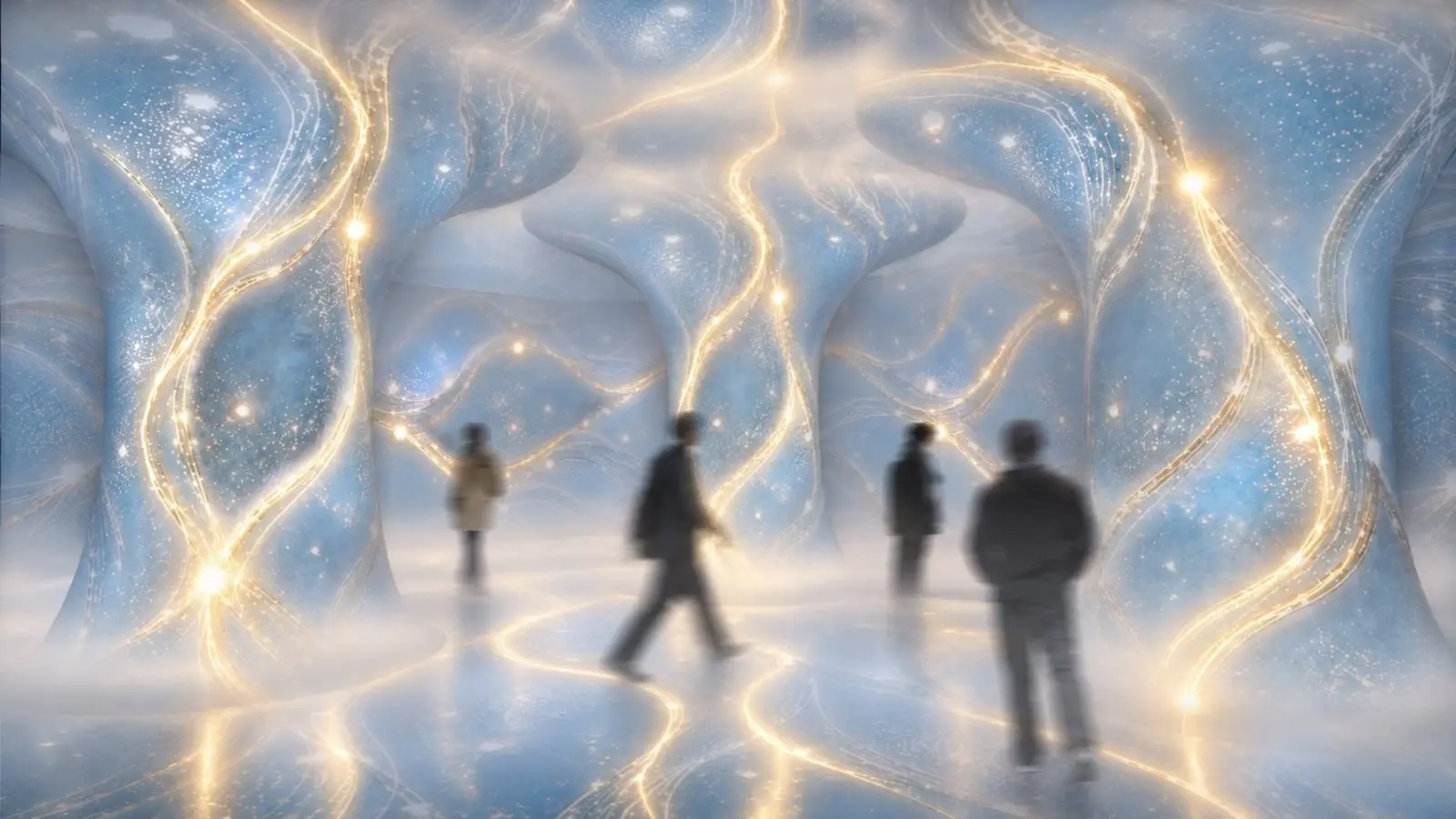
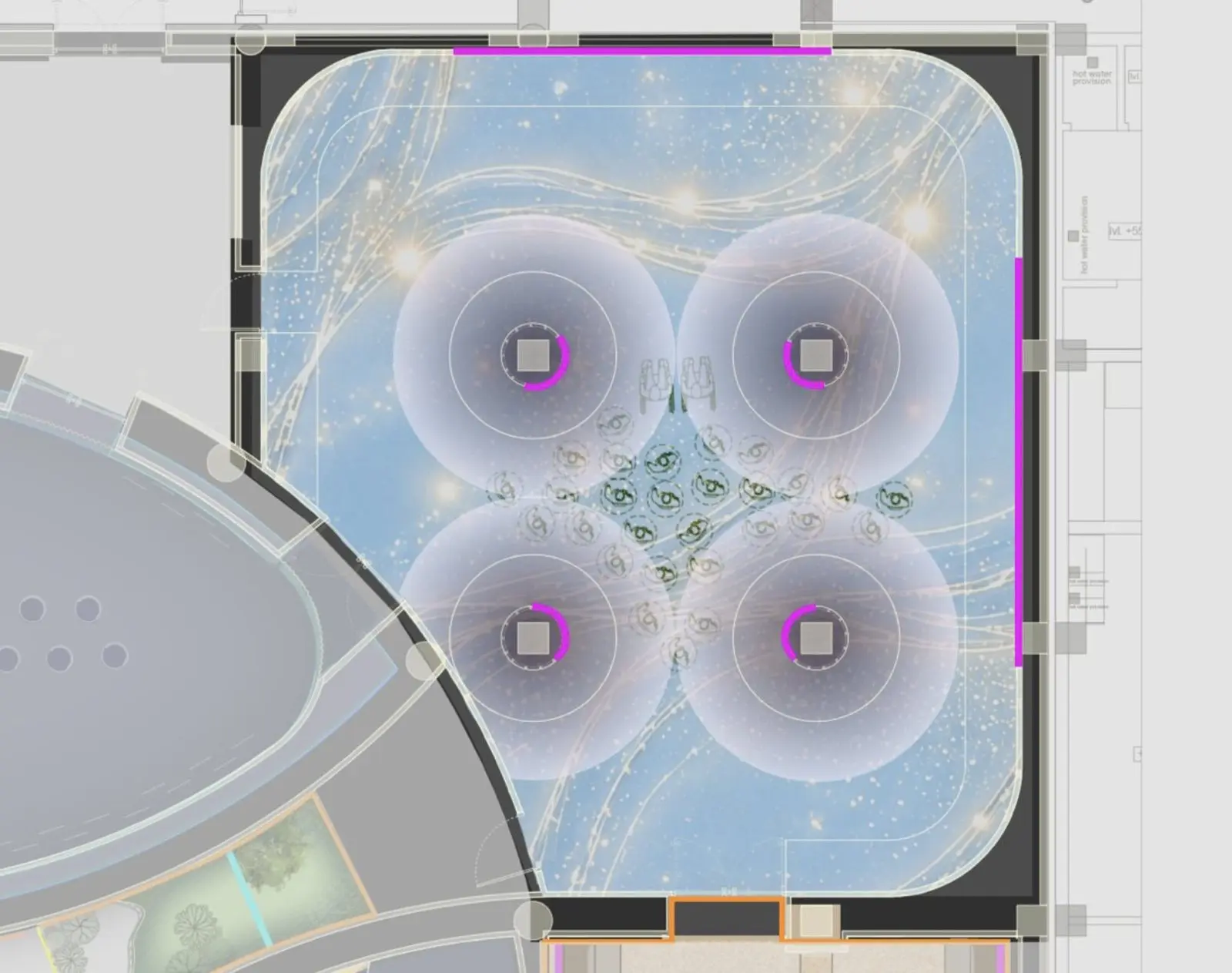
You enter a serene, mostly white chamber shaped by soft organic curves across the floor and ceiling, with abstract cosmic visuals flowing slowly over every surface. Devarshi begins with the modern medical definitions of death, and then their limits, especially in light of resuscitation and near-death cases.
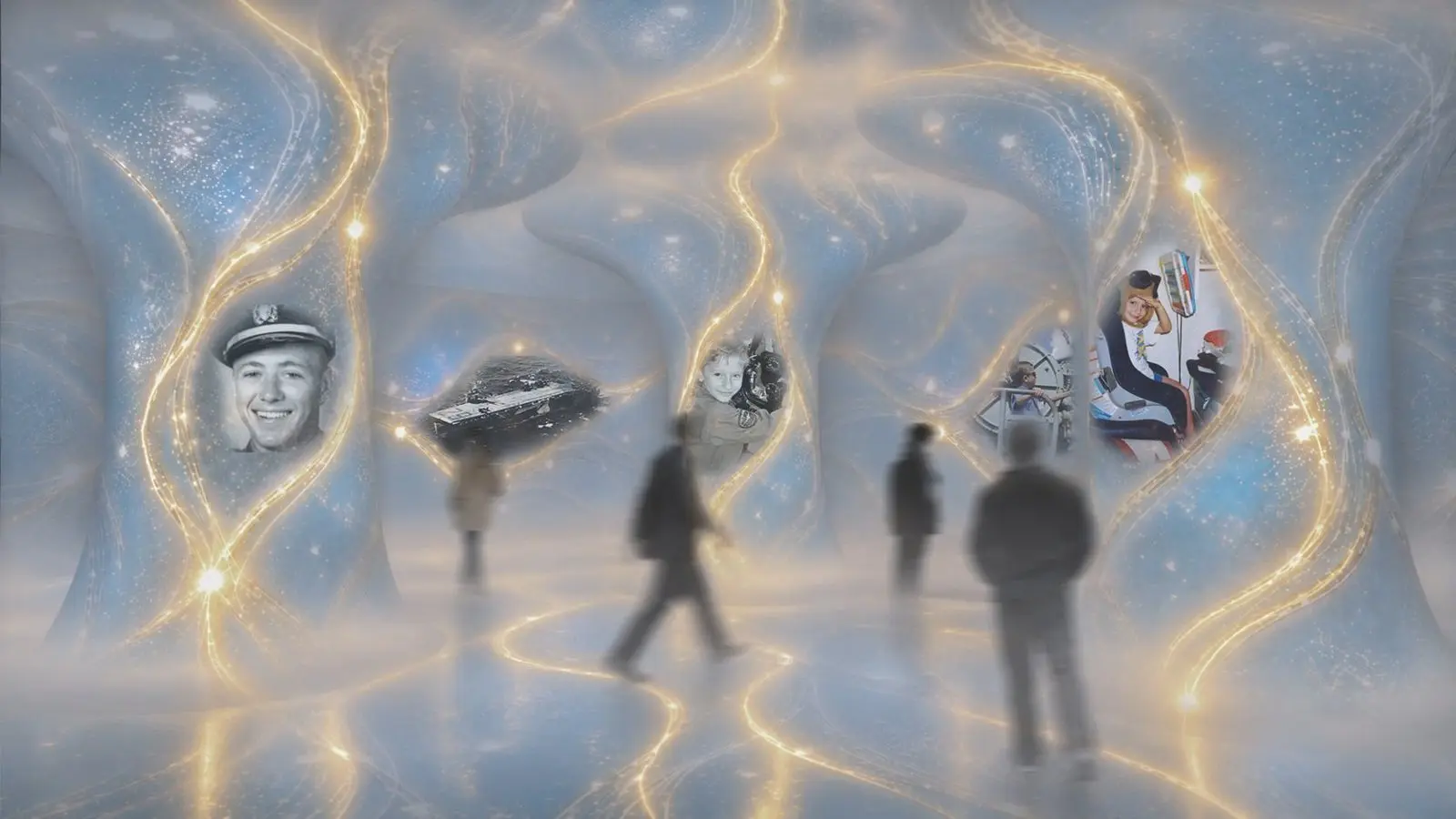
Through verses of the Bhagavad-gītā and the teachings of Srila Prabhupada, you learn that death takes place when the atma, the eternal conscious self, leaves the body. Then documented cases of reincarnation appear on circular monitors set into the walls, including the well-known case of James Leininger, with verified past-life memories, birthmarks that match fatal injuries, and continuity of behaviour.
You can walk up to the walls to explore more cases and real stories from around the world. Finally you discover what shapes the next life. A modern metaphor makes karma easy to picture: the universe keeps a vast cosmic database that records every action, intention and consequence, and shapes the lives to come.
You step into a calm white space of curving forms, where cosmic visuals drift slowly across the floor, walls and ceiling.
Devarshi explains how medicine defines death, and why resuscitation and near-death cases show the limits of those definitions.
Verses of the Bhagavad-gītā and the teachings of Srila Prabhupada explain that death is the moment the atma leaves the body.
On circular monitors in the walls, documented cases such as James Leininger's present past-life memories, matching birthmarks and continuity of behaviour.
Karma is pictured as a vast cosmic database that records every action, intention and consequence, shaping the next life.
The big idea
Death is the moment the atma leaves the body. Our desires and our karma, the consequences of our actions across lifetimes, shape the life that follows.
Questions it asks
You will come away understanding
Words to know
the eternal conscious self
action and its consequences, carried across lifetimes
Bring it to life
Your support creates this peaceful chamber and its surrounding screens, giving every visitor a gentle, thoughtful space to reflect on life, death and what lies beyond.
Design Habit estimate for the gallery, including GST
Sponsor this exhibitLevel 1 · Who Am I?The whole level: galleries and visitor spaces
Sponsor the levelAny amountEvery gift is recorded for this exhibit and for SMOVP
Donate to this exhibitEstimates from Design Habit (April 2026), shown in US dollars at ₹95 per US$1. Final costs are confirmed with each sponsor.
1.7
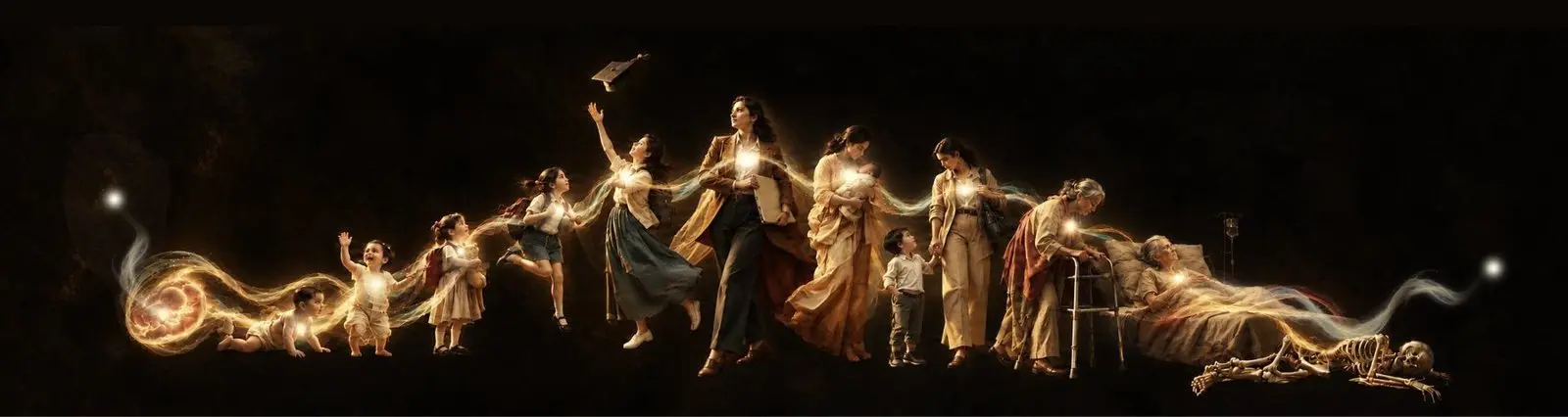
At the centre of a 360-degree painted world, a single spark appears, a body grows around it, and life after life unfolds while the spark remains.
Discover and supportClose ×Life after life, the body changes. The spark of the self remains.
What you will experience
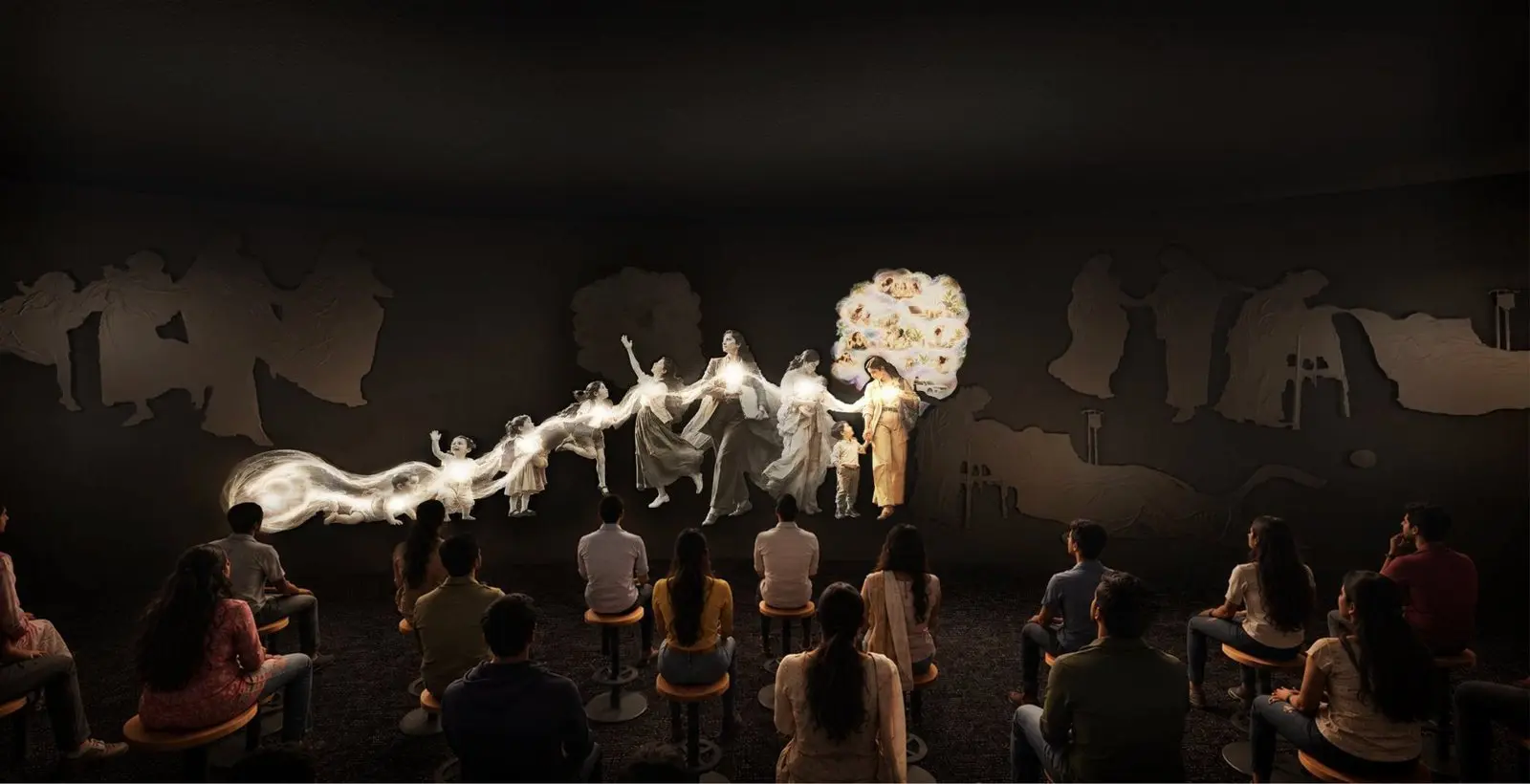
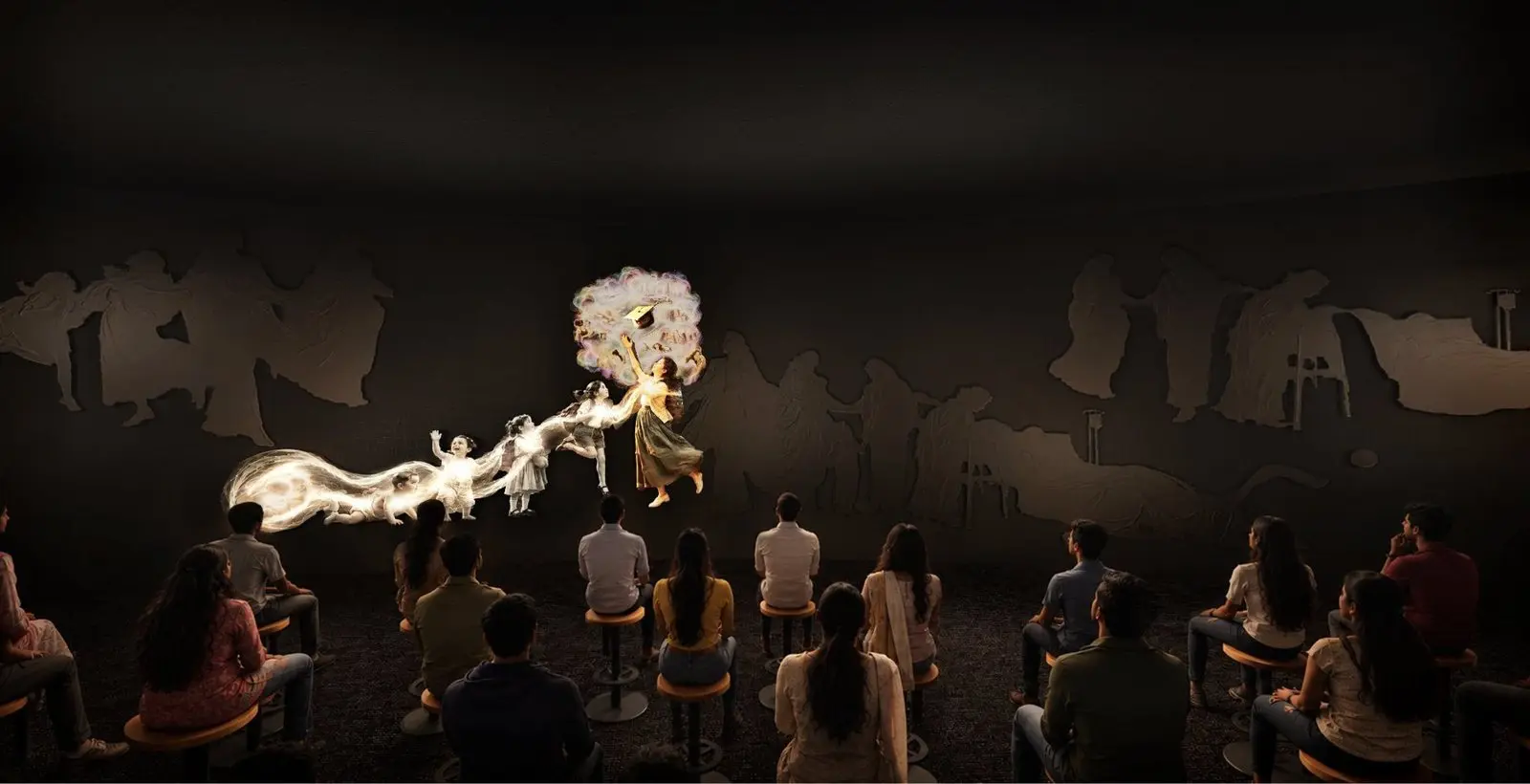
You take your seat at the centre of a 360-degree world, painted and projected all around you. In the darkness a single spark of light appears. Slowly, a human form grows around it, and a life begins to unfold: a childhood, a family, a place in the world. Then that life dissolves, and the spark remains, shining.
Life after life unfolds around you. The spark takes on new bodies, male and female, across different cultures, nations, occupations and eras. Each time, it carries something forward, like a backpack filled with desires, impressions and tendencies gathered along the way. Each life is shaped by what came before, and the journey continues.
Look closely and you notice a second, softer light accompanying the spark through every birth. It never leaves. This is the Supersoul (Paramatma), the steady companion who guides the self across lifetimes. As the cycles complete, you are left with a quiet sense of wonder: bodies are temporary, but consciousness endures beyond every one of them.
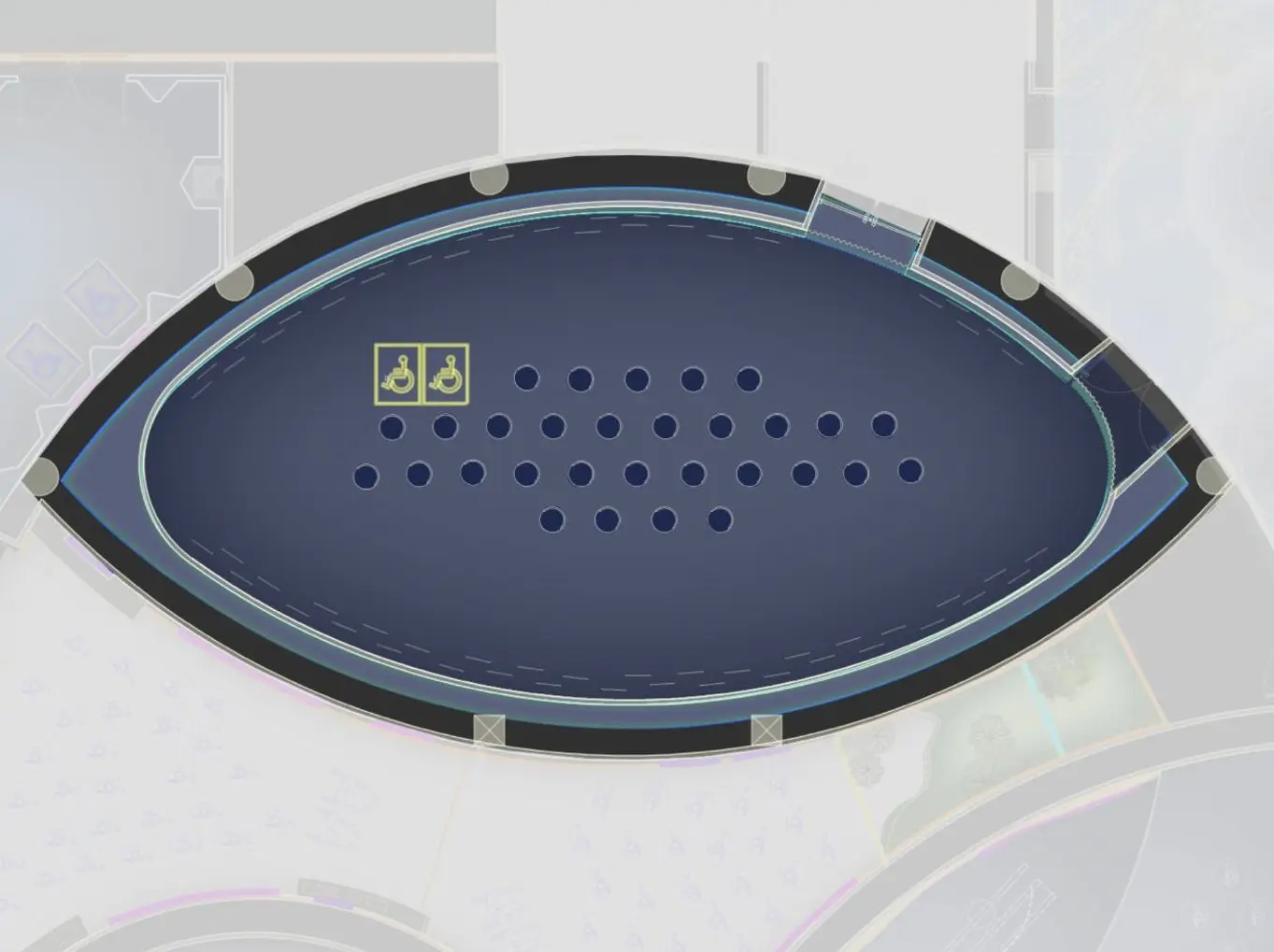
You sit at the centre of a 360-degree world, painted and projected all around you. In the darkness a single spark of light appears: the atma. Slowly a human form grows around it, and a life begins to unfold before your eyes.
That life dissolves, yet the spark remains. Cycle after cycle, it takes on new bodies, male and female in turn, across different ethnicities, cultures, occupations and circumstances. You watch one life give way to the next, all around you.
In each life the spark carries something forward, like a backpack filled with desires, karma and tendencies, the vāsanās gathered along the way. You see how the subtle body carries these impressions, so that every new life is shaped by what came before.
Look closely and you notice a second, softer spark accompanying the first through every birth. It never leaves. This is the Supersoul (Paramatma), the steady companion offering guidance across lifetimes. As the cycles end, you sense that consciousness endures beyond every body.
As you leave, a new question opens: if the atma is what makes the human body alive, what about all the other creatures? The journey continues upstairs with Level 2: What is life?
The big idea
The body is temporary, but the atma endures. The subtle body carries our desires and tendencies forward, while the Supersoul accompanies us through every life.
Questions it asks
You will come away understanding
Words to know
the self, shown as a luminous spark
the second, softer light: divine guidance across lifetimes
tendencies carried from life to life
Bring it to life
Your gift paints and projects this panoramic world of changing lives, bringing a beloved teaching to every visitor on a grand scale.
Design Habit estimate for the gallery, including GST
Sponsor this exhibitLevel 1 · Who Am I?The whole level: galleries and visitor spaces
Sponsor the levelAny amountEvery gift is recorded for this exhibit and for SMOVP
Donate to this exhibitEstimates from Design Habit (April 2026), shown in US dollars at ₹95 per US$1. Final costs are confirmed with each sponsor.
Level 2
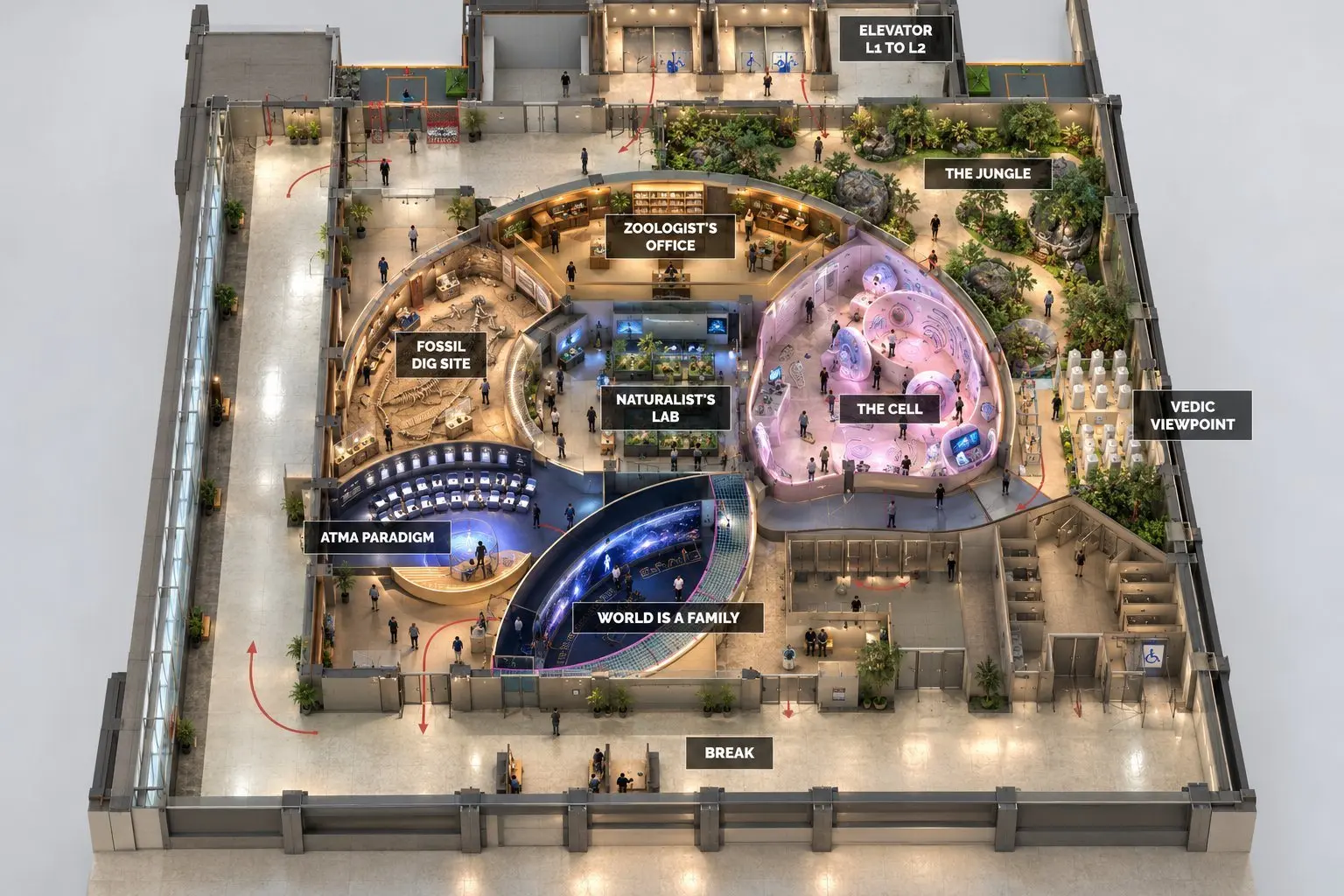
Grieving elephants, dreaming octopuses, the hidden city of a single cell: life in all its wonder, and the atma within every being.
This level invites you to explore the mystery and diversity of life, guided by both science and Vedic wisdom. It begins with the rich emotional and cognitive lives of animals, their grief, play and memory, hinting at a deeper presence of consciousness beyond the human form. Going deeper, you meet the idea of jīva-jāti: all life is animated by the atma, whose presence in a body is expressed uniquely in each species. Through immersive environments, from fossil digs to biology labs, you encounter the unanswered questions of modern evolutionary theory alongside the Vedic view of life's origins. Conversations between the scientists and the narrator explore how inconceivable it is for life to emerge from chemicals, how species appear fully formed in the fossil record without links to earlier creatures, and how the adaptations we see within species are shaped by the atma's consciousness interacting with nature under the guidance of the Supersoul (Paramatma).
Finally, the level moves towards a vision of unity: vasudhaiva kuṭumbakam, the world is one family. Every being is connected by the Supersoul, the witness in every heart, guiding life through inner intelligence. The experience ends with a powerful realisation: life is not random but conscious, interconnected, sacred and purposeful. The final exhibit also explores the value of the human birth and our responsibility towards other creatures.
2.1
A forest alive with creatures, where smart mirrors become windows onto real behaviour: grief, play, memory. At the end, a light awakens in every creature.
Discover and supportClose ×Step into a forest of creatures and discover the inner lives of animals.
What you will experience
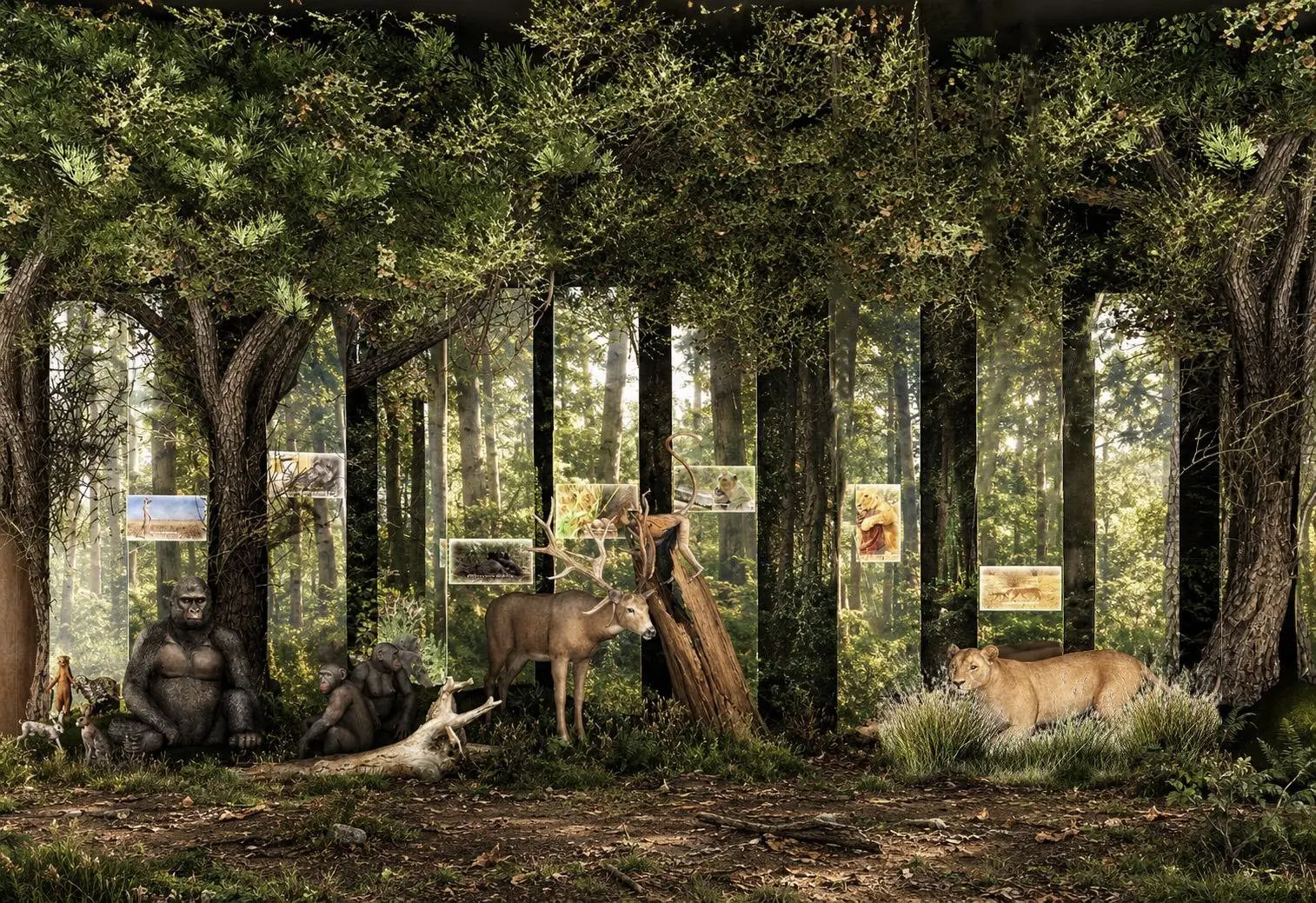
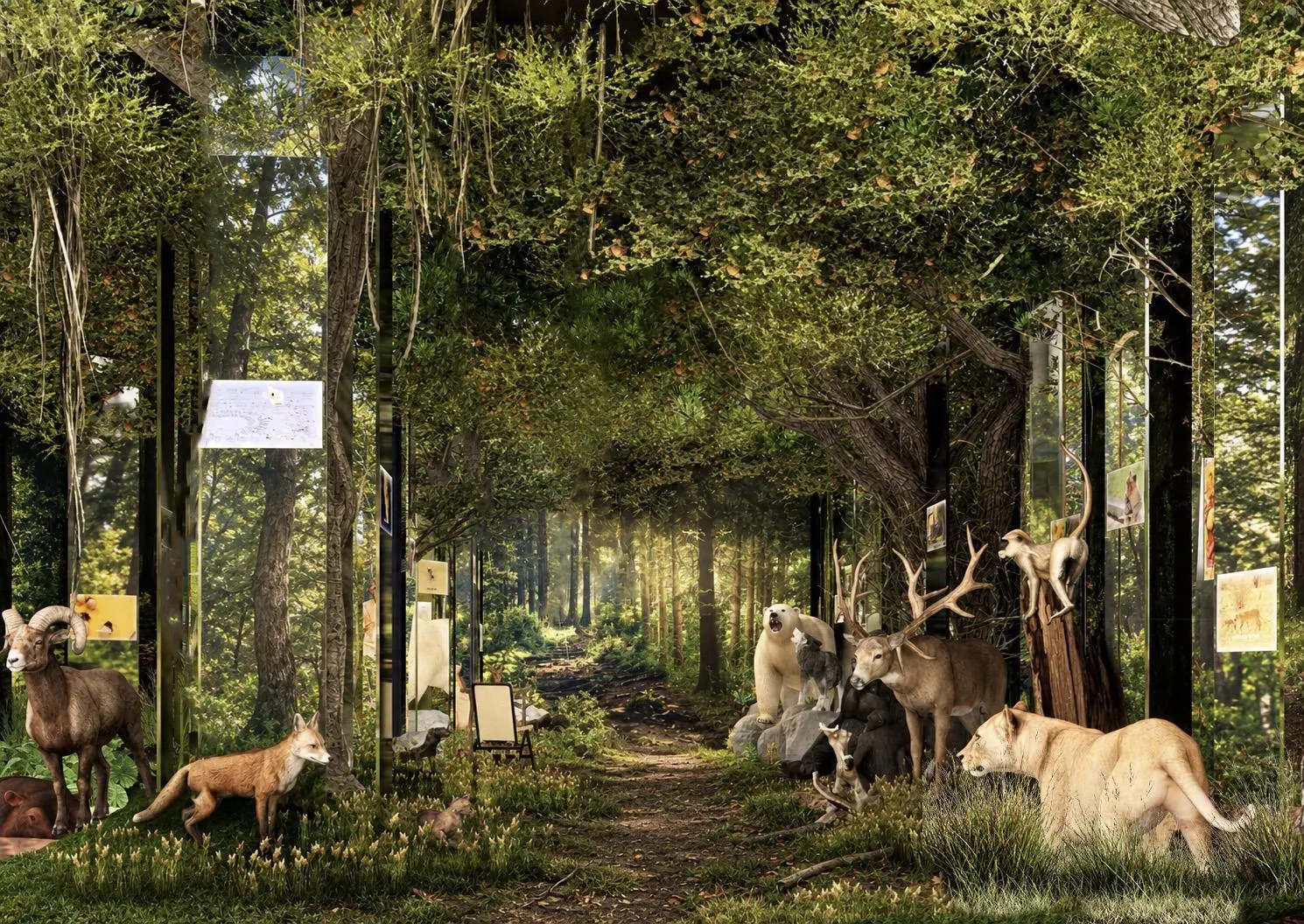
You enter a forest alive with creatures. Lifelike animal sculptures stand among the trees, and beside them, mirrors turn into windows onto astonishing real footage. Elephants grieve for their dead. Crows play. Octopuses appear to dream. A gorilla communicates in sign language. Animals cooperate, help other species, use tools and solve problems with remarkable creativity.
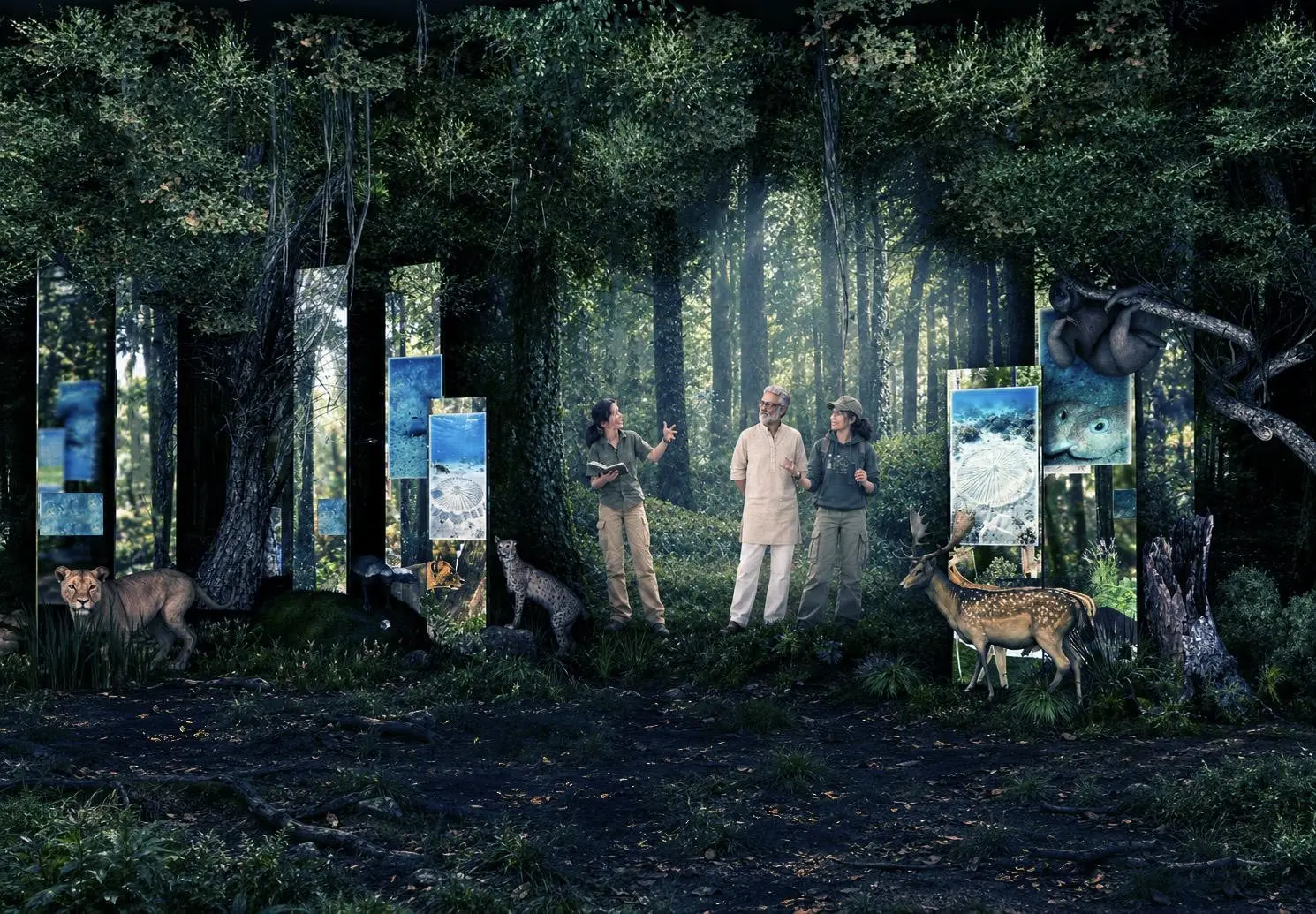
The narrators appear in projection above a mound, and Jane, a zoologist, draws your attention to specific examples of animal intelligence. As she speaks, the relevant videos fill every screen in the forest. When the videos switch off, the smart mirrors become ordinary mirrors again, reflecting the jungle endlessly so that it seems to go on forever.
As the evidence builds, the forest seems to come alive in a new way. You look at the creatures around you and begin to see them not as machines, but as fellow conscious beings. At the end, a light awakens inside every creature in the clearing, a sign of the atma present within all forms of life.
You enter a forest filled with lifelike animal sculptures. Beside them, mirrors turn into windows onto astonishing real footage: elephants grieving, crows at play, an octopus that seems to dream and a gorilla using sign language. The inner lives of animals open up around you.
More windows reveal animals cooperating, helping other species, using tools and solving problems with real creativity. You watch intelligence and kindness appear in creatures you might never have expected, and begin to wonder what is happening inside them.
The narrators appear above a mound, and Jane, a zoologist, points out examples of animal intelligence. As she speaks, the matching videos fill every screen in the forest: grief, play, memory and self-awareness are not unique to humans.
You hear of hermit crabs leaving a safe shell to escape pain, and of the New York Declaration on Animal Consciousness. As the evidence builds, a light awakens inside every creature in the clearing, a sign of the atma within all forms of life.
The big idea
Animals show intelligence, emotion, creativity and self-awareness. Consciousness is not only human: the atma is present within every living being.
Questions it asks
You will come away understanding
Words to know
the conscious self, present in every living being
Bring it to life
Your support fills this forest with its creatures and living windows, opening every visitor's eyes to the inner lives of the animals we share our world with.
Design Habit estimate for the gallery, including GST
Sponsor this exhibitLevel 2 · What Is Life?The whole level: galleries and visitor spaces
Sponsor the levelAny amountEvery gift is recorded for this exhibit and for SMOVP
Donate to this exhibitEstimates from Design Habit (April 2026), shown in US dollars at ₹95 per US$1. Final costs are confirmed with each sponsor.
2.2
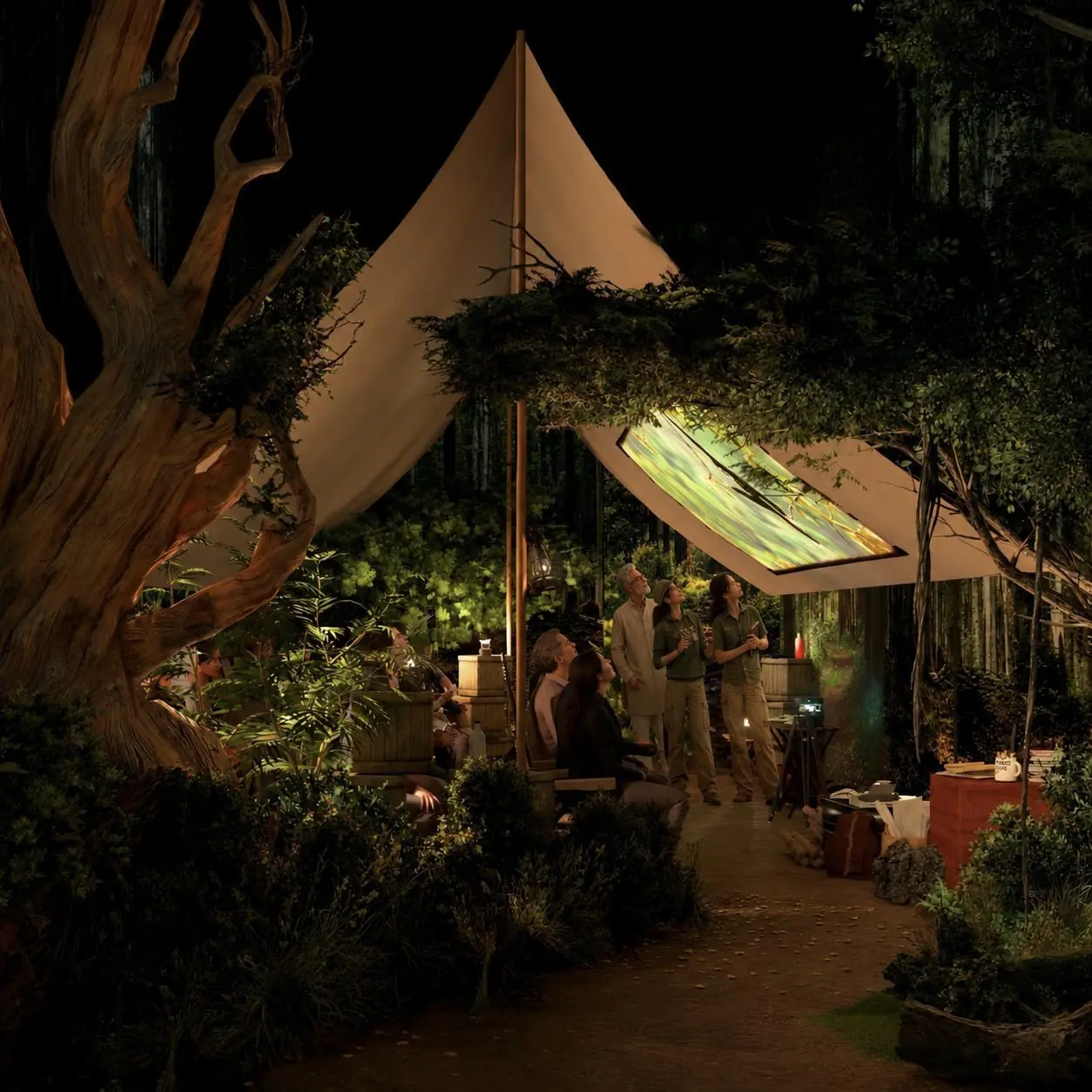
At Riya and Jane's campsite, Devarshi explains what makes something alive and how the Vedic texts define a species, with footage from the field on the canvas above.
Discover and supportClose ×At a quiet campsite in the jungle, ask what makes something alive.
What you will experience
Riya and Jane invite you to their campsite, hidden behind a hedge at the edge of the jungle. You sit on camp chairs under a canvas shelter, surrounded by instruments and finds from their field research, while Jane, Riya and Devarshi talk together in front of you. As they speak, documentary footage from their expeditions plays on the sloping canvas, and Devarshi explains the Vedic understanding with verses from the Bhagavad-gītā, the Śrīmad-Bhāgavatam and the Purāṇas.
They begin with a simple question: what makes something alive? A living deer appears beside one that has died, and you consider what has really changed. You hear how every conscious being seeks survival, knowledge and pleasure, reflecting the nature of the atma itself.
Then the conversation turns to how the Vedic texts define a species: by its unique set of senses for knowing and organs for acting. Eyes of every kind, the star-nosed mole, butterflies that taste with their feet and sidewinding snakes show how differently life can perceive and move.
Behind a hedge at the edge of the jungle you reach Riya and Jane's campsite. You sit on camp chairs under a canvas shelter as they talk with Devarshi, and footage from their expeditions plays on the canvas above.
A living deer appears beside one that has died and is decomposing, and you consider what has really changed. You hear how every conscious being seeks survival, knowledge and pleasure, drives that flow from the sat-cit-ānanda nature of the atma itself.
The conversation turns to how the Vedic texts define a species: by its unique set of jñānendriyas and karmendriyas, faculties for knowing and acting. Different eyes, the star-nosed mole, snake hearing, butterflies tasting with their feet and sidewinding snakes show how differently life perceives and moves.
The big idea
All life seeks to exist, to know and to enjoy, flowing from the nature of the atma. A species type, or jīva-jāti, is defined by its unique faculties of knowing and acting.
Questions it asks
You will come away understanding
Words to know
a species type: life expressed through a particular set of senses and organs
existence, knowledge and bliss: the nature of the atma
the senses for knowing
the organs for acting
Bring it to life
Your gift creates this jungle campsite and its living canvas, a place for every visitor to pause and reflect on what life really is.
The whole level: galleries and visitor spaces
Sponsor the levelAny amountEvery gift is recorded for this exhibit and for SMOVP
Donate to this exhibitEstimates from Design Habit (April 2026), shown in US dollars at ₹95 per US$1. Final costs are confirmed with each sponsor.
2.3
Zoom from your own body into a single cell and walk inside it, its machinery pulsing around you, then step out onto the fiery surface of the Hadean Earth.
Discover and supportClose ×Shrink down, step inside a living cell, and marvel at its machinery.
What you will experience
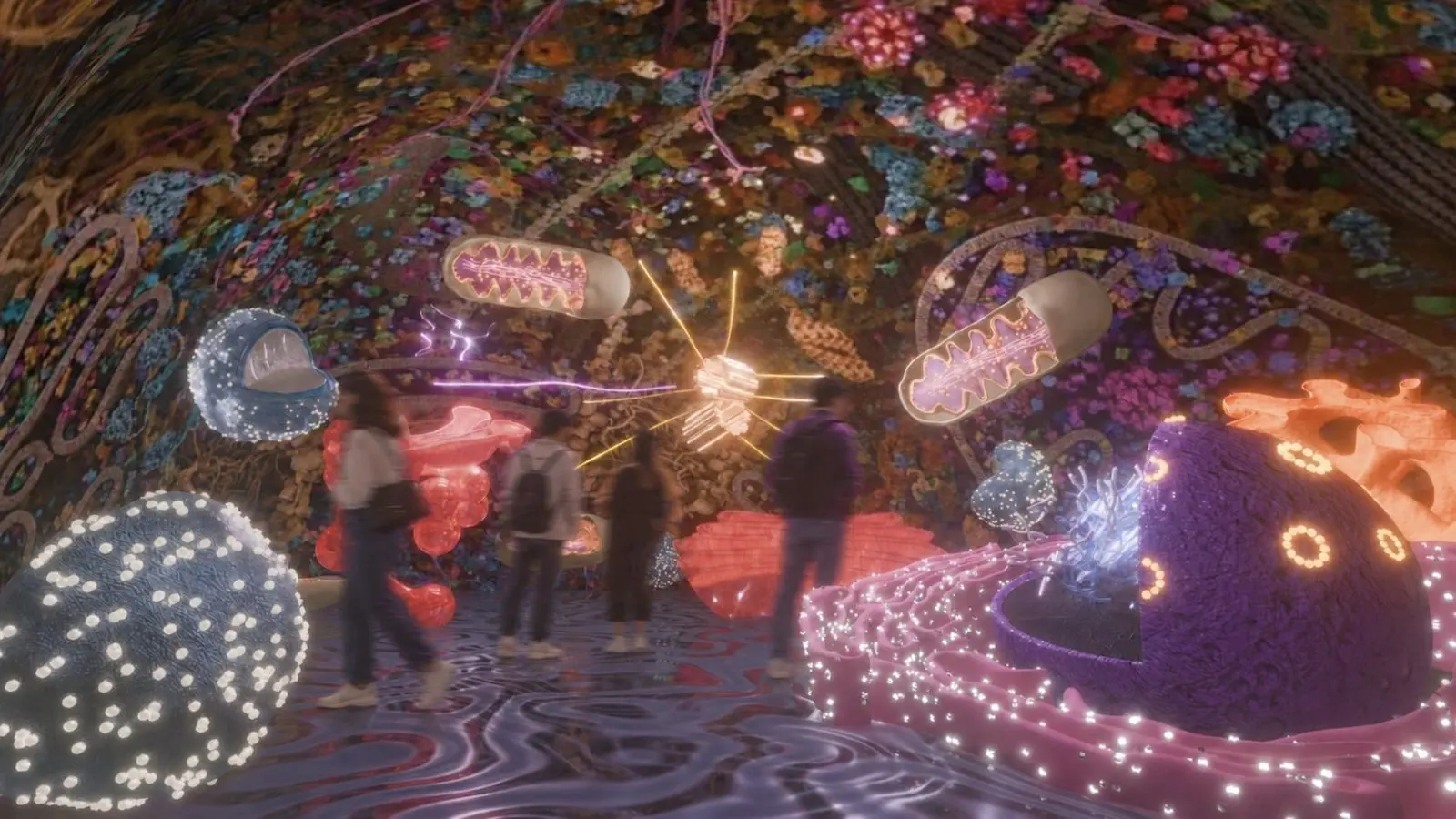
Smoke screens above you play a zoom sequence, from your own body down to a single cell: the basic unit of your body and of all life. A short, gentle ramp then leads you inside a living cell made of fabric that pulses softly around you. Its functions are mapped on the walls in projection and light, and parts of the cell hang from the ceiling and line the walls, so you brush against them as you walk in.
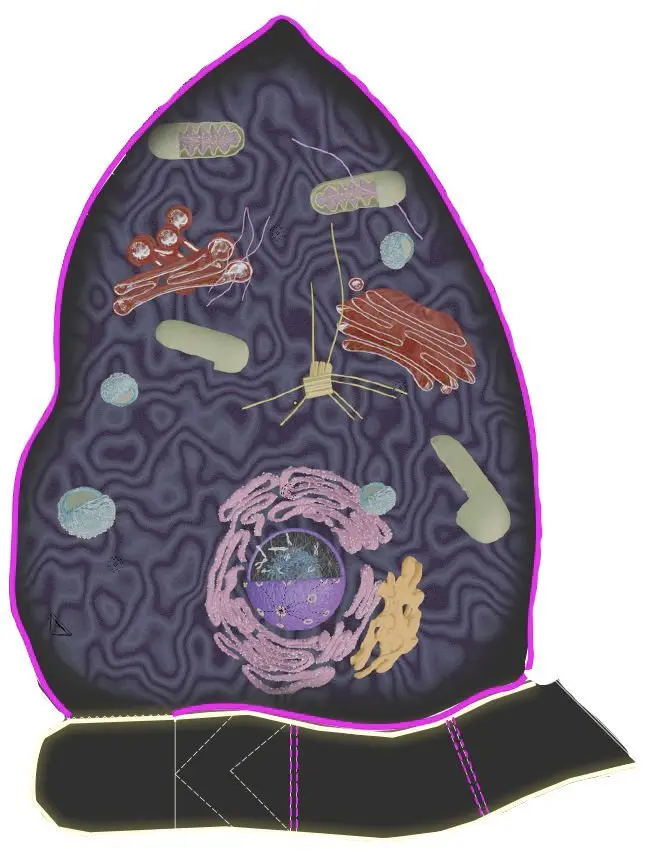
Here you discover that the cell is the fundamental unit of your body and of all life. Every part of its machinery has a role, and each depends on the others. You watch the membrane, the systems that power the cell and the systems that copy it, all working together in perfect coordination.
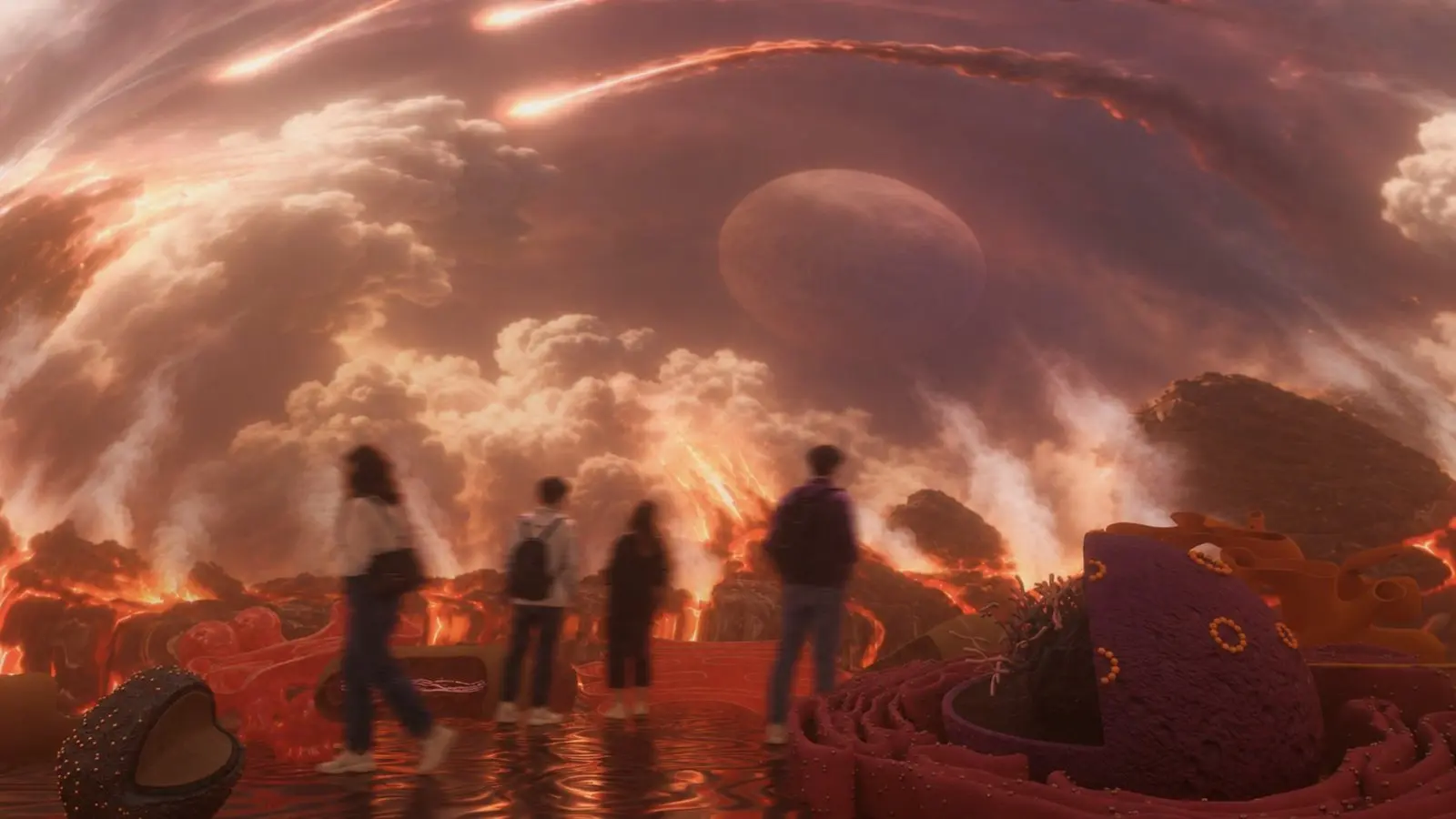
The narrators are heard but never seen. The projections transform into a picture of the first cell, whose functions all depend on one another. Parts of the human cell that the first cell would not have had fold away mechanically, leaving the question in the air: how could it all have come to be at once? Then the visuals become the fiery atmosphere of the Hadean Earth, and you step out.
Smoke screens above you zoom from your own body down to a single cell. A gentle ramp leads you inside a pulsing fabric cell, where hanging parts brush against you as you enter.
You step inside a giant cell that pulses softly all around you. Its machinery is projected on every surface, and you stand in the middle of the intricate, bustling workings that keep you alive, discovering the cell as the fundamental unit of all life.
The projections transform into the first cell, whose functions all depend on one another. Parts of the human cell that it would not have had fold away mechanically, leaving one question: how could it all arise at once?
The walls open and you step out onto the surface of the young Earth in the Hadean period, a violent world of fire and rock. Here the question of how life first began hangs in the air as you move on to the next exhibit.
The big idea
The cell is the foundation of all life, and even the simplest imagined first cell requires interdependent parts working together, raising deep questions about how life began.
Questions it asks
You will come away understanding
Bring it to life
Your support builds this giant, pulsing cell and the journey into it, letting every visitor stand inside the wonder of life at its smallest scale.
Design Habit estimate for the gallery, including GST
Sponsor this exhibitLevel 2 · What Is Life?The whole level: galleries and visitor spaces
Sponsor the levelAny amountEvery gift is recorded for this exhibit and for SMOVP
Donate to this exhibitEstimates from Design Habit (April 2026), shown in US dollars at ₹95 per US$1. Final costs are confirmed with each sponsor.
2.4
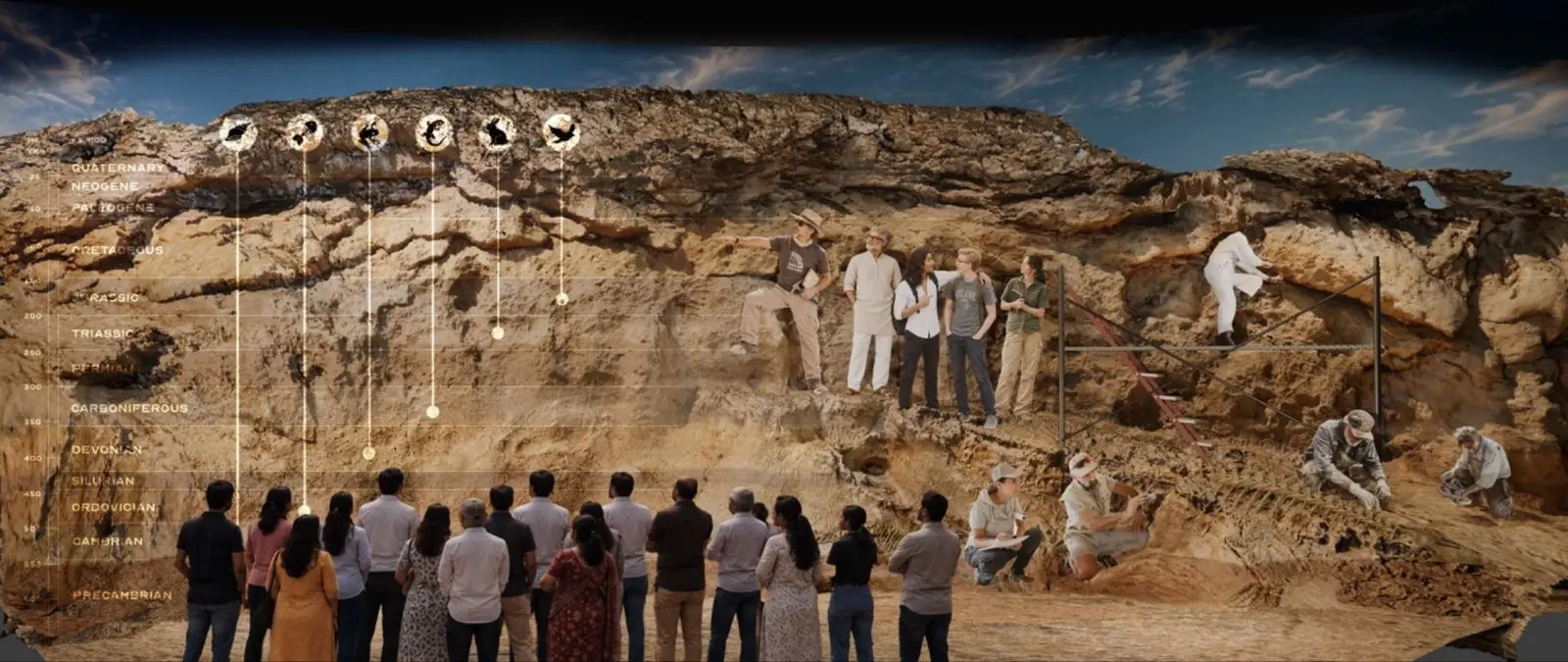
At an active dig site, Diego shows the major groups of life appearing in the rock layers, and asks where the expected links between them should be.
Discover and supportClose ×Explore an active dig site and read the story written in stone.
What you will experience
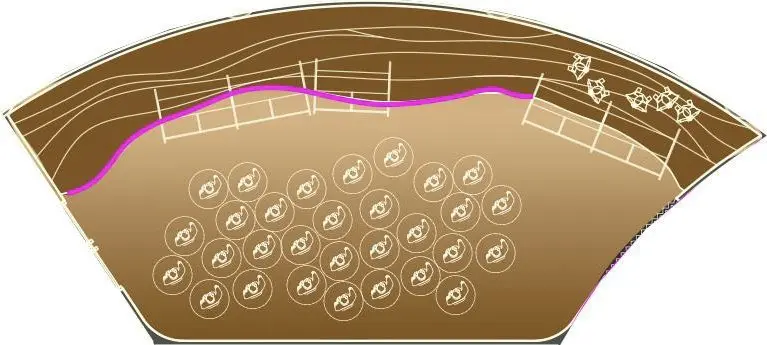
You arrive at an active dig site beneath a towering cliff of rock strata, layer upon layer of Earth's history rising above you. Tools and finds lie scattered across the site, and you are invited to explore it like a field researcher, looking closely at the evidence the rocks preserve.
Diego, a paleontologist, welcomes Jane and the group and takes you through the mysteries of the fossil record. On a huge projection-mapped rock face, the major groups of life appear one after another, and fossils glow in their layers as the narration explains each one's place in Earth's history.
The projection then asks where the expected links between these groups should appear. You look for the transitional forms that would connect one kind of creature to the next, and consider what their absence might mean. You leave the cliff with fresh questions about how the great variety of life came to be.
You arrive at an active dig site beneath a towering cliff of rock strata, layer upon layer of Earth's history rising above you. You explore it like a field researcher, looking closely at the evidence the rocks have preserved.
As the narration unfolds, fossils begin to glow within their layers. You learn how fossils form and what the fossil record can tell us about the living things that came before, laid down one layer at a time in the cliff before you.
A giant projection animates the appearance of major groups of life through Earth's history, including the famous Archaeopteryx. You watch species arrive in the record fully formed, seemingly without links to the creatures that came before them.
The projection asks where the expected transitional species should be. You look for the forms that would connect one kind of creature to the next, and consider what their absence might mean for the story of how life's variety came to be.
The big idea
In the fossil record, many species appear suddenly and fully formed, and the expected transitional forms are often missing, inviting fresh questions about life's origins.
Questions it asks
You will come away understanding
Bring it to life
Funds the rock-strata cliff, the glowing fossils set in its layers and the projection of life's history. Visitors explore it like a field team and draw their own conclusions.
Design Habit estimate for the gallery, including GST
Sponsor this exhibitLevel 2 · What Is Life?The whole level: galleries and visitor spaces
Sponsor the levelAny amountEvery gift is recorded for this exhibit and for SMOVP
Donate to this exhibitEstimates from Design Habit (April 2026), shown in US dollars at ₹95 per US$1. Final costs are confirmed with each sponsor.
2.5
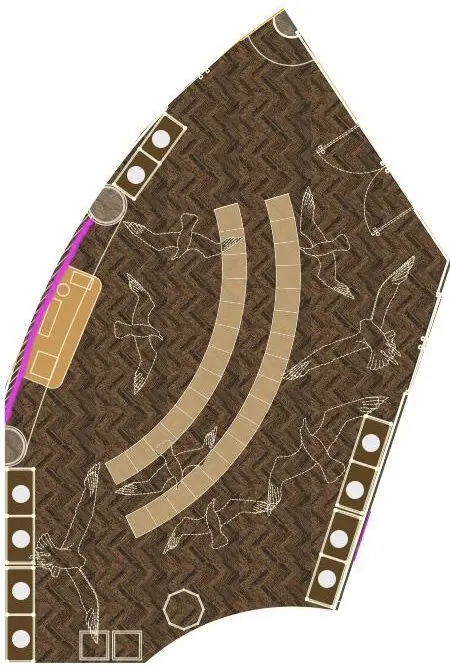
In an old zoologist's study of bones, jars and diagrams, Dr. Miriam weighs the argument from shared features against creatures whose features are their own.
Discover and supportClose ×Inside an old zoologist's study, specimens light up to tell their stories.
What you will experience
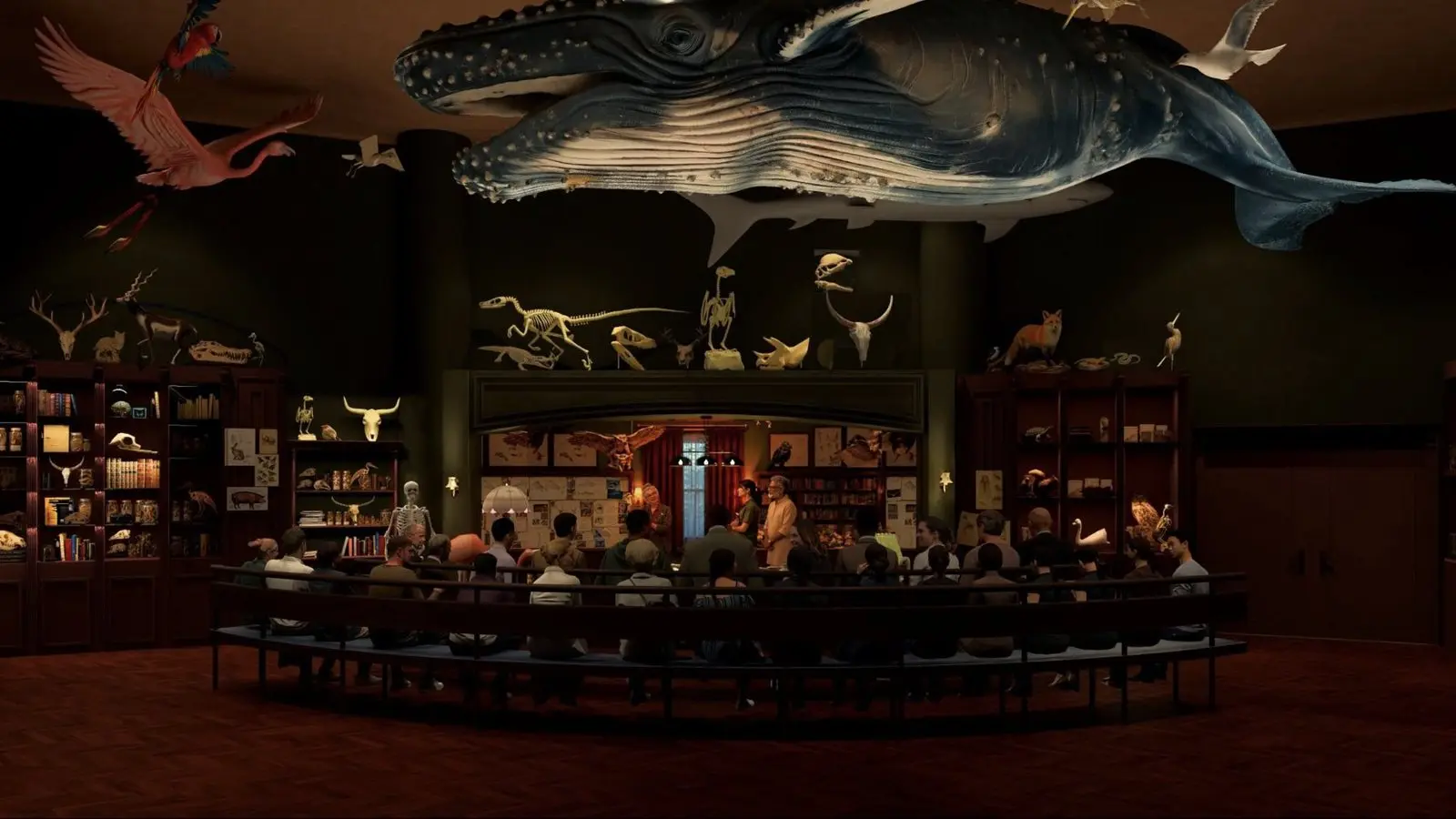
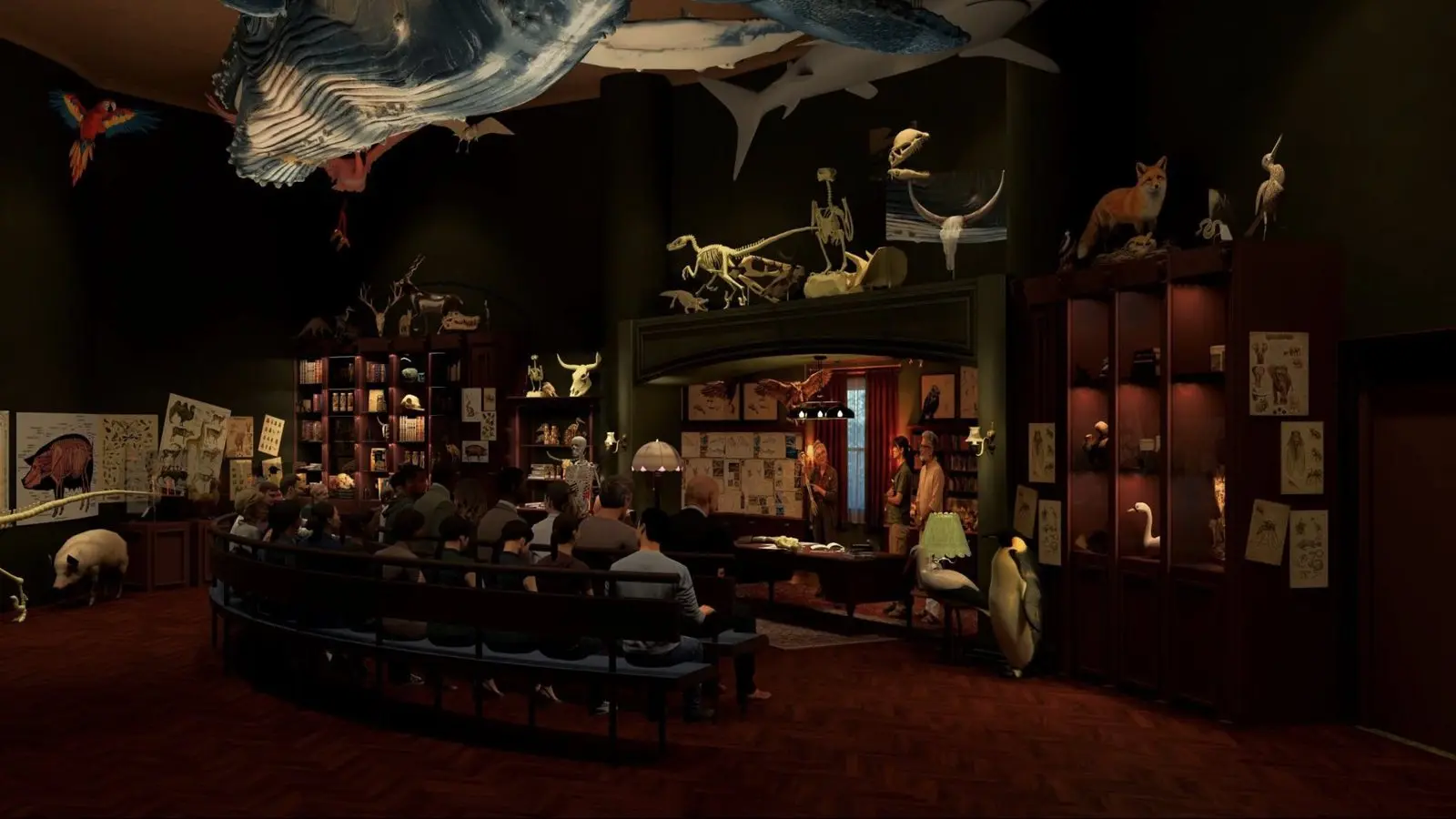
You step into an old-fashioned zoologist's office. Bones and skeletons line the shelves, taxidermy specimens stand watch, jars glint in the lamplight and diagrams are pinned across the walls. It feels like a room where generations of curious minds have worked, measured and wondered.
You sit on benches facing a panoramic screen behind a wooden table, where Dr. Miriam appears in conversation with Jane, Devarshi and the boys, lifting objects from the table to explain one of the classic arguments for evolution: that shared features point to a common ancestor. Models hang from the ceiling, and as each example is mentioned, its model, chart and specimen light up.
The conversation then turns to complications. You discover creatures that share similar features without sharing an ancestor, and others whose features are entirely their own, like the seahorse, whose males carry and give birth to their young. You leave the study seeing the living world as richer and more surprising than any single explanation.
You step into an old-fashioned zoologist's office. Bones line the shelves, taxidermy specimens stand watch, jars glint and diagrams are pinned across the walls. Behind his desk sits the zoologist, ready to talk with his colleague and the narrator.
The zoologist introduces homology, the argument that shared features between creatures point to a common ancestor. As he speaks, specimens around the room light up to illustrate each point, and you follow the conversation from shelf to shelf.
The talk turns to a complication: creatures that share strikingly similar features without sharing an ancestor. Specimens light up again as you see how similar designs appear in unrelated lines of life, and what that means for the argument.
Finally you meet creatures whose features are entirely their own, like the seahorse, whose males carry and give birth to their young. You leave the study seeing the living world as richer and more surprising than any single explanation allows.
The big idea
The argument from shared features is still widely taught, but similar features that arise independently, and features unique to one kind of creature, complicate the picture.
Questions it asks
You will come away understanding
Bring it to life
Your support fills this study with its specimens and illuminated stories, inviting every visitor into a lively scientific conversation.
Design Habit estimate for the gallery, including GST
Sponsor this exhibitLevel 2 · What Is Life?The whole level: galleries and visitor spaces
Sponsor the levelAny amountEvery gift is recorded for this exhibit and for SMOVP
Donate to this exhibitEstimates from Design Habit (April 2026), shown in US dollars at ₹95 per US$1. Final costs are confirmed with each sponsor.
2.6
Riya's safari moves between laboratory sets and the field to show how species really change: dog breeds, moths, sticklebacks and bacteria.
Discover and supportClose ×Board a vintage safari bus and watch living species adapt before your eyes.
What you will experience
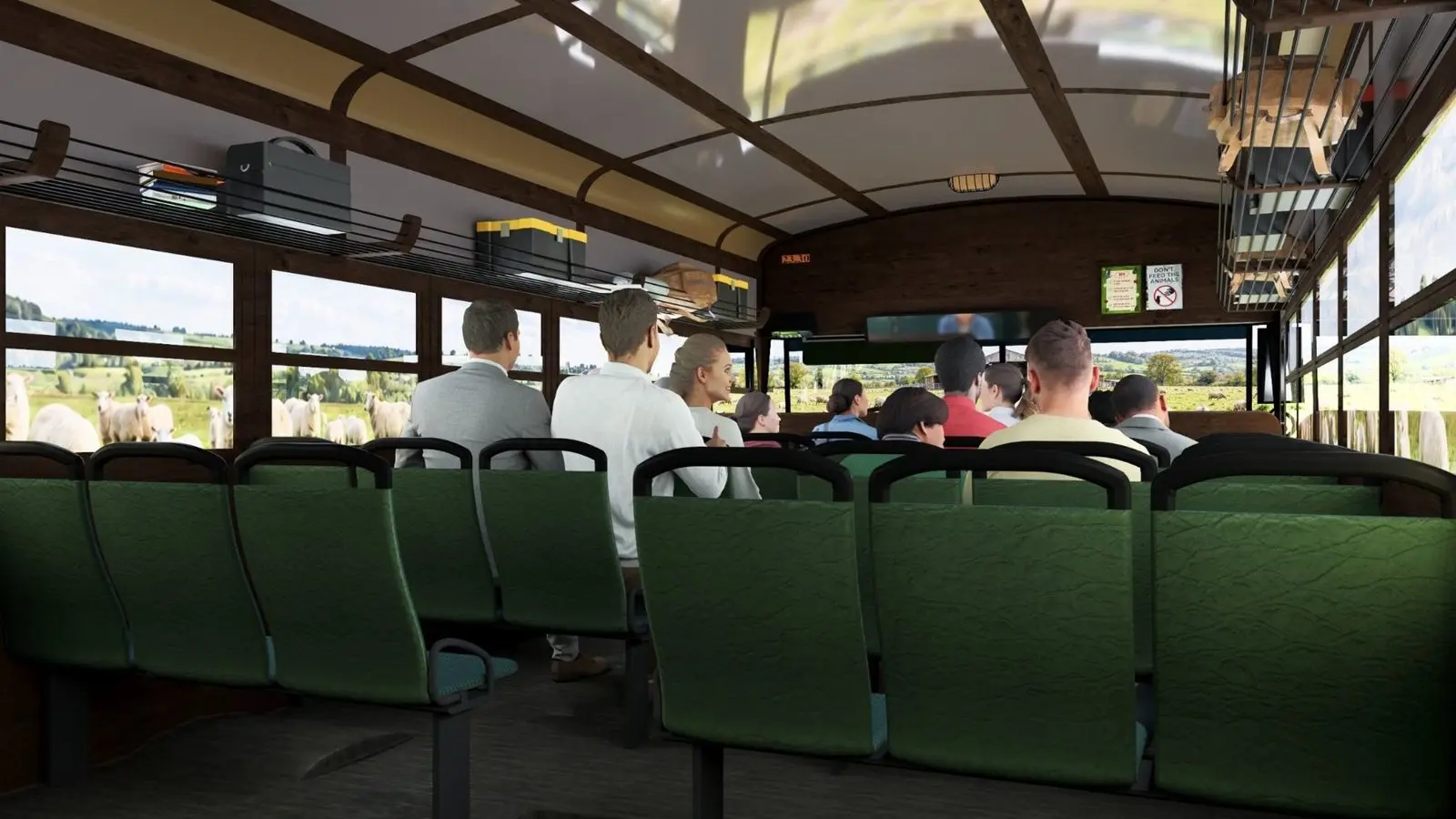
Riya's safari takes you into the two sides of a naturalist's work. On one side are recreated laboratory sets, each prepared for an example in the story; on the other, foliage recreates the field where naturalists spend most of their time. In a safari bus, screens become windows onto the landscapes and the laboratory, and the narrators guide you from one set to the next.
Here you explore the difference between small changes within a species and the origin of entirely new kinds of life. You see how people have shaped the many breeds of dog through selective breeding, and how sticklebacks and peppered moths have adapted to their environments in the wild.
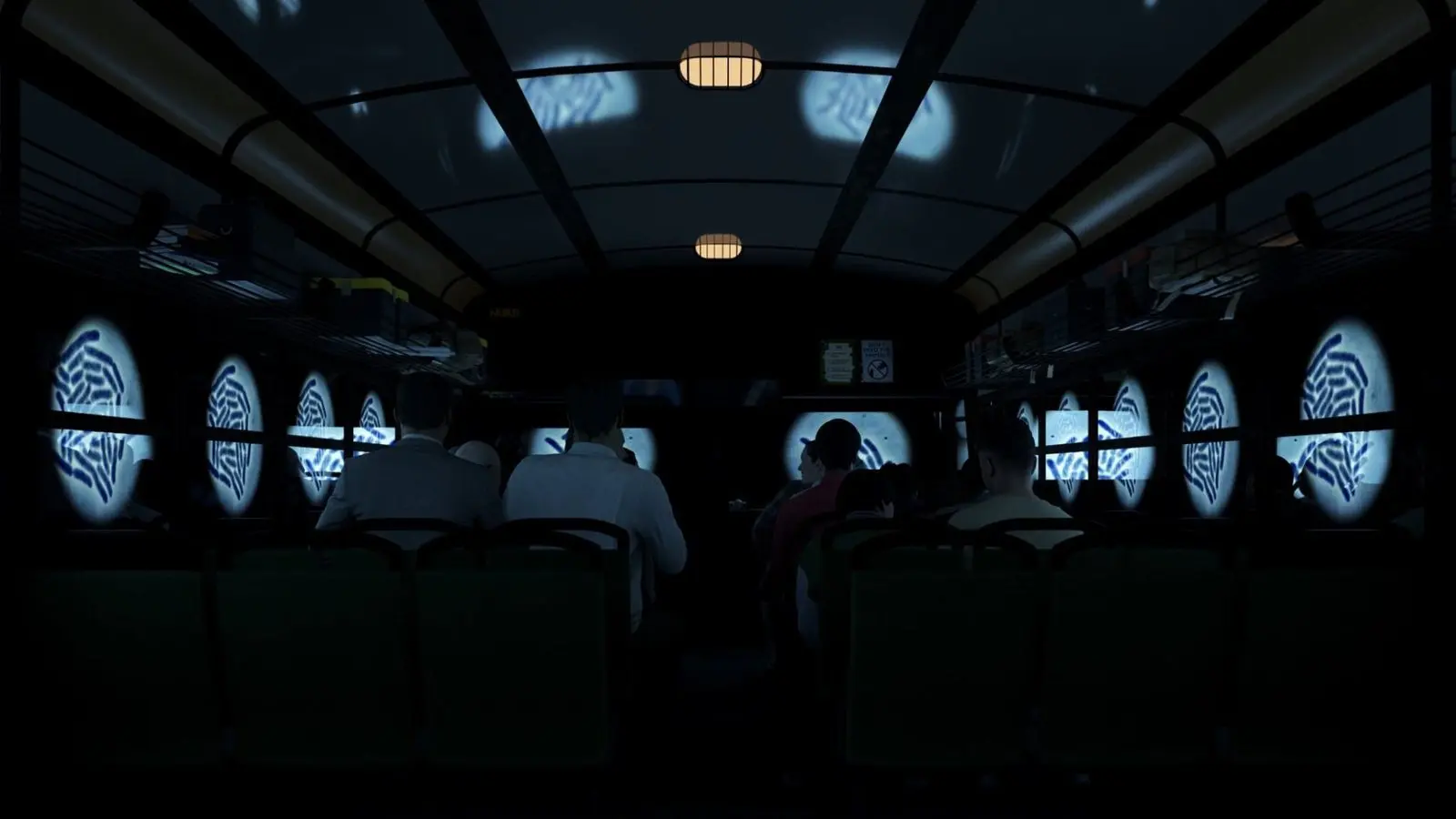
In the final laboratory you peer at bacteria evolving under the microscope, part of the world's longest-running evolution experiment. Change within species is real and observable, and you see it clearly. You also see that it is a different claim from the appearance of new kinds, and you leave ready to think about the difference.
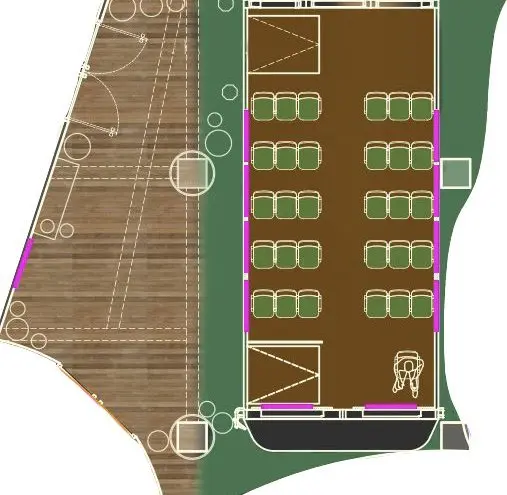
You take your seat in Riya's safari bus, where screens become windows onto fields, wildlife and the laboratory. From here the narrators guide you from one set to the next.
In the first laboratory you explore the difference between microevolution, small changes within a species, and macroevolution, the origin of entirely new kinds of life. You see why these are two quite different claims, even though they share one name.
You discover how people have shaped the many breeds of dog through selective breeding. Generations of careful choices have produced remarkable variety, yet every breed remains a dog, a clear example of change within a kind.
You see how sticklebacks and peppered moths have adapted to pressures in their environments. These well-known cases show species changing in the wild, in response to the world around them, in ways that scientists can observe and measure.
In the final laboratory you peer at bacteria evolving under the microscope, part of the Long-Term Evolution Experiment, the world's longest-running. Change within species is real and observable, and you leave ready to weigh it against the origin of new kinds.
The big idea
Adaptation within species, in response to environmental pressure, is real and observable, but it is a different claim from the origin of new kinds of life.
Questions it asks
You will come away understanding
Bring it to life
Your gift builds the safari bus and the naturalist's laboratories, giving every visitor a hands-on look at how life adapts and changes.
Design Habit estimate for the gallery, including GST
Sponsor this exhibitLevel 2 · What Is Life?The whole level: galleries and visitor spaces
Sponsor the levelAny amountEvery gift is recorded for this exhibit and for SMOVP
Donate to this exhibitEstimates from Design Habit (April 2026), shown in US dollars at ₹95 per US$1. Final costs are confirmed with each sponsor.
2.7
A giant 3D printer shows nature's process of creation, from intent to information to a body for the atma, as holographic creatures fill the world.
Discover and supportClose ×A new vision of how and why species appear, and a body to design.
What you will experience
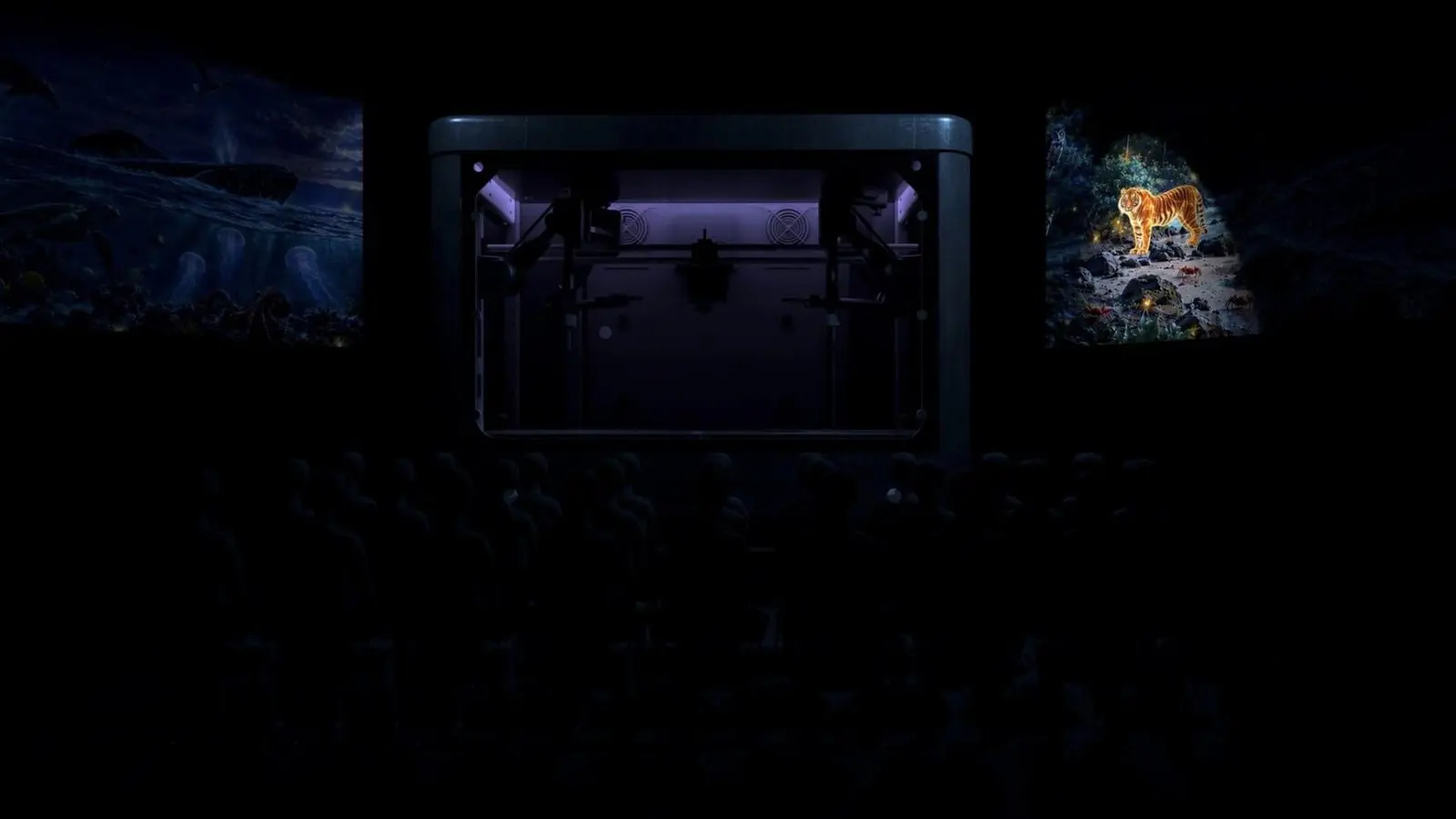
The narrators appear in projection and recap the four exhibits before: the jungle, the cell, the fossil record and the changes seen in the field. Then, in a dramatic reveal, a giant 3D printer appears before you.
The printer illustrates nature's bottom-up process of creation as the Vedic view presents it. It begins with intent, which becomes information, structures and templates, and finally the selection of a body that suits the desires of the atma. The body is a vehicle shaped by consciousness interacting with nature under the guidance of the Paramatma.
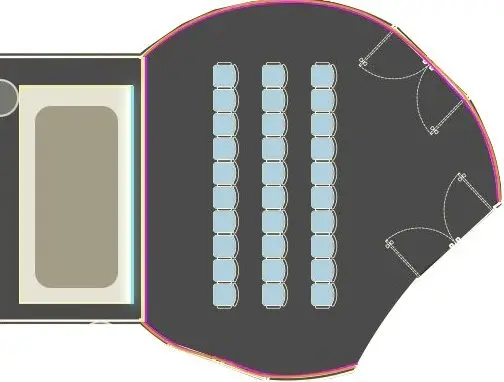
One by one, holographic creatures are printed. They float out of the printer as projections and take their places in the artwork on the walls around you, populating the world with life.
The narrators appear in projection and recap what the jungle, the cell, the fossils and the field have shown.
A giant 3D printer is revealed. It shows creation from the top down in meaning, but bottom-up in process: intent, then information and templates, then a body suited to the desires of the atma.
Holographic creatures are printed, float out of the printer and take their places in the artwork on the surrounding walls, filling the world with life.
The big idea
The body is a vehicle through which the atma experiences the world, and adaptations are shaped by consciousness interacting with nature under the agency of the Supersoul.
Questions it asks
You will come away understanding
Words to know
the conscious self
the Supersoul, who guides every living being
Bring it to life
Your support brings this panel, its holographic stage and its creative design activity to life, turning a new idea into something every visitor can explore.
Design Habit estimate for the gallery, including GST
Sponsor this exhibitLevel 2 · What Is Life?The whole level: galleries and visitor spaces
Sponsor the levelAny amountEvery gift is recorded for this exhibit and for SMOVP
Donate to this exhibitEstimates from Design Habit (April 2026), shown in US dollars at ₹95 per US$1. Final costs are confirmed with each sponsor.
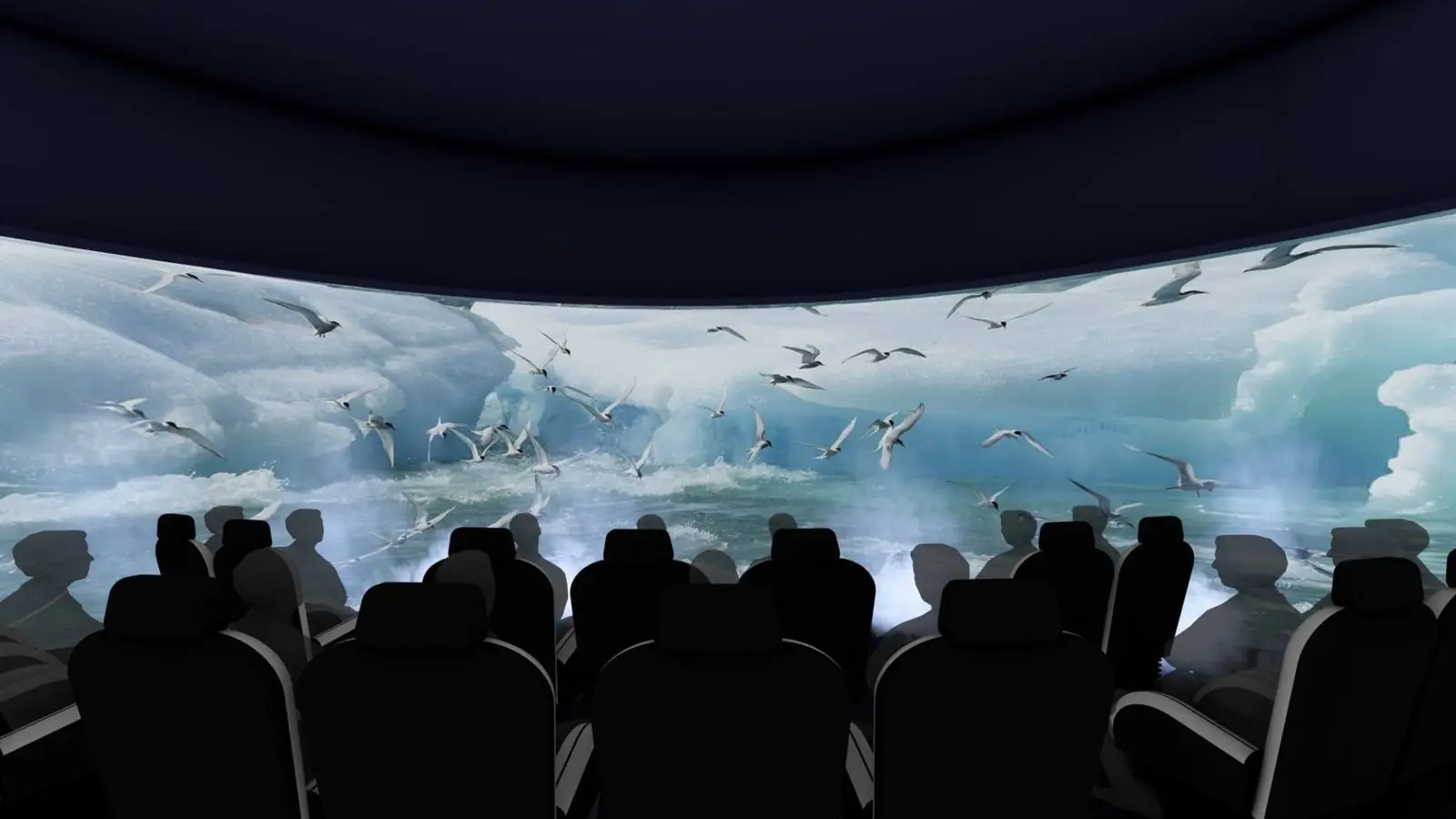
2.8
Fly with terns and butterflies through the Earth's great cycles as wind and mist arrive on cue: Vasudhaiva Kuṭumbakam, the world is one family.
Discover and supportClose ×Fly with terns and butterflies, and discover the intelligence that unites all life.
What you will experience
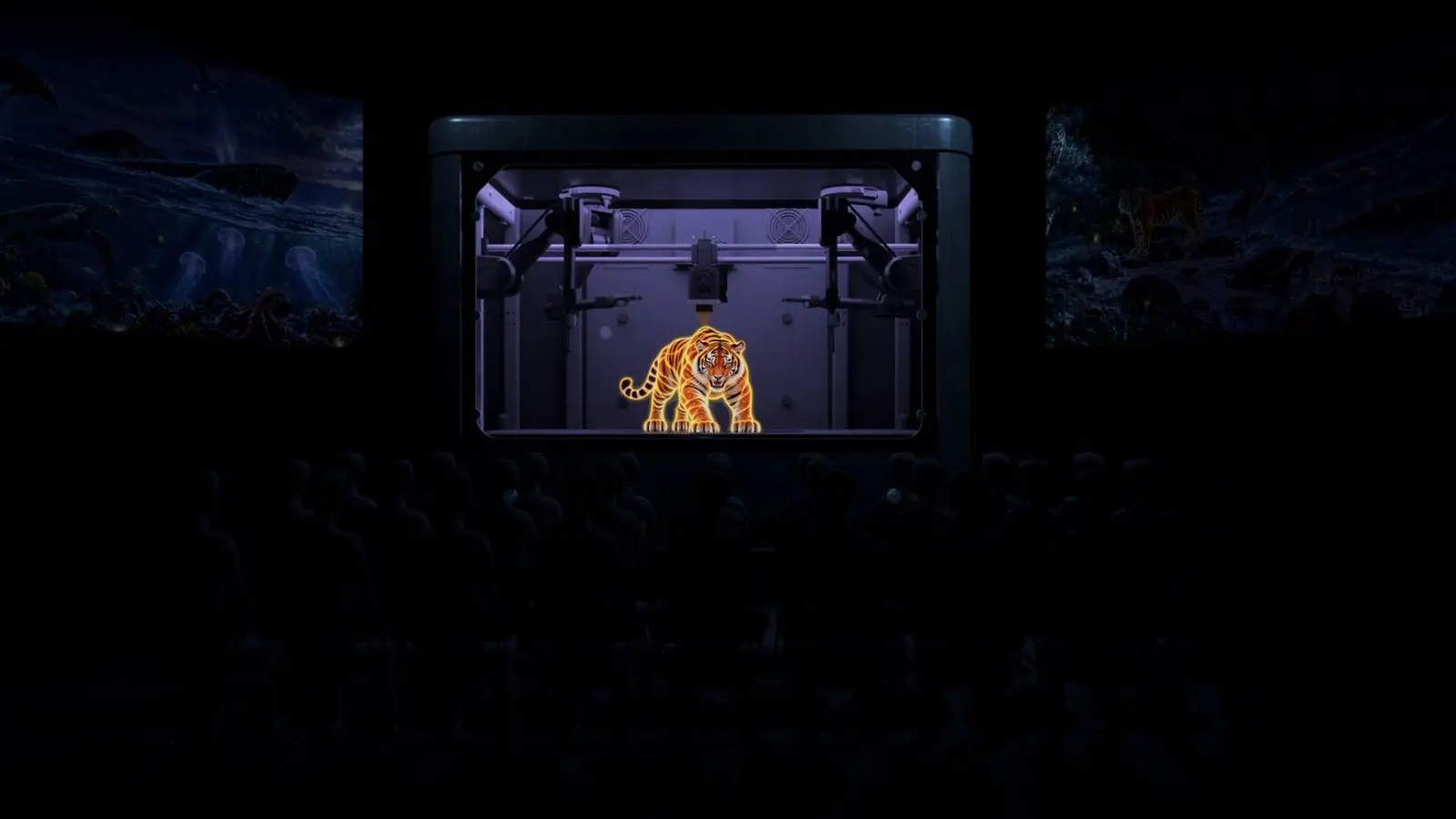
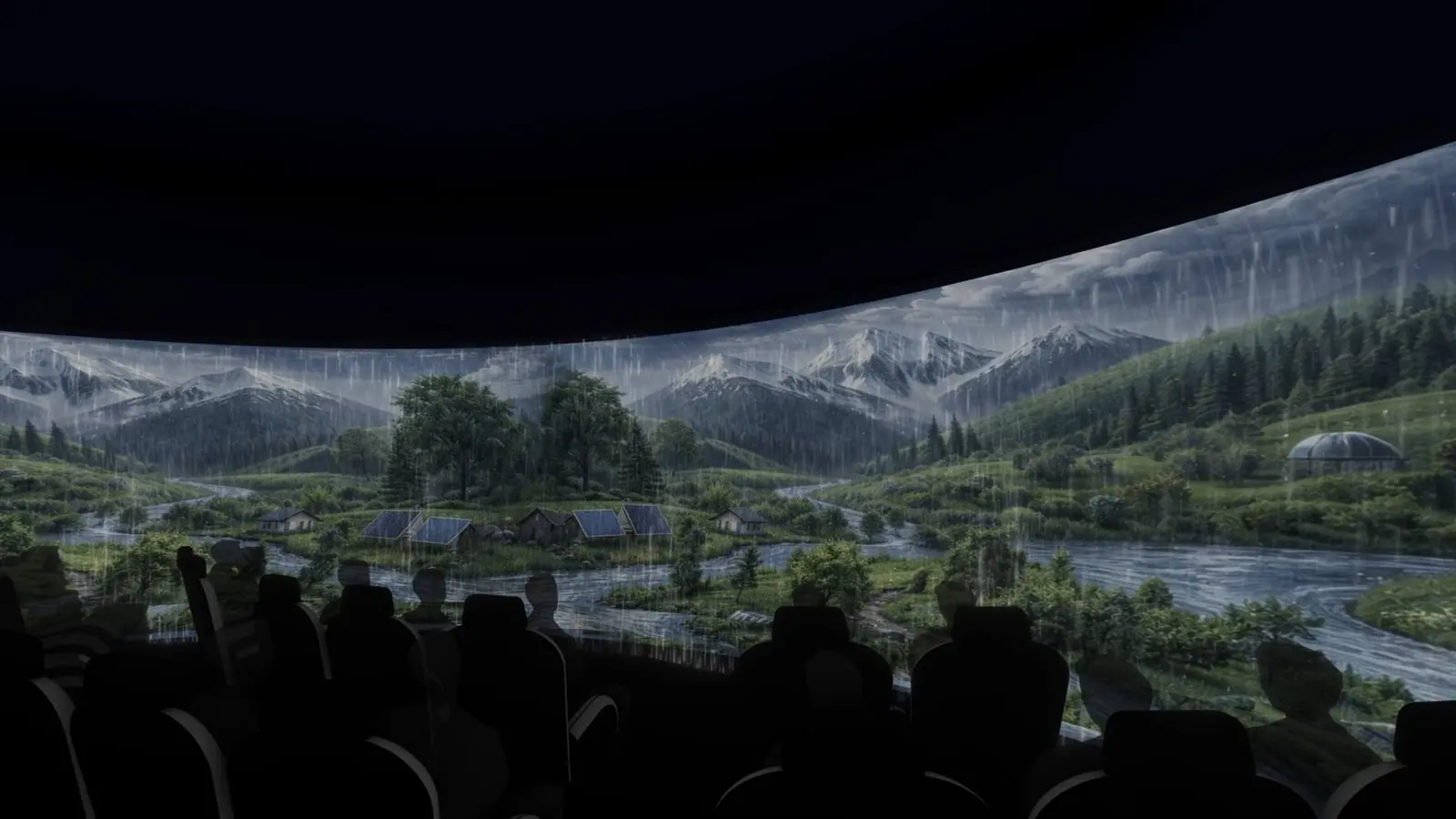
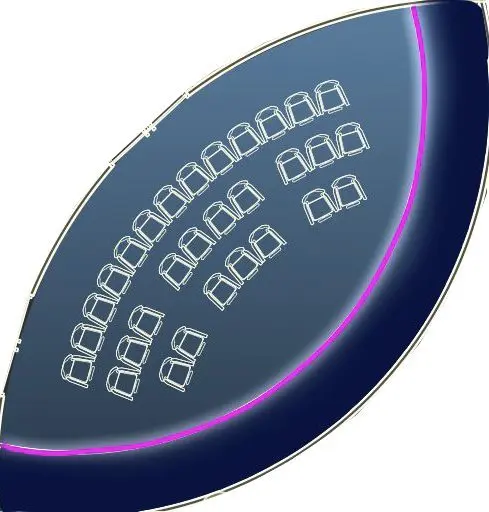
You settle into a theatre seat that lifts and moves with the film on a vast wrap-around screen. Rain falls, mist rises, smoke drifts and wind sweeps past at just the right moments. You are carried through the great cycles of the Earth, the systems of water, air and life that make our planet a home for complex living beings.
Then you take flight. You travel alongside Arctic terns on their epic journeys, and with monarch butterflies on their extraordinary migration. Their unerring navigation hints at an intelligence guiding life from within. You see how every species is joined to every other, and how the atma journeys through many forms of life.
As the film reaches its close, you discover the single intelligence that connects every living thing: the Supersoul (Paramatma), the witness in all hearts. You come to see the value of your human birth as a unique chance for spiritual growth, and the responsibility it brings to care for the Earth and all its creatures as one family.
You settle into a theatre seat that lifts and moves with the film on a vast wrap-around screen. Rain falls, mist rises, smoke drifts and wind sweeps past at just the right moments, drawing your whole body into the story.
You are carried through the great cycles of the Earth, the interlocking systems that make our planet a home for complex life. You feel them at work around you and see how much the living world depends on their steady rhythm.
The film turns to the unity of all species. You see how reincarnation joins every creature to every other, as the atma journeys through many forms of life. Vasudhaiva kuṭumbakam, the world is one family, takes on a living meaning.
You take flight with Arctic terns on their epic journeys and with monarch butterflies on their extraordinary migration. Their navigation points to an intelligence guiding life from within, the Supersoul (Paramatma), the witness in all hearts, and to the value of your human birth.
The big idea
The world is one family. Every being is connected by the Supersoul, and human life brings both a rare opportunity and a responsibility towards all other creatures.
Questions it asks
You will come away understanding
Words to know
the world is one family
the witness in all hearts
Bring it to life
Your gift brings this immersive theatre to life, with its moving seats, wind and rain, so every visitor can feel the unity of all life on Earth.
Design Habit estimate for the gallery, including GST
Sponsor this exhibitLevel 2 · What Is Life?The whole level: galleries and visitor spaces
Sponsor the levelAny amountEvery gift is recorded for this exhibit and for SMOVP
Donate to this exhibitEstimates from Design Habit (April 2026), shown in US dollars at ₹95 per US$1. Final costs are confirmed with each sponsor.
Level 3
Fly from the edge of the observable universe to the cosmic lotus and the breath of Mahāviṣṇu.
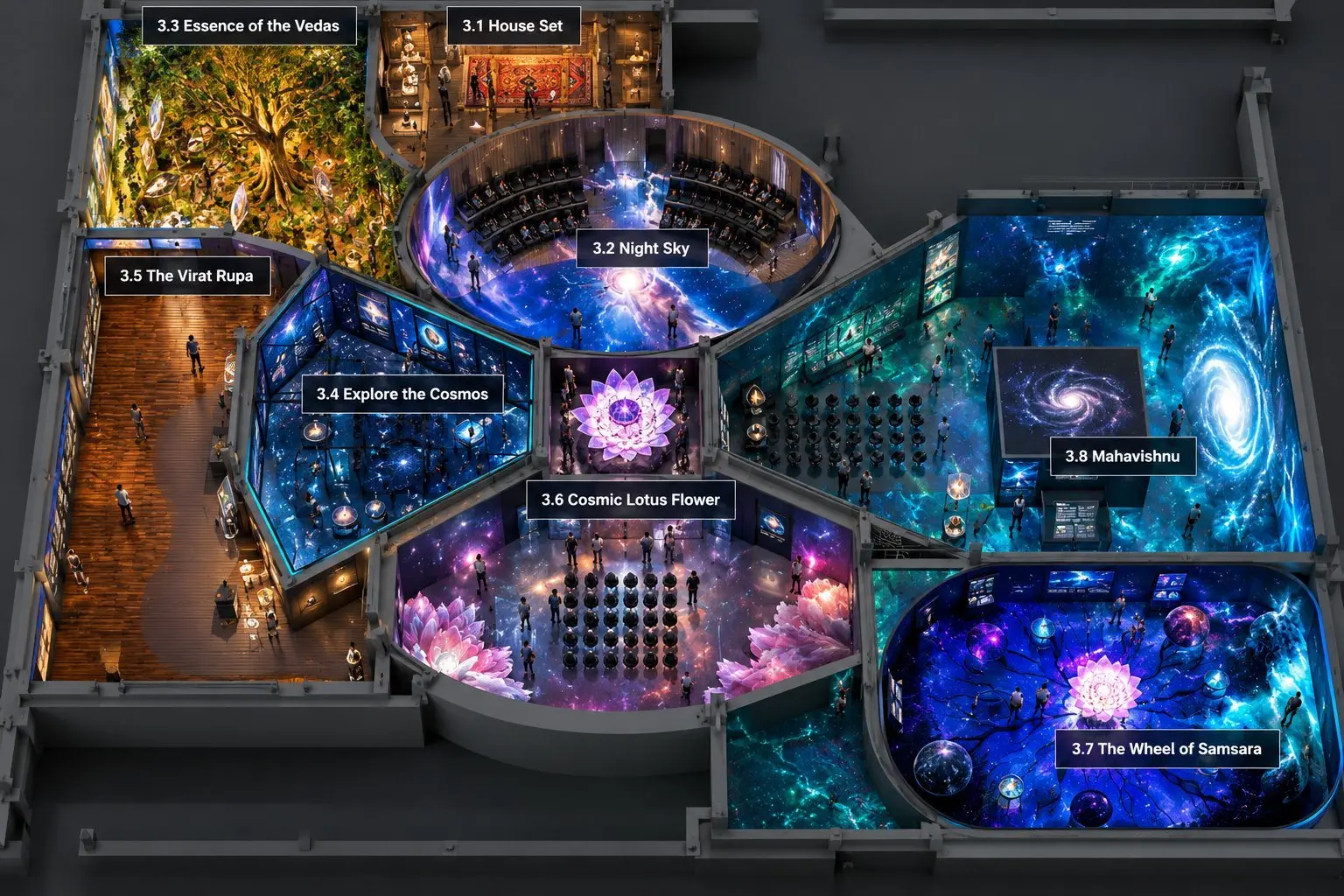
This level takes you on a journey that begins at the furthest reaches of observable space and ends in the profound Vedic vision of creation, cosmic cycles and a purpose rooted in consciousness. It opens beneath the night sky and then flies through the universe, past supernovae, galaxies and vast superclusters, marvelling at cosmic fine-tuning: the world around us is so precisely tuned for life that even the smallest change in our distance from the Sun or the speed of light would make it hostile to intelligent life. Here scientific theories begin to break down the closer we get to the origin, and you are invited to ponder the limits of observation and the growing sense that something more fundamental than space-time lies at the root of reality. From this turning point the level moves into the Vedic framework of the cosmos. Before creation, raw potential (pradhāna) awaits activation by time (kāla), and the Virāṭ-rūpa emerges.
As the Virāṭ-rūpa manifests, the living information structure of the universe, you see yourself included in its design, a reminder that every atma (jīva) takes part in shaping the cosmos. This flows into the Cosmic Lotus, where Brahmā, the architect of our brahmāṇḍa, awakens to his purpose. With the devas, prajāpatis and atmas he orchestrates the inverted tree, an image of universal design through conscious co-creation, explored further in the Wheel of Saṁsāra, where you begin to see how temporary every experience within the brahmāṇḍa is, how endless our search for happiness can be, and why the human birth is so precious. The journey culminates with Mahāviṣṇu, within whose vast meditative form universes appear and dissolve, each breath containing countless brahmāṇḍas. It ends in contemplative silence, inviting reflection, inner stillness and a glimpse of existence beyond material embodiment.
3.1
An elevator rises through clouds to a Himalayan clearing and the narrator's mountain home of star charts and instruments, where the cosmic journey begins.
Discover and supportClose ×Rise through the clouds to a mountain home where the exploration of the cosmos begins.
What you will experience
You step into an elevator that begins to rise through dusk-lit clouds. As you ascend, you hear the voice of an astronomer who has spent his life studying the universe. He has just encountered the idea of revealed knowledge, and he shares his awe and his doubts as the clouds part around you.
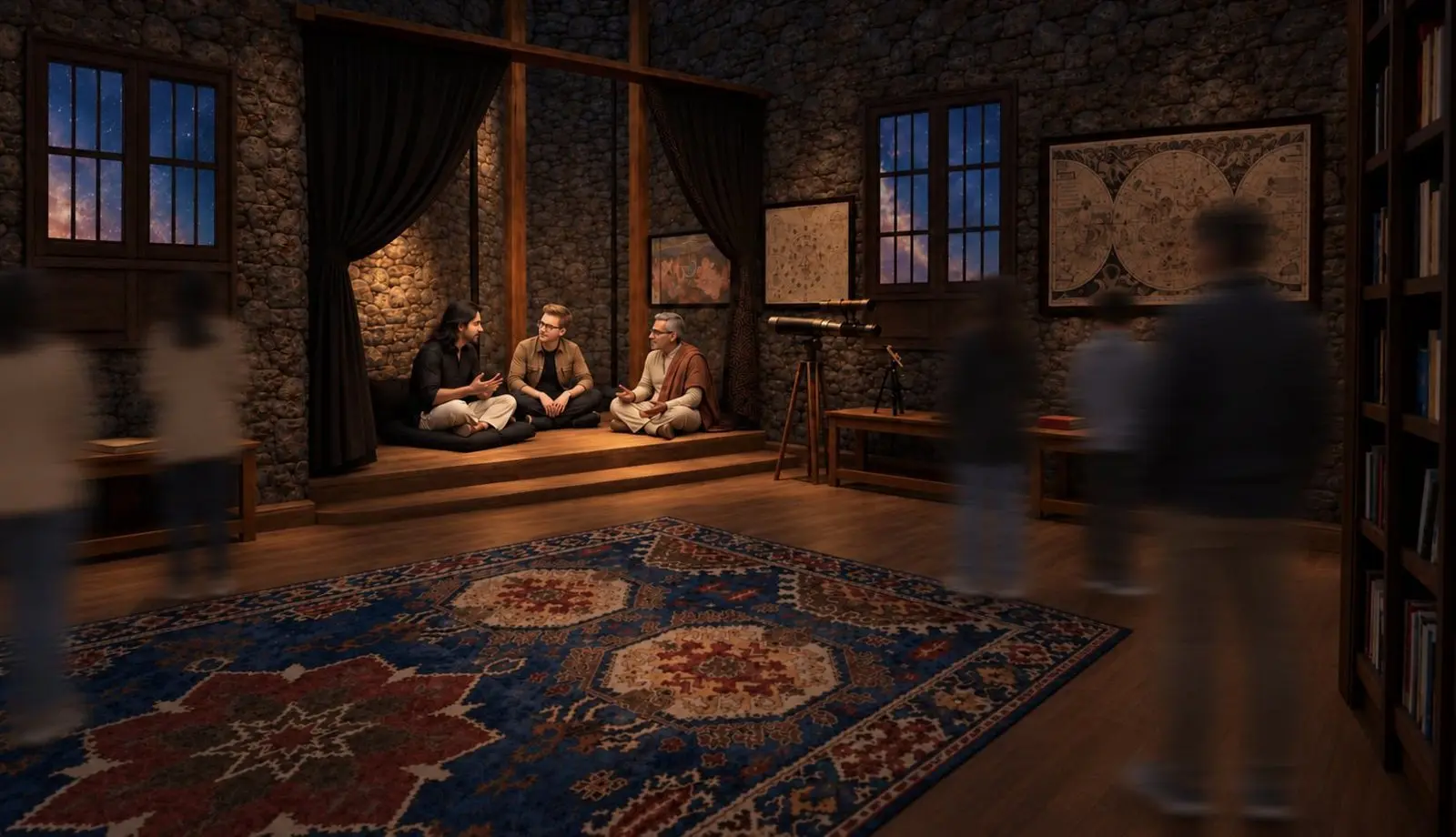
The doors open into a clearing high in the Himalayas, and into the narrator's mountain home. The study contains astronomy equipment and present-day and Vedic-era star charts, with windows overlooking the peaks. Bookshelves hold works of astronomy, science and Vedic texts, side by side.
Posters on the walls celebrate the wonders of the sky: pulsars, the elegant rhythm of Jupiter's moons Io, Europa and Ganymede, the Sun's eleven-year cycle and the faint afterglow of the early universe. Here, between the astronomer's questions and the narrator's openness, your exploration of the cosmos as described in the Bhāgavata Purāṇa begins.
You step into an elevator that rises through dusk-lit clouds. As you ascend, you hear the voice of an astronomer who has spent his life studying the universe and has just encountered the idea of revealed knowledge. He shares his awe and his doubts.
The doors open onto a Himalayan clearing and into the narrator's home. His study holds astronomy equipment, present-day and Vedic-era star charts, and windows overlooking the mountains. Bookshelves place works of astronomy and science side by side with Vedic texts.
Posters celebrate wonders of the sky: pulsars, the 1:2:4 orbital rhythm of Io, Europa and Ganymede, the Sun's eleven-year cycle and the faint afterglow of the early universe. Between the astronomer's questions and the narrator's openness, your exploration of the Bhāgavata Purāṇa's cosmos begins.
The big idea
A contemplative passage from the questions of the self to the questions of the cosmos, where an astronomer's awe and doubt meet the narrator's openness to revealed knowledge.
Questions it asks
You will come away understanding
Words to know
revealed, non-human testimony; Vedic knowledge
the scripture also known as the Śrīmad-Bhāgavatam
Bring it to life
Your support builds this rising elevator and the narrator's mountain study, a peaceful threshold to the wonders of the universe.
Design Habit estimate for the gallery, including GST
Sponsor this exhibitLevel 3 · Where Am I?The whole level: galleries and visitor spaces
Sponsor the levelAny amountEvery gift is recorded for this exhibit and for SMOVP
Donate to this exhibitEstimates from Design Habit (April 2026), shown in US dollars at ₹95 per US$1. Final costs are confirmed with each sponsor.
3.2
Under the dome, the ancient sky turns around Dhruva, the Pole Star, as the Seven Sages circle and the harmony between the heavens and human life is revealed.
Discover and supportClose ×Beneath the ancient sky, watch the stars turn around Dhruva, the Pole Star.
What you will experience
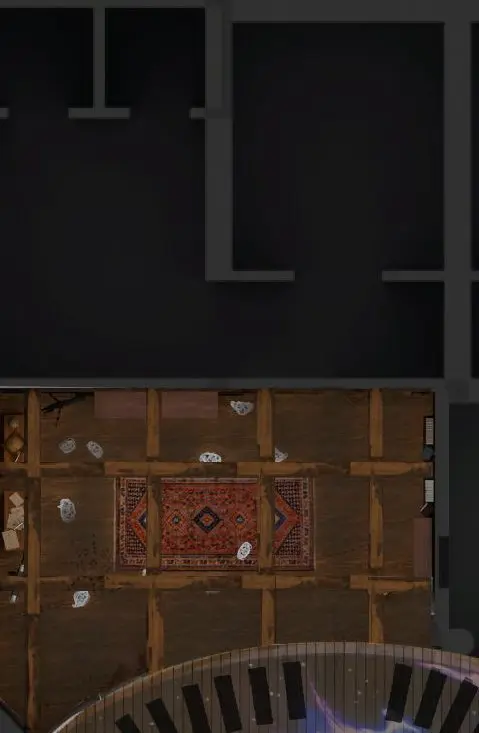
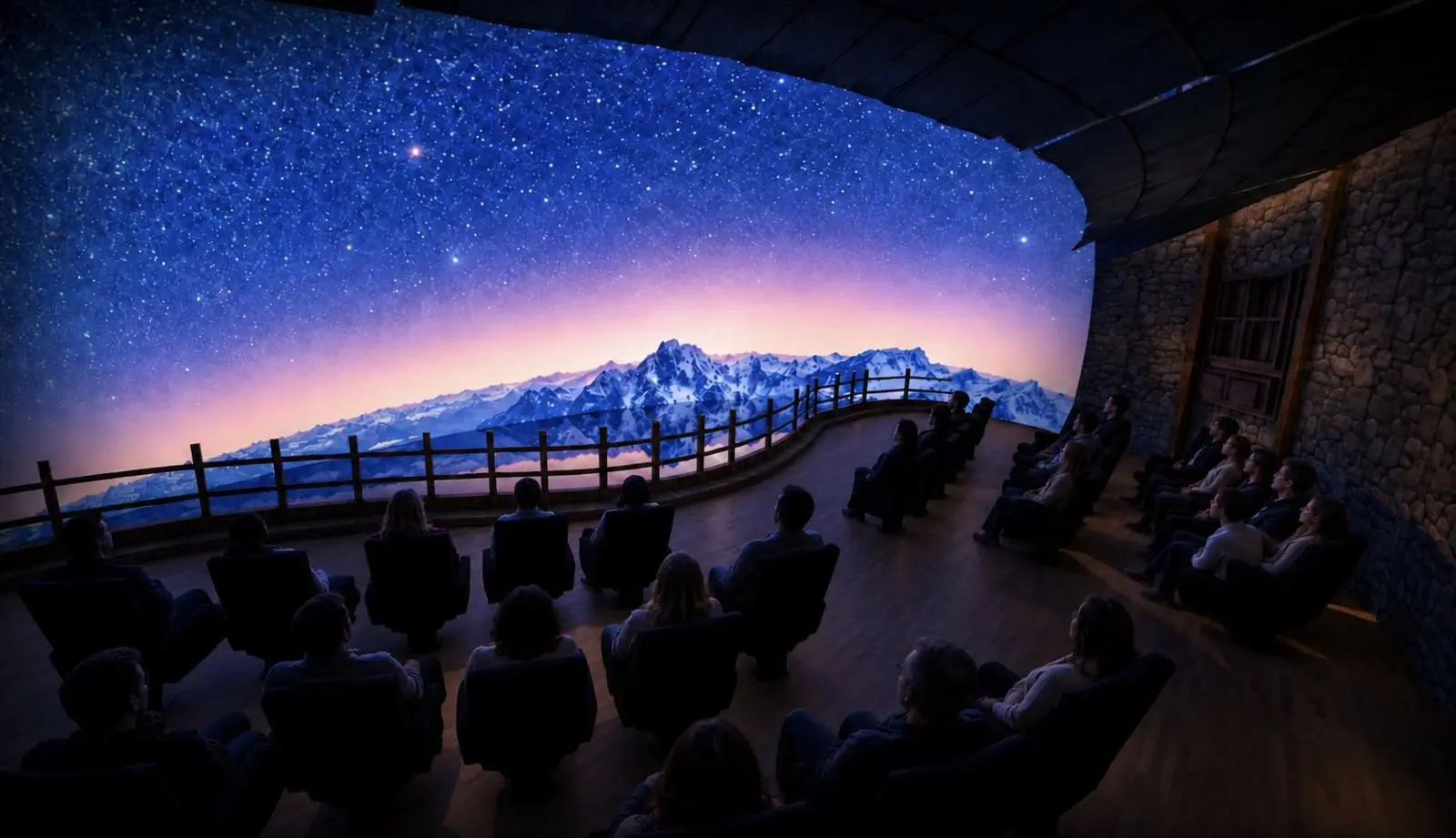
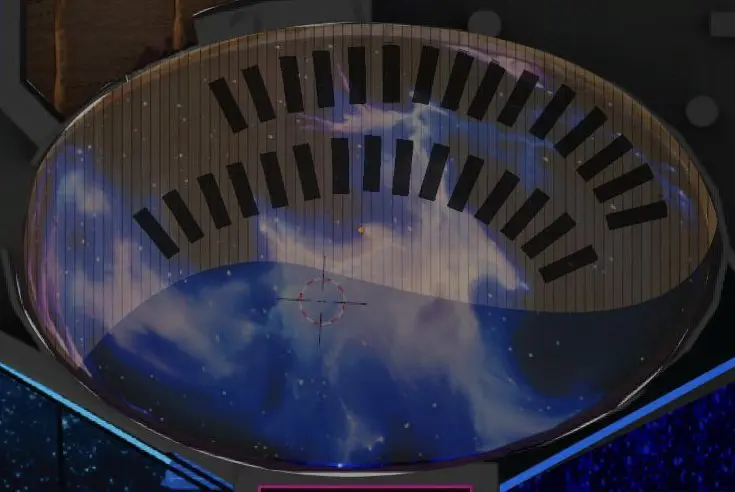
You enter the dome and take your place on the deck. Above you spreads the ancient night sky, and beneath you the Earth is partly visible, grounding you in the sense of standing on our planet and looking out. Natural night sounds rise around you as your eyes adjust to the darkness.
Gentle narration helps you find your bearings: east, west and south. Then, slowly, the stars begin to turn. You watch the whole sky rotate around a single fixed point, Dhruva, the Pole Star, just as sky-watchers did for thousands of years.
Close to the pole, the Seven Sages circle in their timeless ritual motion. You experience the sky not as a distant picture but as a living rhythm, and sense the harmony between the way we live and the cycles we see above us.
You enter the dome and take your seat on the deck. The ancient night sky spreads above you, and beneath you the Earth is partly visible, grounding you on our planet. Natural night sounds rise around you as your eyes adjust to the dark.
Gentle narration helps you find your bearings in the sky: east, west and south. You begin to read the heavens as the ancients did, as an embodied and grounded experience rather than a distant picture on a screen.
Slowly the stars begin to turn. The whole sky rotates around a single fixed point, Dhruva, the Pole Star, and nearby the Sapta Ṛṣis, the Seven Sages, circle in ritual motion. You sense the living rhythm of the heavens above you.
The big idea
Watching the sky as the ancients did reveals its rhythms and orientation, and the harmony between human life and the cycles of the heavens.
Questions it asks
You will come away understanding
Words to know
the Pole Star, the fixed point around which the sky turns
the seven sages, seen as the stars circling the pole
Bring it to life
Your gift fills this dome with the turning ancient sky, giving every visitor an embodied experience of the heavens as our ancestors knew them.
Design Habit estimate for the gallery, including GST
Sponsor this exhibitLevel 3 · Where Am I?The whole level: galleries and visitor spaces
Sponsor the levelAny amountEvery gift is recorded for this exhibit and for SMOVP
Donate to this exhibitEstimates from Design Habit (April 2026), shown in US dollars at ₹95 per US$1. Final costs are confirmed with each sponsor.
3.3
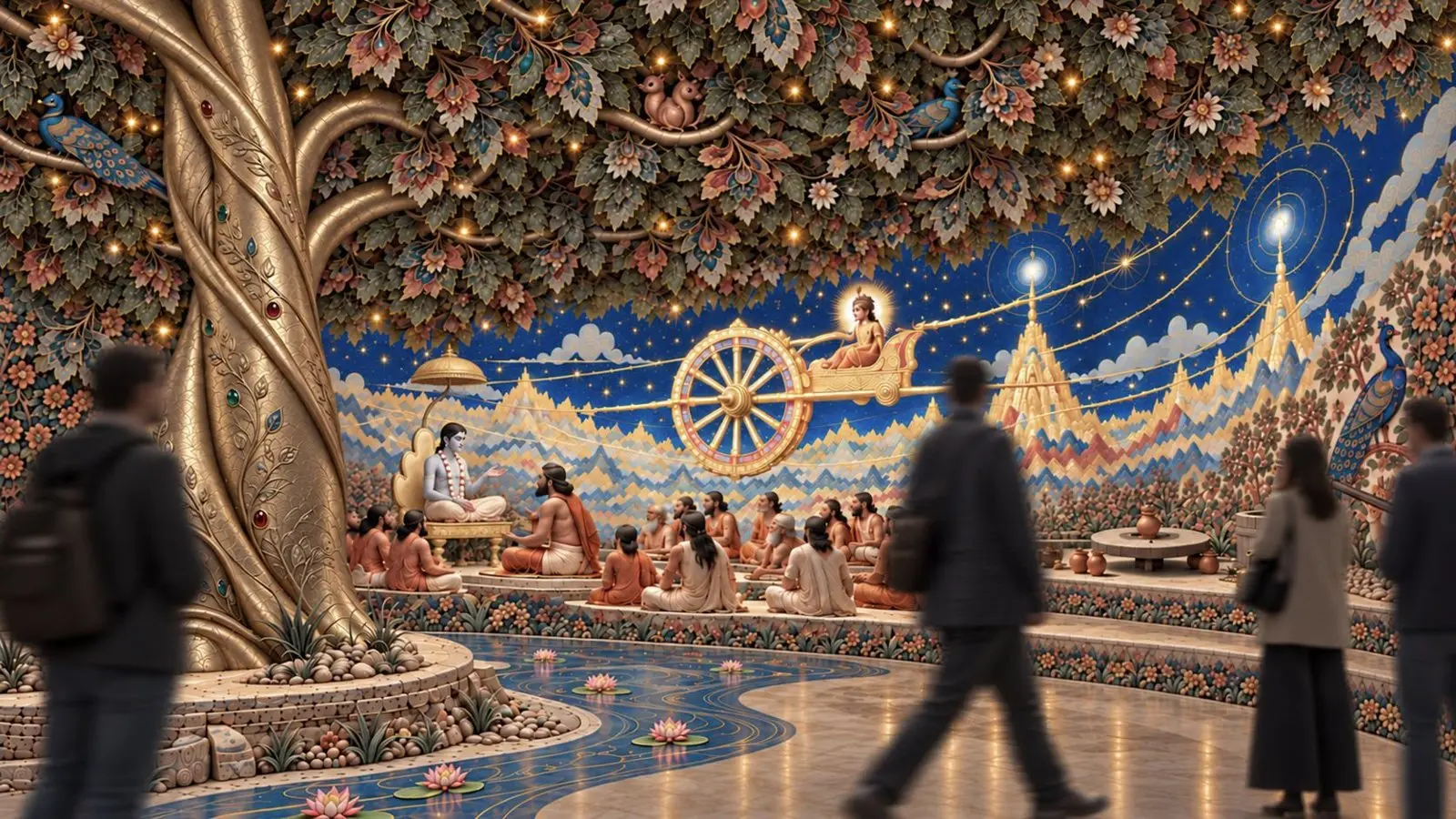
On a riverbank, witness the dialogue between King Parīkṣit and the sage Śukadeva: the questions and answers at the heart of the Bhāgavatam.
Discover and supportClose ×On the banks of the Ganges, hear a dying king ask the greatest questions.
What you will experience
You arrive on the banks of the Ganges. Here King Parīkṣit, facing his own imminent death, sits before the sage Śukadeva. With little time left, the king asks the deepest questions of existence, and the sage answers. This is the conversation at the heart of the Bhāgavatam.
As the dialogue unfolds, the narrator links its verses and analogies to the ideas of modern science and philosophy. Questions about the cosmos, the self and the purpose of life are harmonised into a single picture, with the Supersoul as the primeval consciousness at its centre.
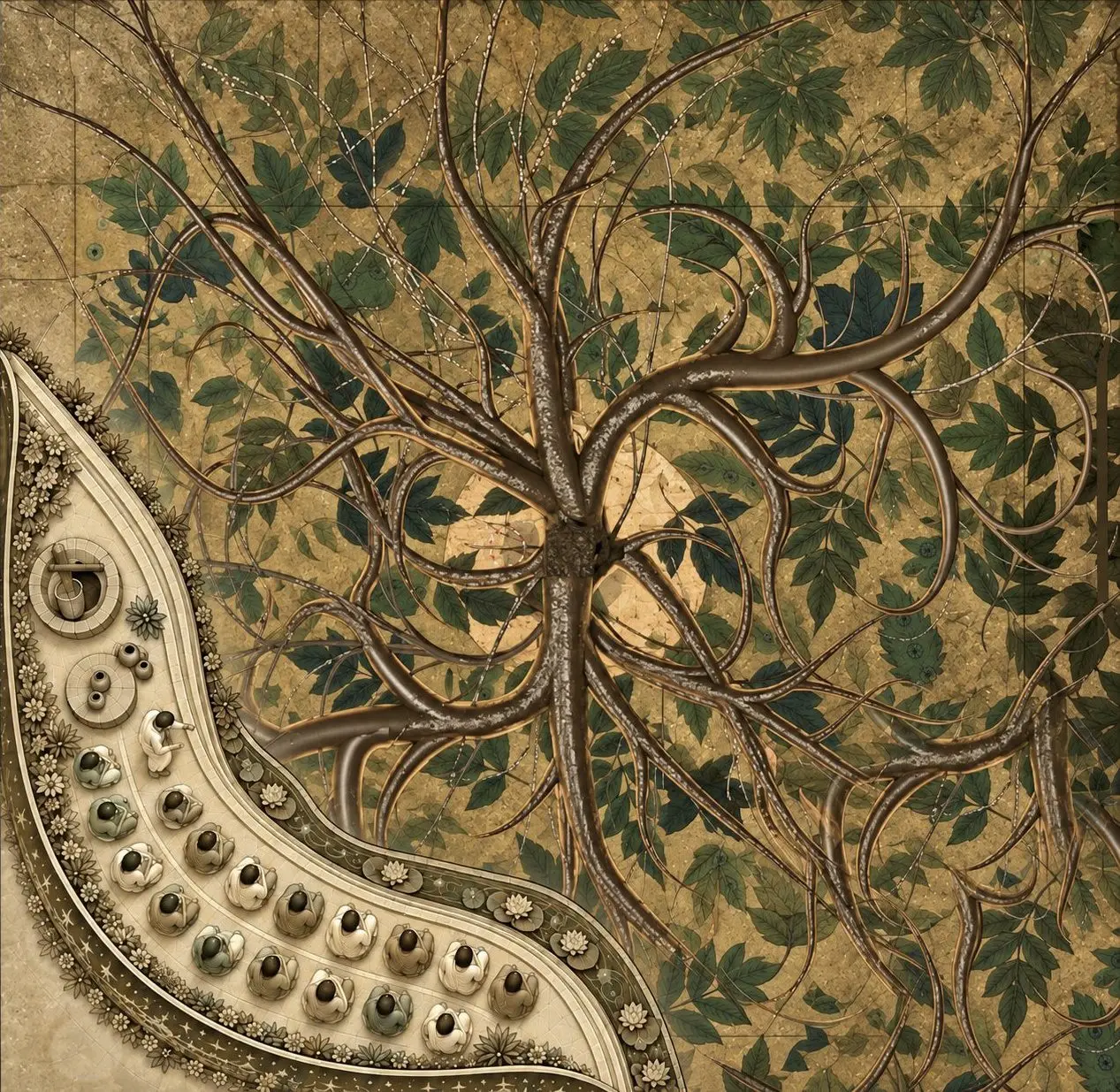
All around you, a hand-painted Kalamkari tree and traditional mural backdrops surround the scene with imagery drawn from India's artistic heritage. You sit among them as a listener, invited to ask the same questions as the king.
You arrive on a dramatised riverbank where King Parīkṣit sits before the sage Śukadeva. Painted mural backdrops and digital imagery surround the scene, and you take your place as a listener to the conversation at the heart of the Bhāgavatam.
The king asks the deepest questions of existence, and the sage answers. You hear their exchange unfold, verse by verse, as questions about the cosmos, the self and the purpose of life are posed and answered before you.
The narrator links the verses and analogies of the dialogue to modern concepts in science and philosophy. Beneath a hand-painted Kalamkari tree, you are invited to ask the same questions as the king and to see how they still speak today.
The big idea
The profound questions of existence posed by King Parīkṣit and answered by Śukadeva bring timeless wisdom and modern ideas together in one holistic picture.
Questions it asks
You will come away understanding
Words to know
the scripture recording the dialogue of King Parīkṣit and Śukadeva
the narrator who guides visitors through the museum
Bring it to life
Your support brings this riverbank scene and its hand-painted Kalamkari tree to life, giving every visitor a seat at one of history's great conversations.
Design Habit estimate for the gallery, including GST
Sponsor this exhibitLevel 3 · Where Am I?The whole level: galleries and visitor spaces
Sponsor the levelAny amountEvery gift is recorded for this exhibit and for SMOVP
Donate to this exhibitEstimates from Design Habit (April 2026), shown in US dollars at ₹95 per US$1. Final costs are confirmed with each sponsor.
3.4
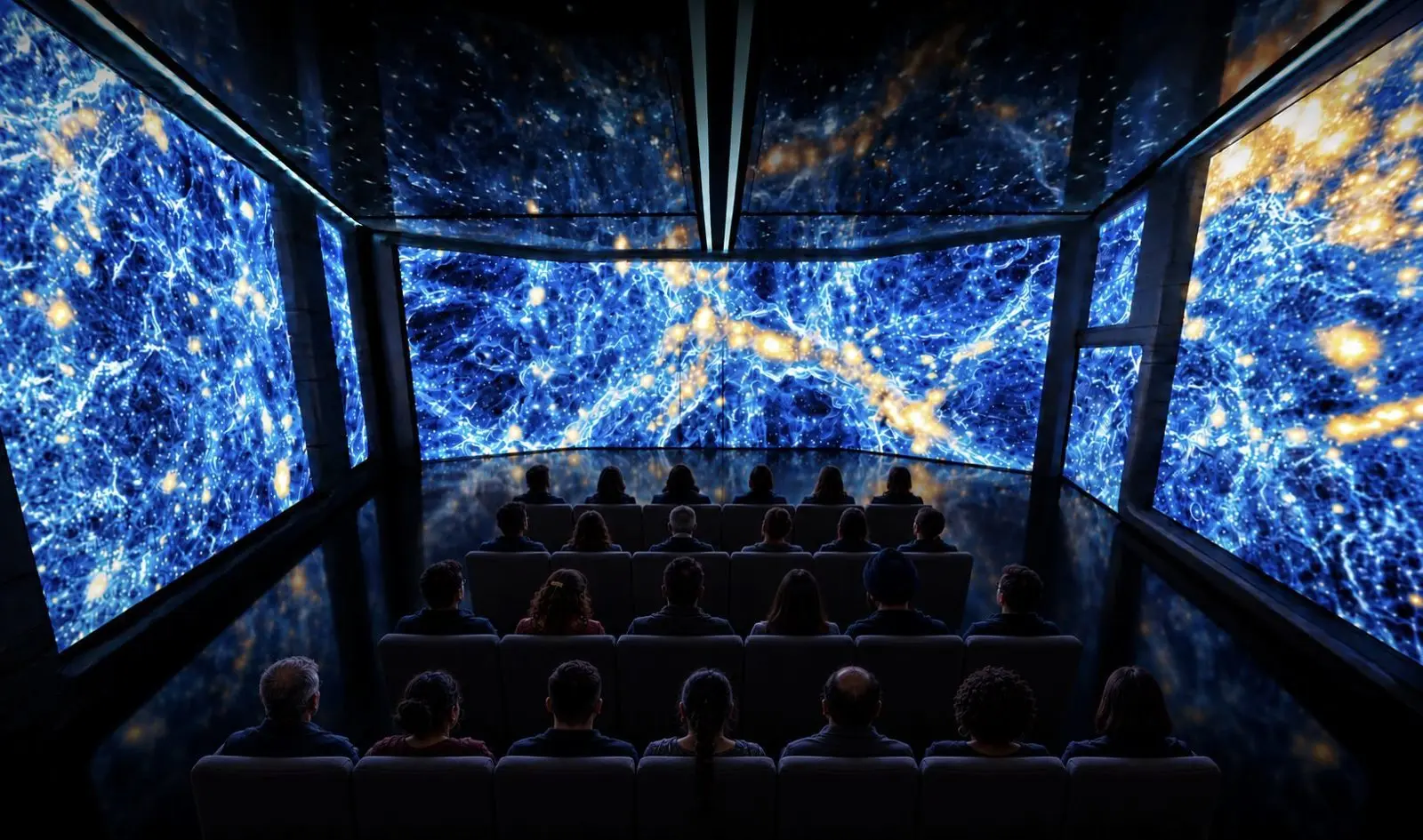
A simulation built from real astronomical data carries you to the cosmic web and back towards the Big Bang, until at the singularity science itself falls silent.
Discover and supportClose ×Leave Earth behind and fly to the edge of the known universe, and back in time.
What you will experience
A darkened chamber opens into a breathtaking simulation built from real astronomical data. You leave Earth and cross the boundary of the solar system, then sail onward into the starfields of the Milky Way, our home galaxy, spread out around you in all its shimmering glory. Familiar points of light become suns.
You witness supernovae, the explosive deaths of stars that scatter the elements of life across space. You pass black holes and travel on, until whole galaxies become points of light woven into the vast cosmic web. At every scale, you marvel at how finely the universe seems tuned for life.
Then telescopes become time machines. Looking further means looking back, and you travel towards the early universe and its faint afterglow, nearer and nearer to the Big Bang. At the singularity, the laws of physics break down. You are left with a striking thought: something more fundamental than space and time may lie at the root of reality.
A darkened chamber opens into a simulation built from real astronomical data. You leave Earth behind and cross the boundary of the solar system into the open space beyond, where familiar points of light become distant suns.
You sail into the starfields of the Milky Way, our home galaxy, spread out around you in shimmering glory. You begin to sense its scale, and how finely tuned our place within it seems for intelligent life.
You witness supernovae, the explosive deaths of stars, scattering across space the elements that later form planets and living things. You realise that the stuff of your own body was once forged inside the stars.
You travel past black holes, where gravity grows so strong that even light cannot escape. Built from real astronomical data, the simulation brings you close to these extremes, and you marvel at what the universe holds.
You travel on until whole galaxies become points of light woven into the vast cosmic web. At every scale you marvel at how finely the universe seems tuned, where even small changes would make the world unfavourable for intelligent life.
Telescopes become time machines: looking further means looking back. You travel towards the early universe, nearer and nearer to the Big Bang, until at the singularity the laws of physics break down. Something more fundamental than space and time may lie beneath reality.
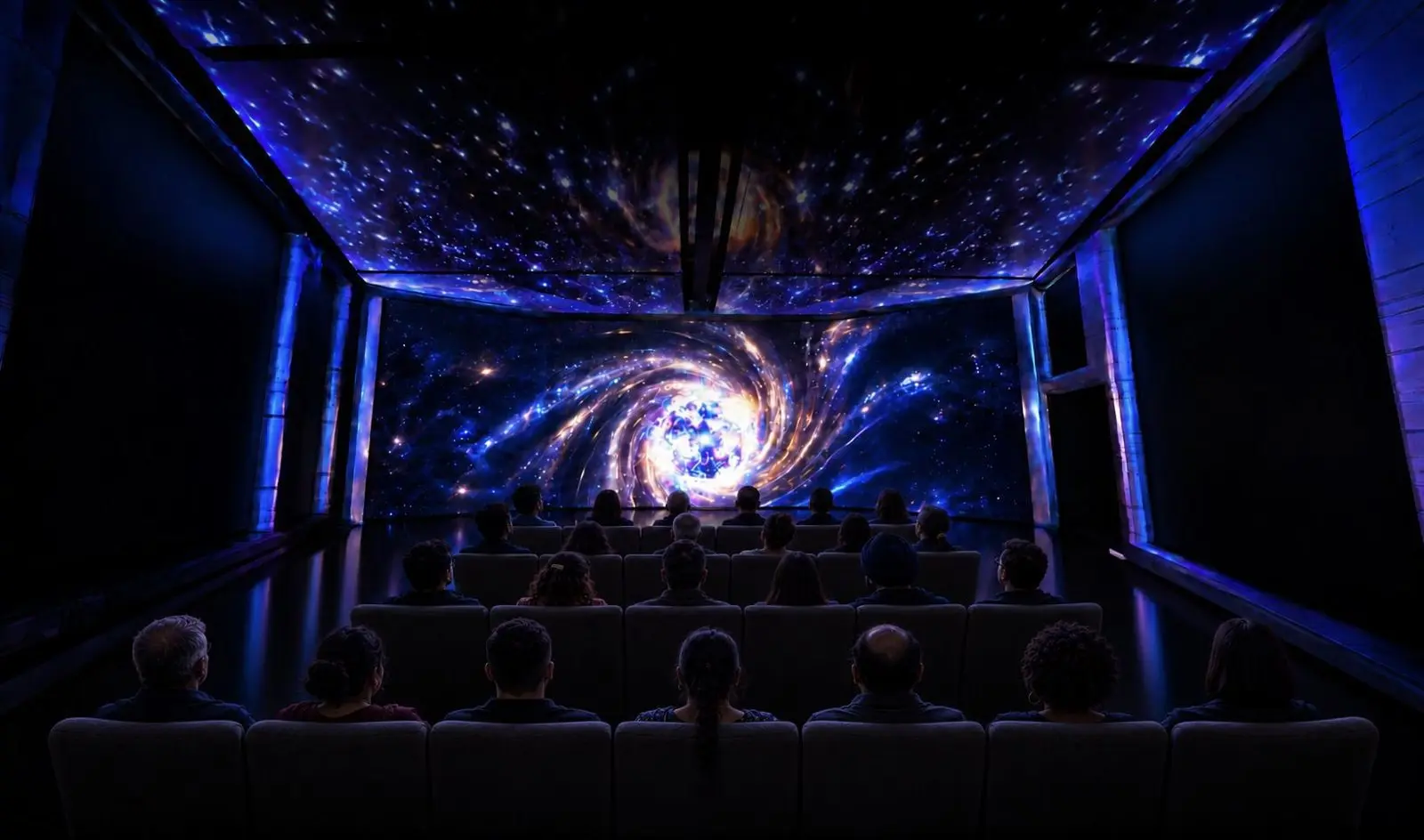
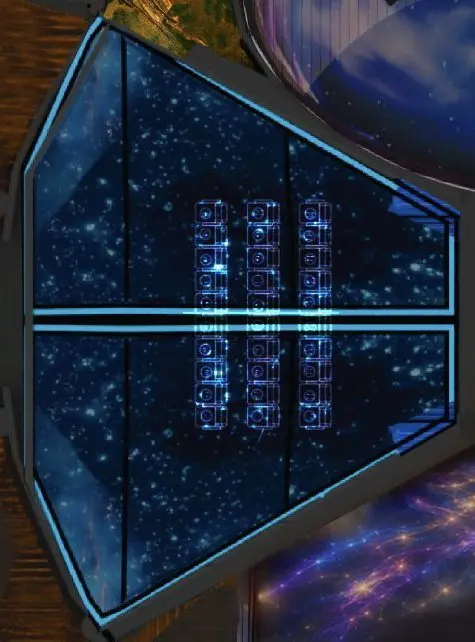
The big idea
The universe is finely tuned at every scale, and as science approaches the origin, its theories break down, suggesting something deeper than space and time.
Questions it asks
You will come away understanding
Bring it to life
Your gift powers this journey through the cosmos, letting every visitor travel from Earth to the edge of the universe and to the very limits of science.
Design Habit estimate for the gallery, including GST
Sponsor this exhibitLevel 3 · Where Am I?The whole level: galleries and visitor spaces
Sponsor the levelAny amountEvery gift is recorded for this exhibit and for SMOVP
Donate to this exhibitEstimates from Design Habit (April 2026), shown in US dollars at ₹95 per US$1. Final costs are confirmed with each sponsor.
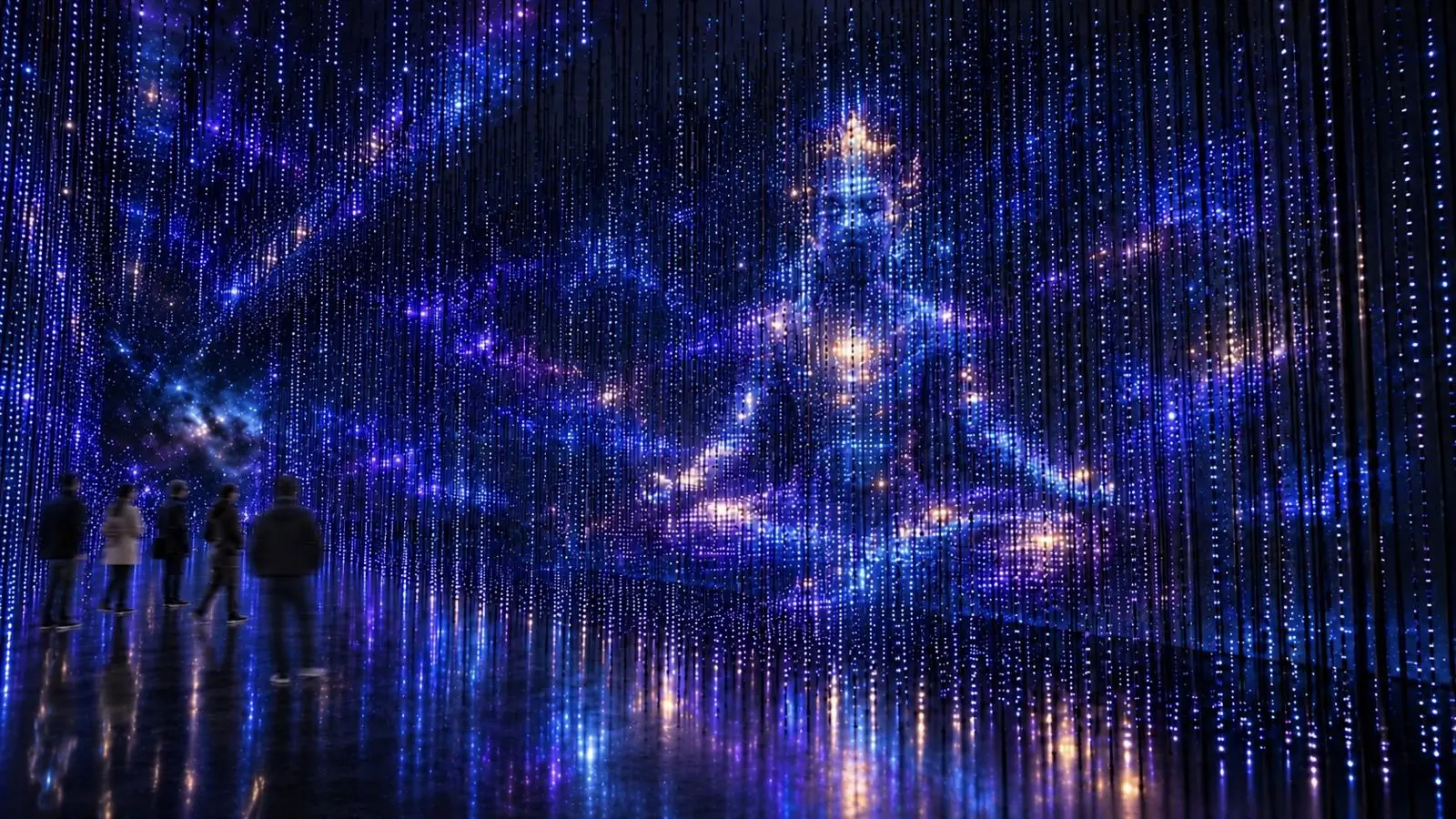
3.5
In a mirrored infinity room, a vast cosmic person appears in meditation, the living architecture of existence, and you find your own place within it.
Discover and supportClose ×Enter the time before matter, and watch the cosmic person emerge in meditation.
What you will experience
You step into a mirrored infinity room. Reflections stretch away endlessly in every direction, and sound and abstract light evoke the state before matter existed: a timeless substrate of pure potential, waiting. Time begins to stir it into motion.
With the vibration of OM, forms begin to emerge from that potential. Patterns gather and grow until a vast cosmic person appears, seated in meditation: the Virāṭ-rūpa, the architecture of existence, the living information structure of the universe. Within this form, the laws of nature arise and the framework for life and consciousness is set in place.
Then you discover something remarkable: your own place within it. Each atma, with its desires and its karma, was part of the design from the very beginning. Before you leave, you are invited to imprint your own intention within the cosmic form, a reminder that the universe is a participatory creation, guided by the Supersoul (Paramatma).
You step into a mirrored infinity room. Reflections stretch away endlessly, and sound and abstract light evoke the state before matter: pradhāna, raw potential, waiting to be set in motion by kāla, time. You stand at the edge of creation.
With the vibration of OM, forms begin to emerge from pure potential. You hear and feel the sound fill the room as patterns gather and grow around you, giving shape to what was formless only a moment before.
A vast cosmic person appears, seated in meditation: the Virāṭ-rūpa, the architecture of existence and the living information structure of the universe. Within this form the laws of nature arise, establishing a purposeful framework for life and consciousness.
You discover your own place within the cosmic form. Each atma, with its desires and karma, was part of the design from the beginning. Before leaving, you imprint your intention within it, sharing in a participatory creation guided by the Supersoul (Paramatma).
The big idea
Information precedes matter. The laws of nature arise within the cosmic form, and every atma has a place in a purposeful, participatory universe guided by the Supersoul.
Questions it asks
You will come away understanding
Words to know
the cosmic person; the living information structure of the universe
raw potential of matter before creation
time
the individual soul
Bring it to life
Your support creates this infinite mirrored space and the emergence of the cosmic form, offering every visitor a glimpse of the universe before time began.
Design Habit estimate for the gallery, including GST
Sponsor this exhibitLevel 3 · Where Am I?The whole level: galleries and visitor spaces
Sponsor the levelAny amountEvery gift is recorded for this exhibit and for SMOVP
Donate to this exhibitEstimates from Design Habit (April 2026), shown in US dollars at ₹95 per US$1. Final costs are confirmed with each sponsor.
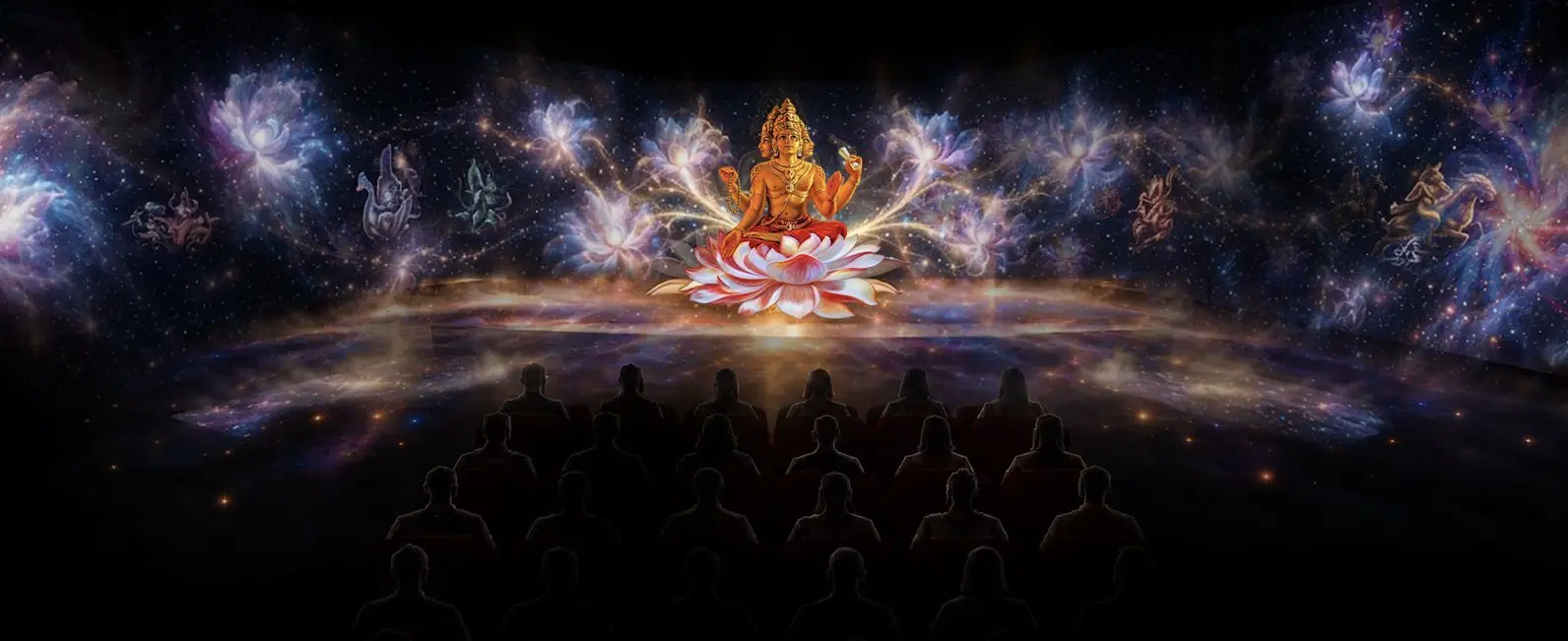
3.6
A lotus rises and opens to reveal Brahmā, the engineer of the cosmos, who arranges the fourteen worlds into a living tree.
Discover and supportClose ×A lotus blossoms, Brahmā awakens, and the fourteen worlds take shape.
What you will experience
In darkness, the cosmic egg appears. From the seated cosmic form, a lotus bud slowly rises. As it blossoms, a monumental figure of Brahmā is revealed at its heart, the first living being of the universe. He looks around him, searching for his own origins, unsure where he has come from or what he is meant to do.
Then the word tapaḥ sounds, once and then again. Brahmā turns inward and enters deep meditation. Empowered from within, he understands his purpose as the engineer of the universe. You learn that he can create only because the Supersoul (Paramatma) has entered the heart of the cosmic form, just as the atma brings a body to life.
Brahmā sets to work. Before your eyes he assembles the fourteen worlds into a living chandelier, an inverted banyan tree, from the radiant higher planes at the top, through the earthly realms, to the depths of the lower worlds. Then a vast cosmic zoom-out carries you onward to see the whole design in its place.
In darkness, the brahmāṇḍa, the cosmic egg, appears. From the seated cosmic form a lotus bud slowly rises, and as it blossoms a monumental figure of Brahmā is revealed at its heart, the first living being of the universe.
Brahmā looks around him, searching for his own origins. Unsure where he has come from or what he is meant to do, he gazes across the darkness, and you share his wonder at waking into a vast, unexplained cosmos.
The word tapaḥ sounds once, and then again. Brahmā turns inward and enters deep meditation. Empowered from within, he understands his purpose as the engineer of the universe, able to create because the Supersoul (Paramatma) has entered the heart of the cosmic form.
Brahmā assembles the fourteen worlds into a living chandelier, an inverted banyan tree: sattvic upper planes beginning with Brahmāloka, rajasic earthly worlds and tamasic subterranean realms. Then a vast cosmic zoom-out carries you onward to see the whole design in place.
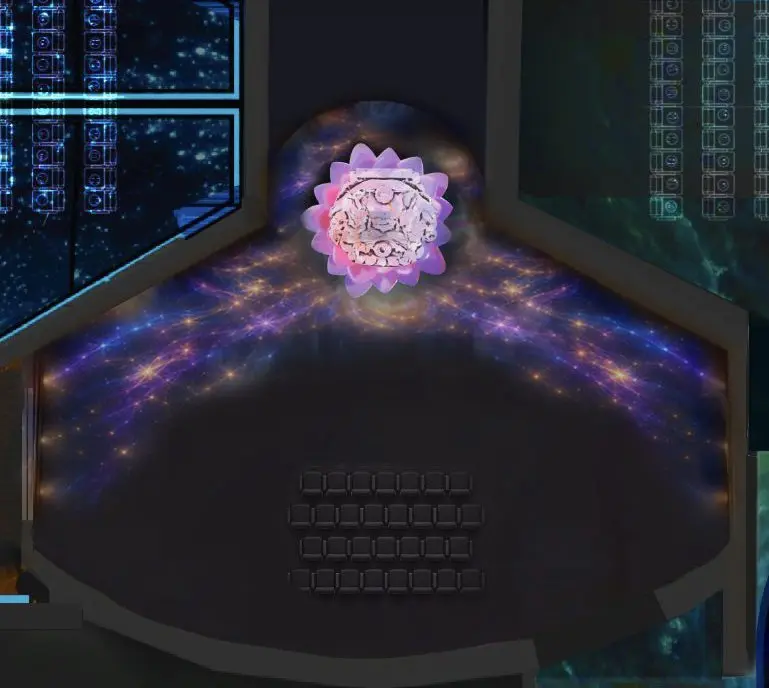
The big idea
Brahmā shapes the universe through meditation and conscious co-creation, empowered by the Supersoul, arranging the fourteen worlds for different levels of consciousness.
Questions it asks
You will come away understanding
Words to know
the cosmic egg; a single universe
austerity; the word that calls Brahmā into meditation
a world or realm; the universe holds fourteen
the first living being of the universe, its engineer
Bring it to life
Your gift brings the blossoming lotus and the monumental figure of Brahmā to life, letting every visitor witness the moment the universe takes shape.
Design Habit estimate for the gallery, including GST
Sponsor this exhibitLevel 3 · Where Am I?The whole level: galleries and visitor spaces
Sponsor the levelAny amountEvery gift is recorded for this exhibit and for SMOVP
Donate to this exhibitEstimates from Design Habit (April 2026), shown in US dollars at ₹95 per US$1. Final costs are confirmed with each sponsor.
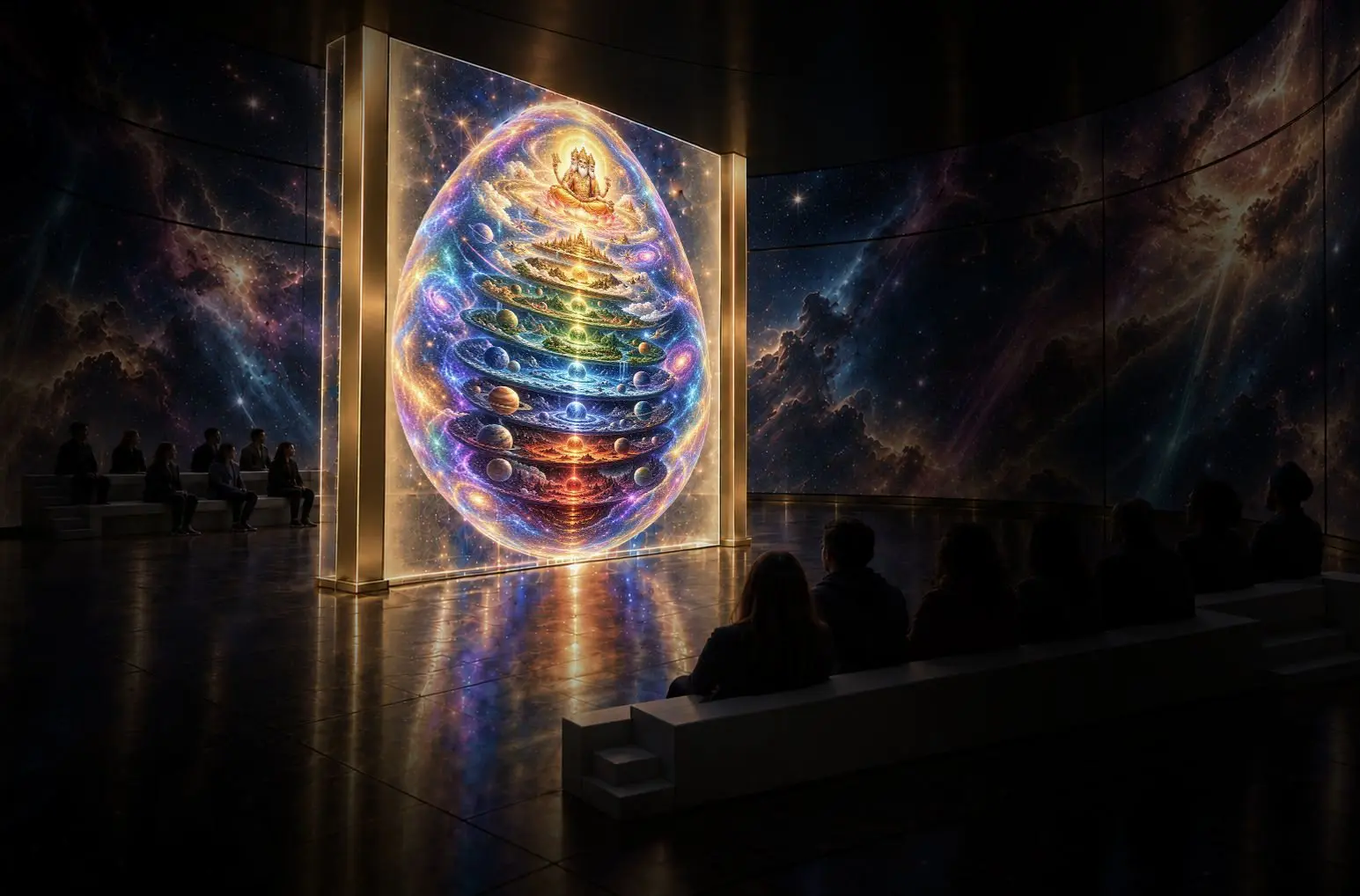
3.7
An inverted tree of worlds carries you from Earth to the heavens and back: the passing nature of every experience, and the precious gift of a human birth.
Discover and supportClose ×Journey through the fourteen worlds, and discover why no place here lasts forever.
What you will experience
You enter a space where an inverted tree stands between glass panels. Its roots reach upward and its branches spread below, and the panels around it explain what each branch represents: the fourteen worlds of the universe, grouped in five tiers. You take time to find your way around this map of existence.
Then the journey begins. Projections on the walls and floor carry you through those worlds. You rise from Earth up to the heavenly realms, with their beauty and long lives, then return to Earth again. You descend to the subterranean heavens hidden below, and finally come home. You are shown these places as a picture of the atma's journey.
Everywhere you go, one thing remains the same: every experience in the universe is temporary. The heavens are wonderful but not forever, and the search for lasting happiness continues. The exhibit invites you to reflect on this endless quest, and on the special value of human birth as the opportunity to step beyond the wheel altogether.
You enter a space where an inverted tree stands between glass panels, its roots above and its branches below. The panels explain what each branch represents: the fourteen worlds of the universe, grouped in five tiers, a map of existence to explore.
Projections on the walls and floor begin to carry you. You rise from Bhū-maṇḍala, the Earth, up through the heavenly realms of Svarga in all their beauty, before returning once more to Earth. You are shown these places as a picture of the atma's journey.
The journey then descends to Bila-svarga, the subterranean heavens hidden below the Earth, and finally brings you home to Bhū-maṇḍala. You have travelled the whole route through the worlds and returned to where you began.
Everywhere you go, one thing remains the same: every experience in the universe is temporary. The search for lasting happiness goes on, and you are invited to reflect on the special value of human birth as the chance to step beyond the wheel.
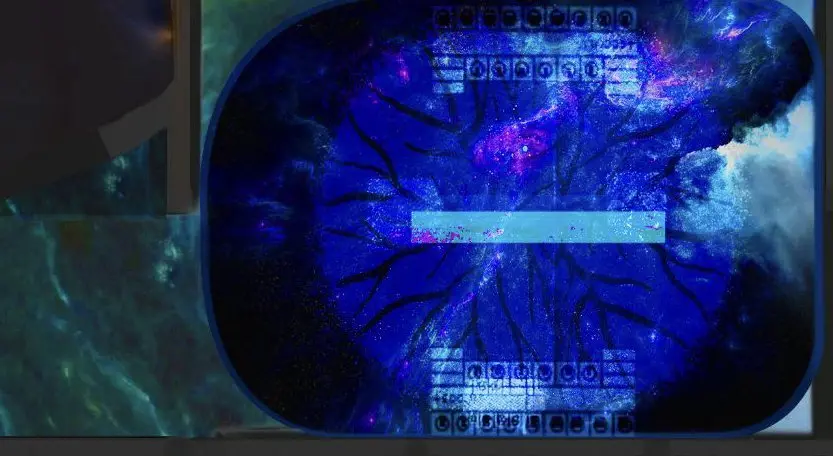
The big idea
Every experience within the universe is temporary. Our endless search for happiness points to the precious value of human birth.
Questions it asks
You will come away understanding
Words to know
the wheel of repeated birth and death
the Earth plane
the heavenly realms
the subterranean heavens
Bring it to life
Your support brings this inverted tree and its journey through the worlds to life, inviting every visitor to reflect on what truly lasts.
Design Habit estimate for the gallery, including GST
Sponsor this exhibitLevel 3 · Where Am I?The whole level: galleries and visitor spaces
Sponsor the levelAny amountEvery gift is recorded for this exhibit and for SMOVP
Donate to this exhibitEstimates from Design Habit (April 2026), shown in US dollars at ₹95 per US$1. Final costs are confirmed with each sponsor.
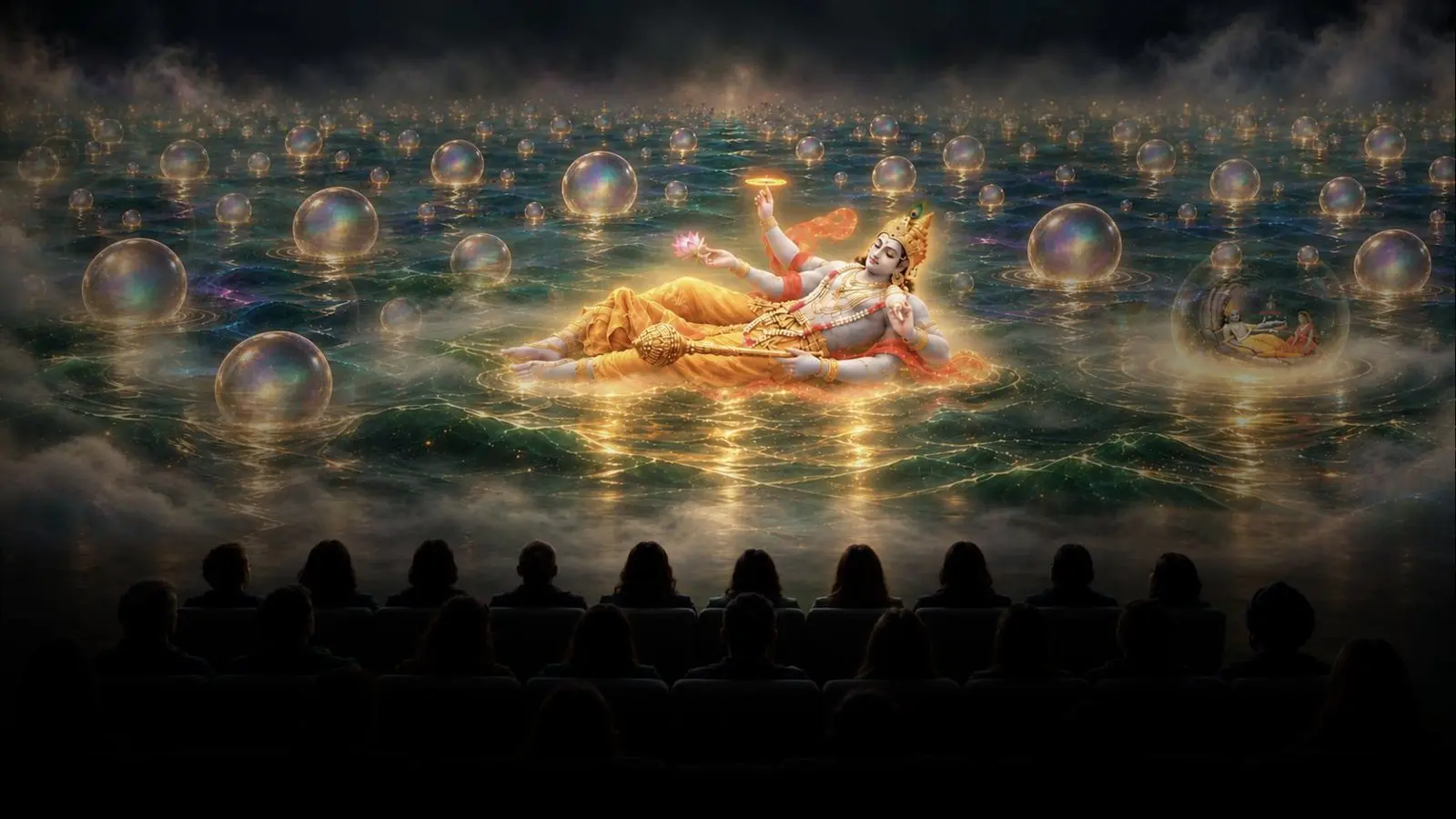
3.8
In near darkness you hear only breathing, until a towering form appears, multiplied into infinity, each breath releasing and withdrawing countless universes.
Discover and supportClose ×In the dark, you hear only breathing. Each breath holds countless universes.
What you will experience
You step into near-total darkness. All you can hear is breathing: slow, deep, resonant. Gradually the space awakens. Wind stirs around you, the floor begins to vibrate beneath your feet and fog drifts through the room. Light fractures across mirrored walls and scatters into what seems like endless space.
At the crescendo, a towering holographic form of Mahāviṣṇu materialises, larger than life and multiplied into infinity. With each breath out, countless universes are released; with each breath in, they are withdrawn. There is a pause, and then forms of Vishnu enter the universes, bringing them to life from within.
You witness the infinite spiral of creation, preservation and dissolution, our whole universe one among countless others in a single breath. Then the journey closes in contemplative silence. As you leave, you return to human scale, carrying the resonance of what you have seen and a quiet sense that existence may reach far beyond the material world.
You step into near-total darkness and hear only breathing, slow, deep and resonant. Gradually the space awakens: wind stirs around you, the floor vibrates beneath your feet, fog drifts through the room and light fractures across mirrored walls into endless space.
At the crescendo, a towering holographic form of Mahāviṣṇu materialises, multiplied into infinity. With each breath, countless universes are drawn in, and you see our own universe as just one among them, held within a single breath.
There is a pause. The breathing stills, and you stand in the silence between one breath and the next, at the turning point of the infinite spiral of creation, preservation and dissolution.
With the breath out, countless brahmāṇḍas are released. Garbhodakaśāyī Viṣṇu and Kṣīrodakaśāyī Viṣṇu enter the universes, bringing them to life from within. You witness creation unfolding on a scale far beyond anything you have imagined.
The journey closes in contemplative silence. As you leave, you return to human scale, carrying the resonance of what you have seen and a quiet sense that existence may reach far beyond material embodiment.
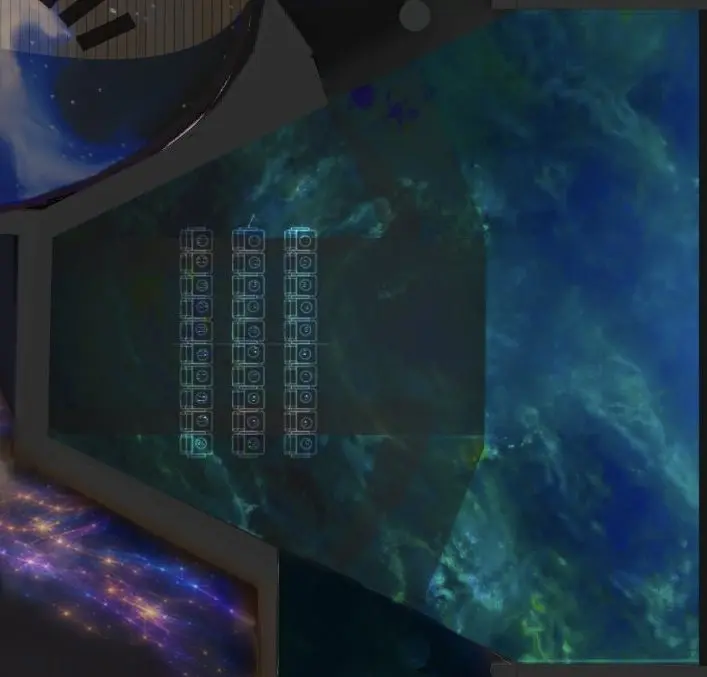
The big idea
Our universe is one of countless universes emerging and dissolving with the breath of Mahāviṣṇu, inviting stillness and the possibility of life beyond material existence.
Questions it asks
You will come away understanding
Words to know
the form of Vishnu within whom universes emerge and dissolve
a universe; countless emerge with each breath
the form of Vishnu who enters each universe
a further form of Vishnu entering the universe
Bring it to life
Your gift brings the breathing darkness, the mirrors and the towering form of Mahāviṣṇu to life, giving every visitor the breathtaking climax of their cosmic journey.
Design Habit estimate for the gallery, including GST
Sponsor this exhibitLevel 3 · Where Am I?The whole level: galleries and visitor spaces
Sponsor the levelAny amountEvery gift is recorded for this exhibit and for SMOVP
Donate to this exhibitEstimates from Design Habit (April 2026), shown in US dollars at ₹95 per US$1. Final costs are confirmed with each sponsor.
Level 4
Pass beyond the material universe into the spiritual sky, the eternal home of the self.
The final ascent. Beyond the shell of the material universe lies the spiritual sky, where everything is conscious and there is no birth, death, old age or disease. Level 4 is in development. Its exhibits will be announced here as the design is confirmed.
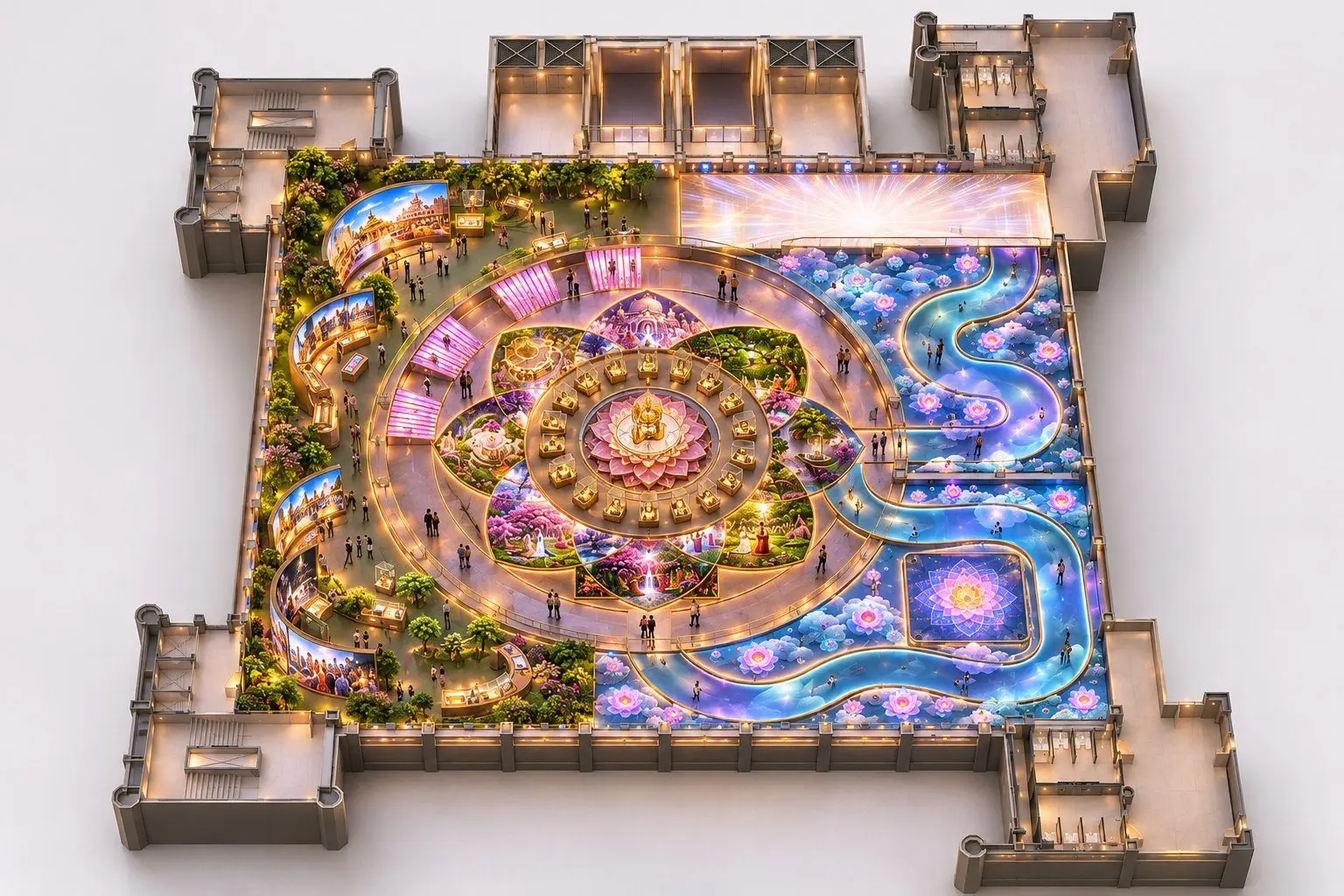
The passage from the cosmos of matter towards the realm of pure consciousness.
The material realm, one quarter of all creation, governed by the material energy.
The abode of Śiva, at the boundary of the spiritual world.
The spiritual sky, the effulgence of God, as brilliant as millions of suns.
The spiritual planets, where everything is conscious and eternal.
The highest spiritual planet, the abode of Krishna in His original form.
Carrying the journey home: relationships, devotion and connection.
Go further
Beyond the main exhibits, Levels 0, 1 and 3 open into Deep Dive areas: zones designed as natural extensions of the journey, for curious visitors and serious spiritual practitioners who want to go beyond the core storyline. Here you can explore at your own pace, with rare archival material, detailed scriptural references and philosophical interpretations, in an intimate setting made for personal contemplation and inquiry.
Each area is accessible on demand and especially rewarding for returning visitors. Sound is designed to keep the space calm: personal headsets and focused directional speakers bring guided narration, ambient soundscapes, scriptural recitation and meditative audio to you alone, without disturbing anyone nearby.
They continue online through the SMOVP Educational Platform, so your exploration can go on long after your visit.
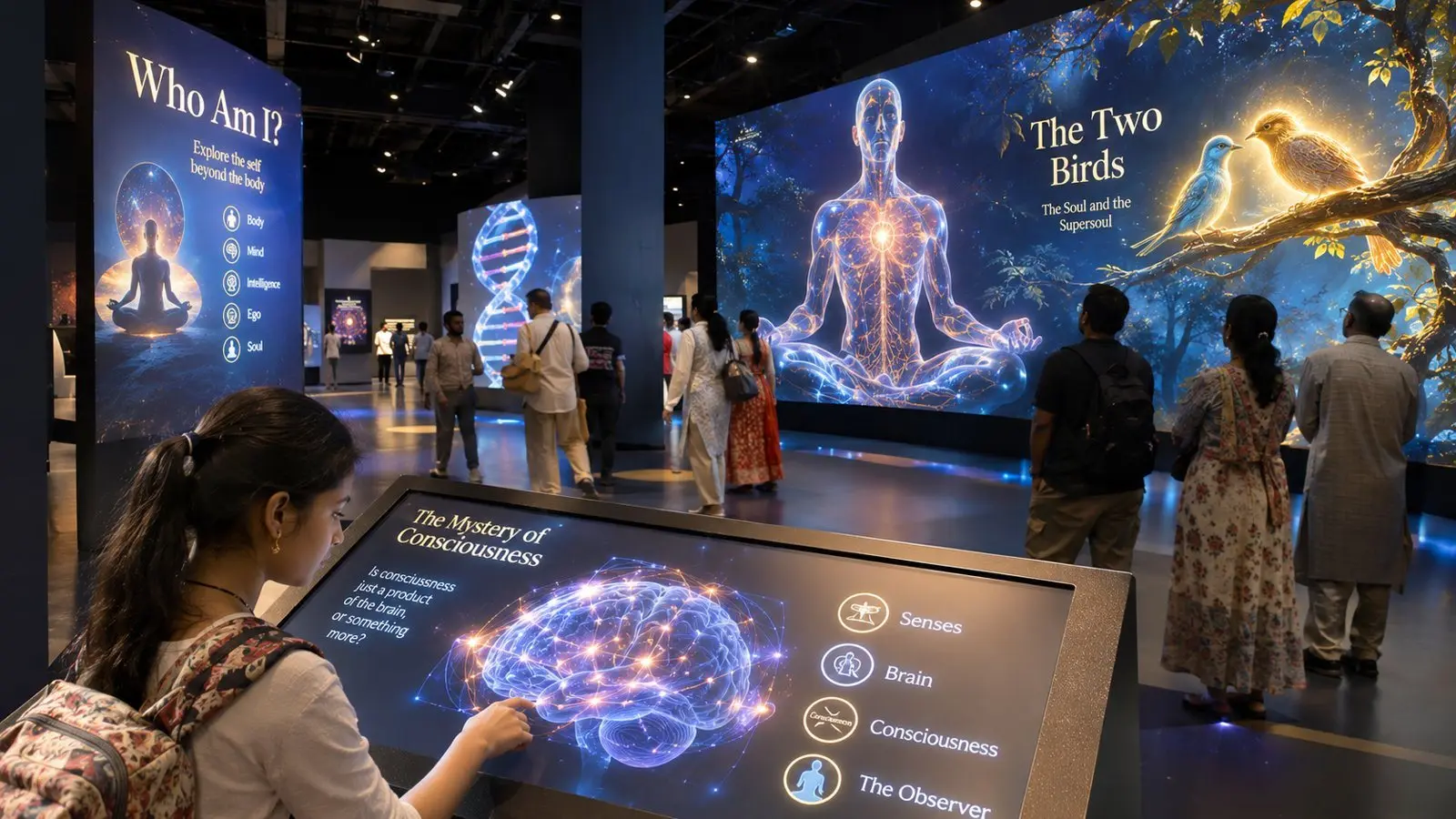
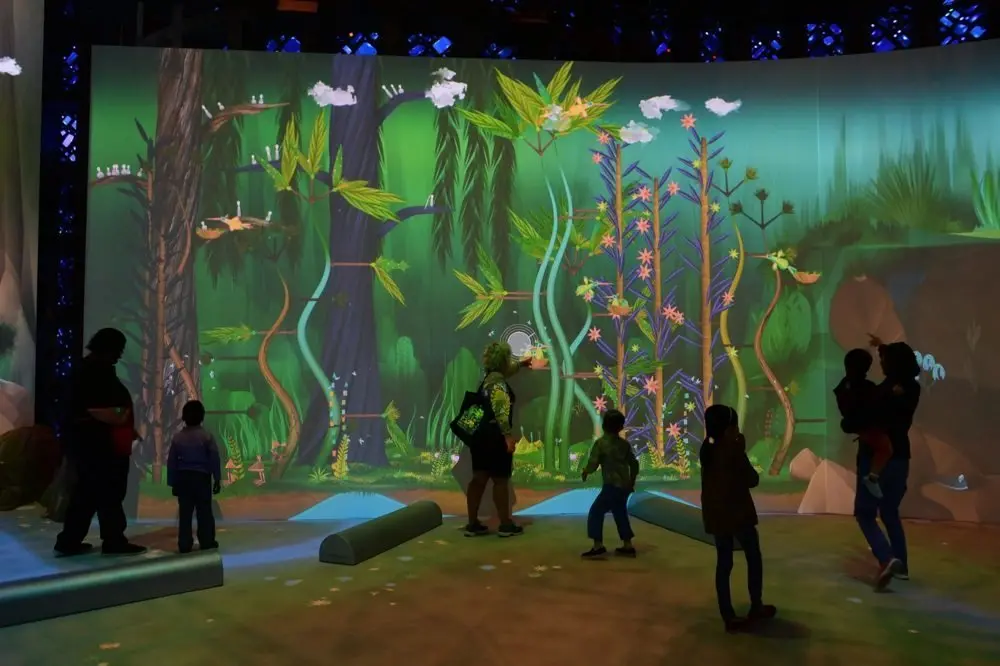
A permanent route of smaller exhibits that lets you revisit and explore further the themes introduced across Levels 0 to 4.
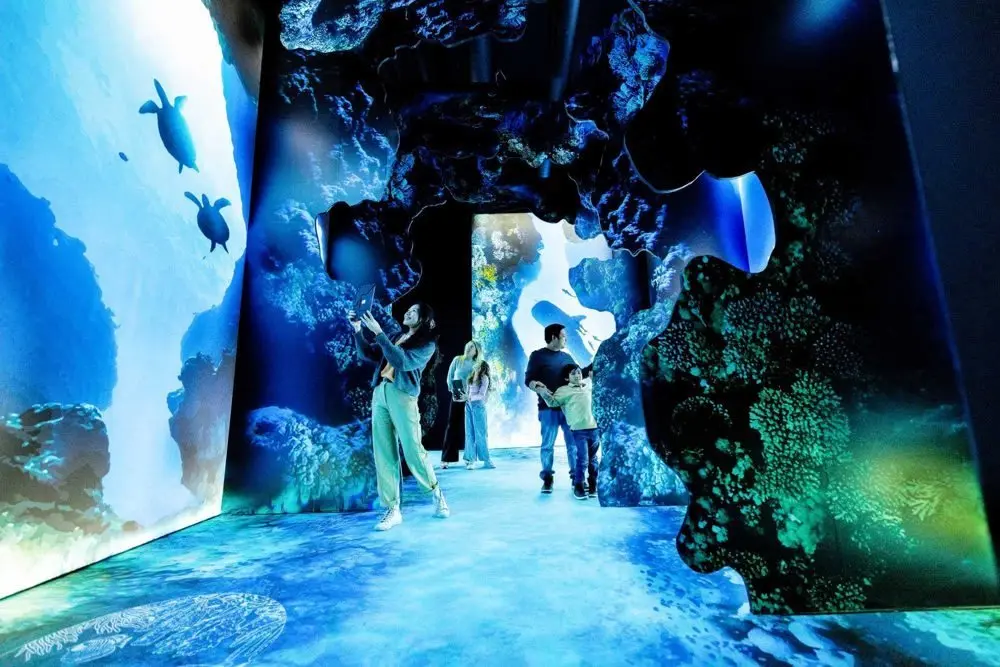
A flexible gallery with modular lighting and display systems, reconfigured for temporary exhibitions, lectures, workshops and other educational programmes.
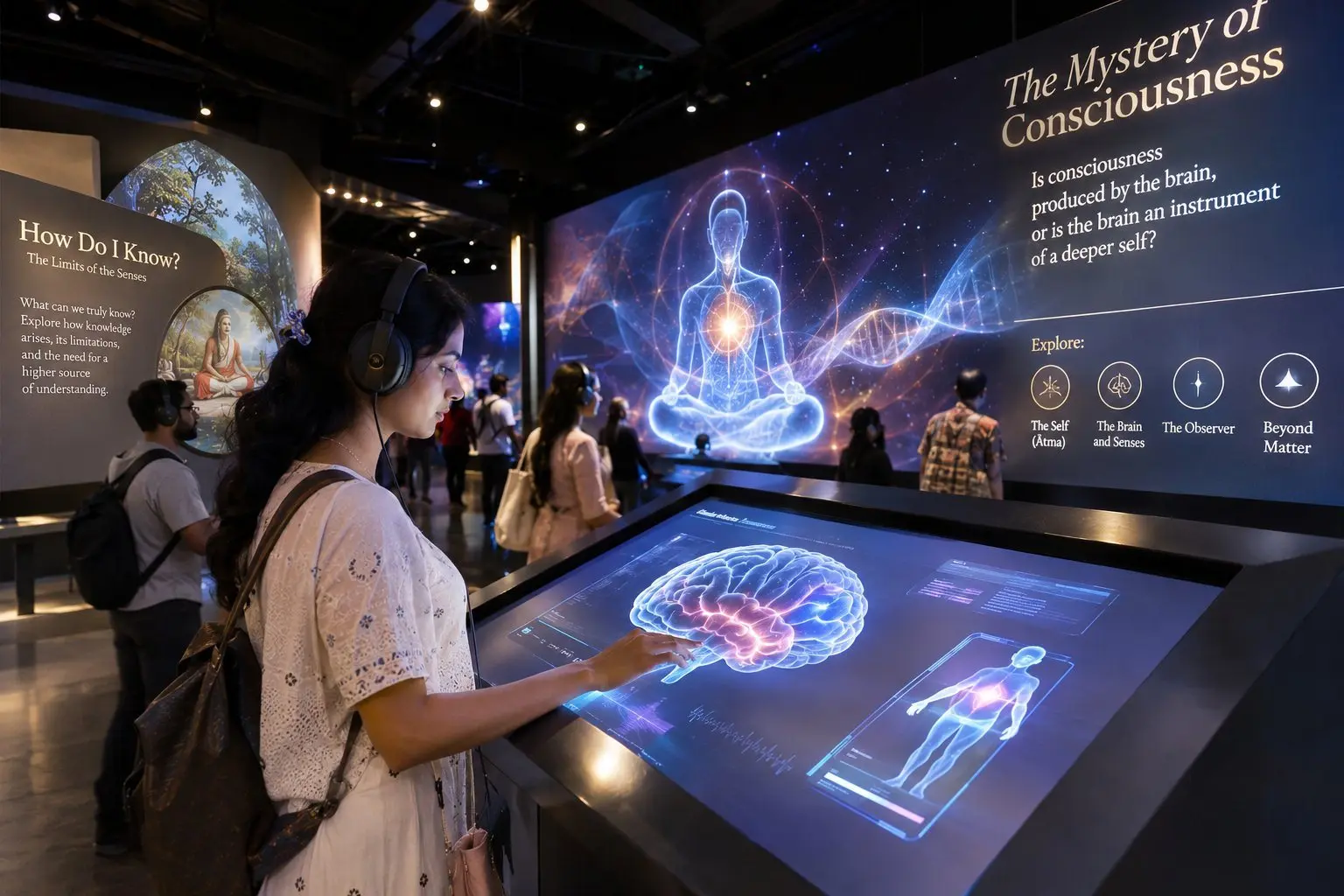
Touch tables, gesture and motion tracking, projection mapping, RFID objects and spatial sound let you explore philosophical ideas, scriptural narratives, timelines and archives at your own pace, through interactive maps, quizzes and responsive storytelling.
A library combining physical books and digital resources. Browse selected books while an AI research assistant helps you explore your questions. The assistant is trained on the museum's scriptural, philosophical and archival resources. AR and VR layers let you explore ideas spatially.
Also in the museum
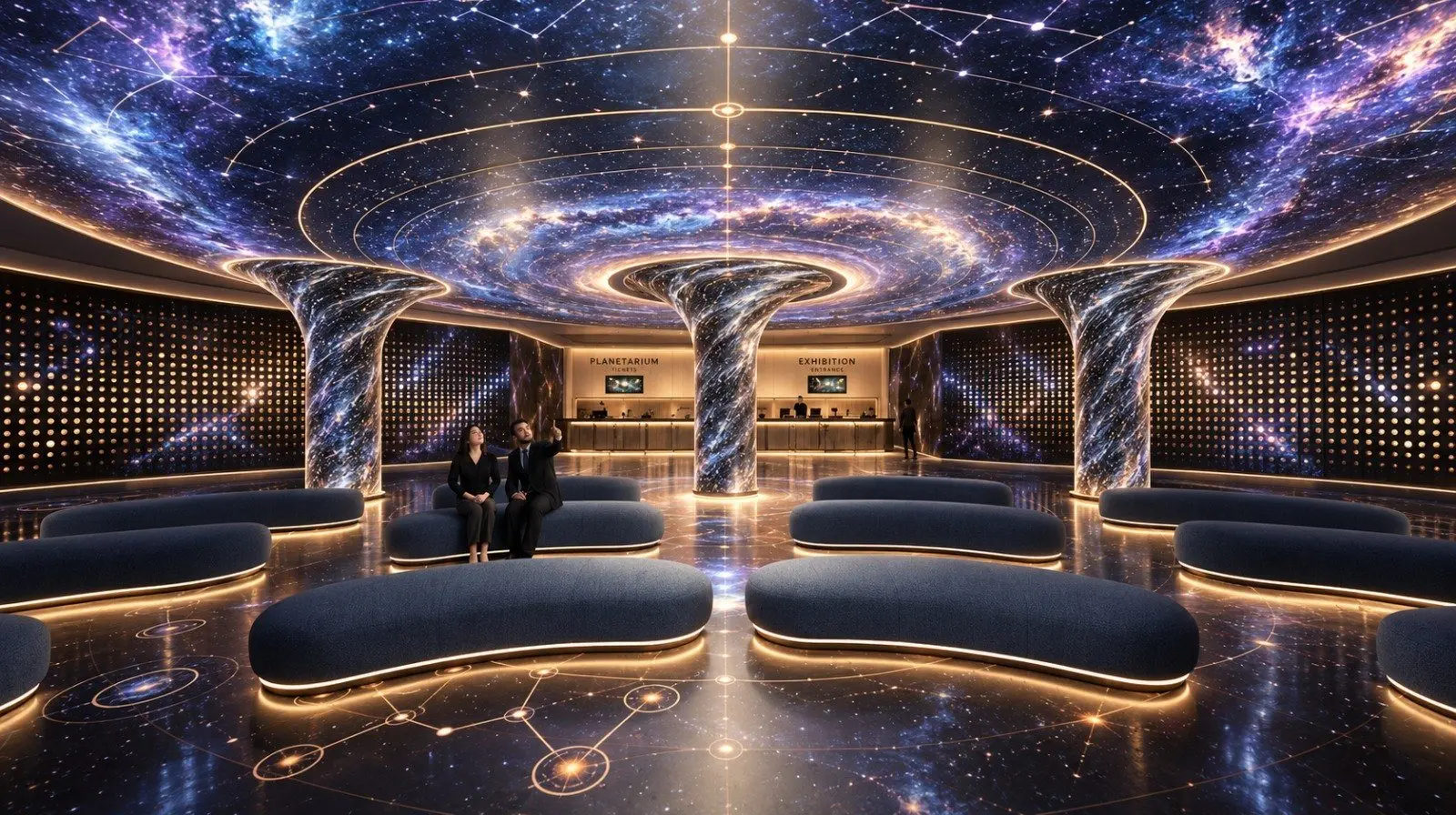
The central hall where your journey begins beneath a ceiling of stars, and where audio guides are collected.
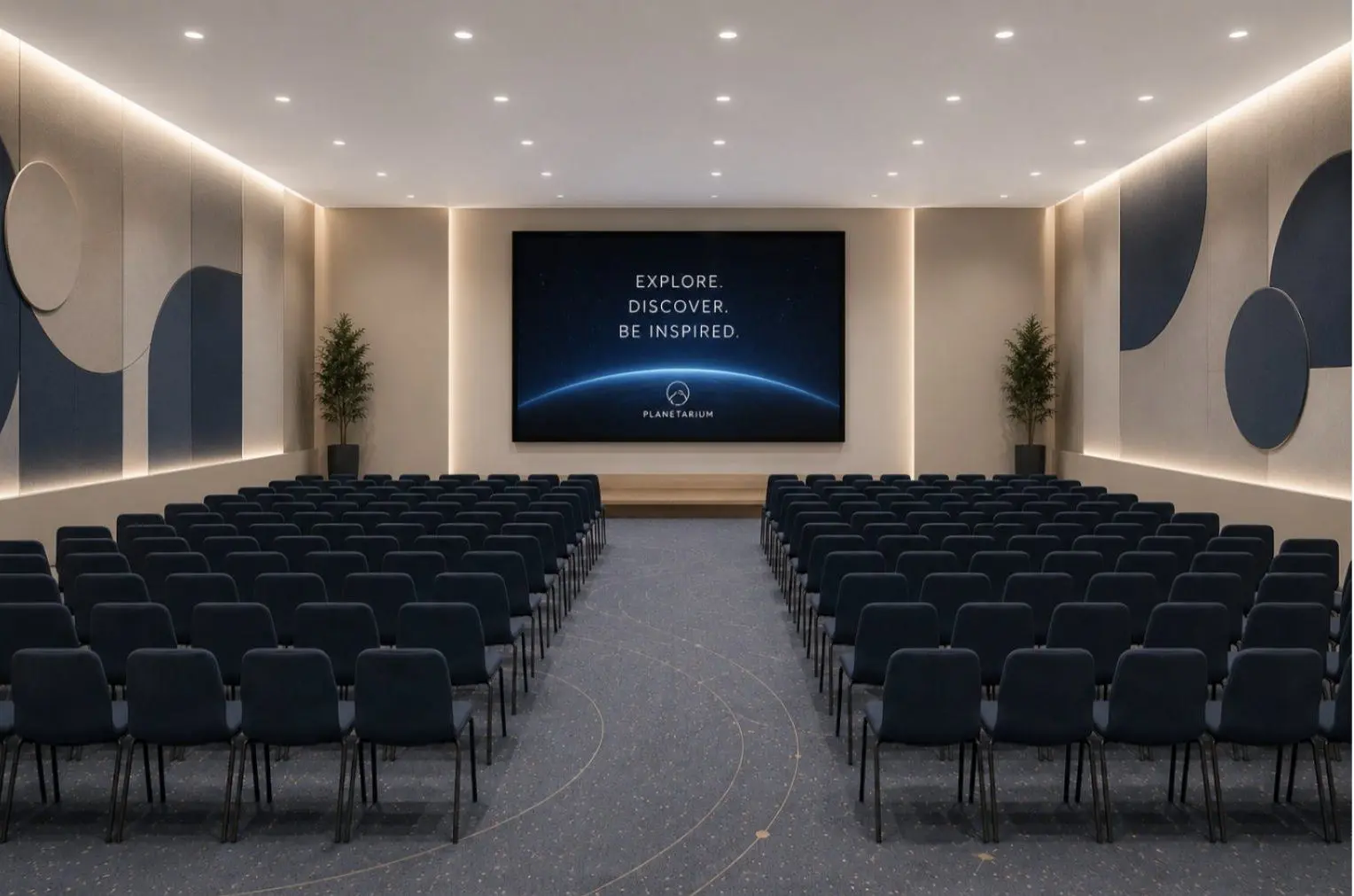
A calm, acoustically designed hall for talks, films, seminars and school programmes.
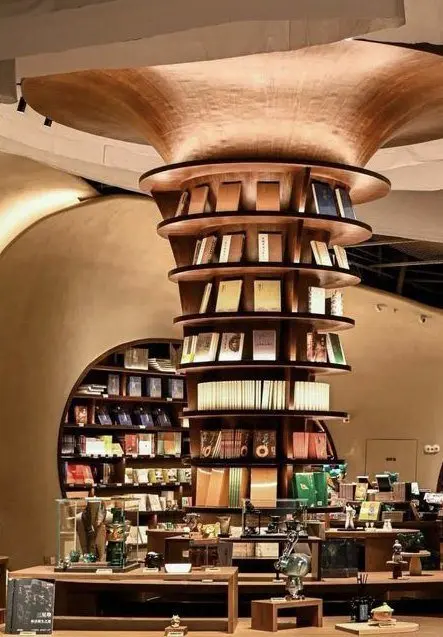
A reading space where books on Vedic knowledge, science and philosophy invite you to keep exploring.
Books, prints and keepsakes inspired by the museum, so the journey can continue at home.
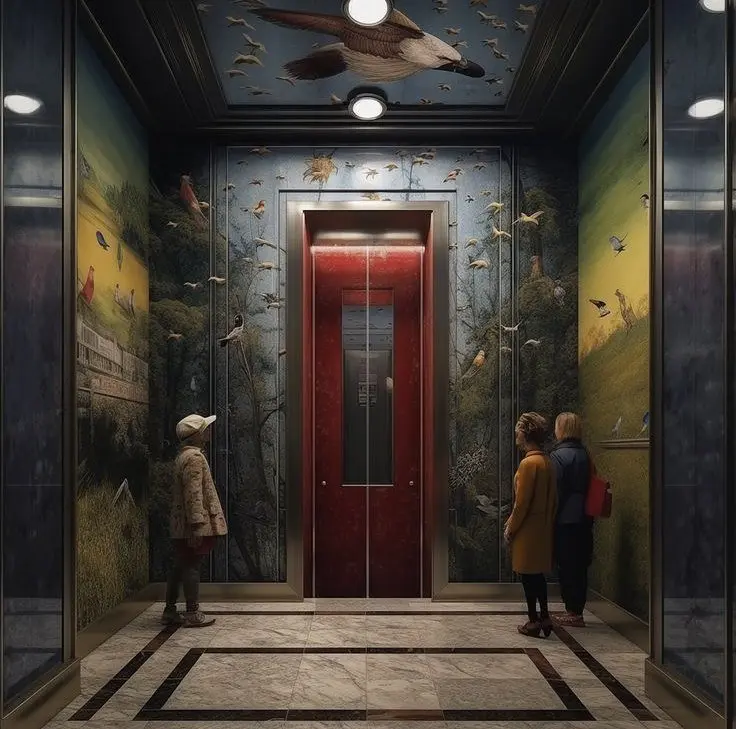
Even the lifts tell a story: each one is themed to the level you are travelling to.
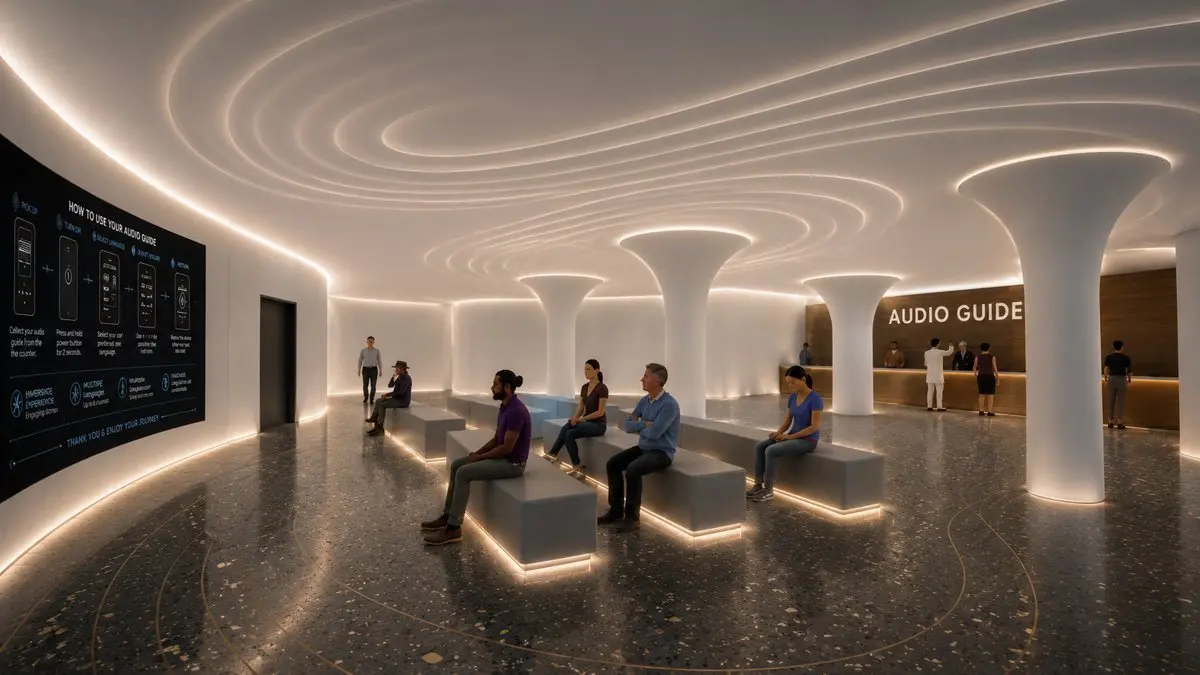
Your guide in your own language, carrying the whole story with no phone needed.