Level 2 · 2.5
Zoologist's Study
Inside an old zoologist's study, specimens light up to tell their stories.
Step inside
What you will experience
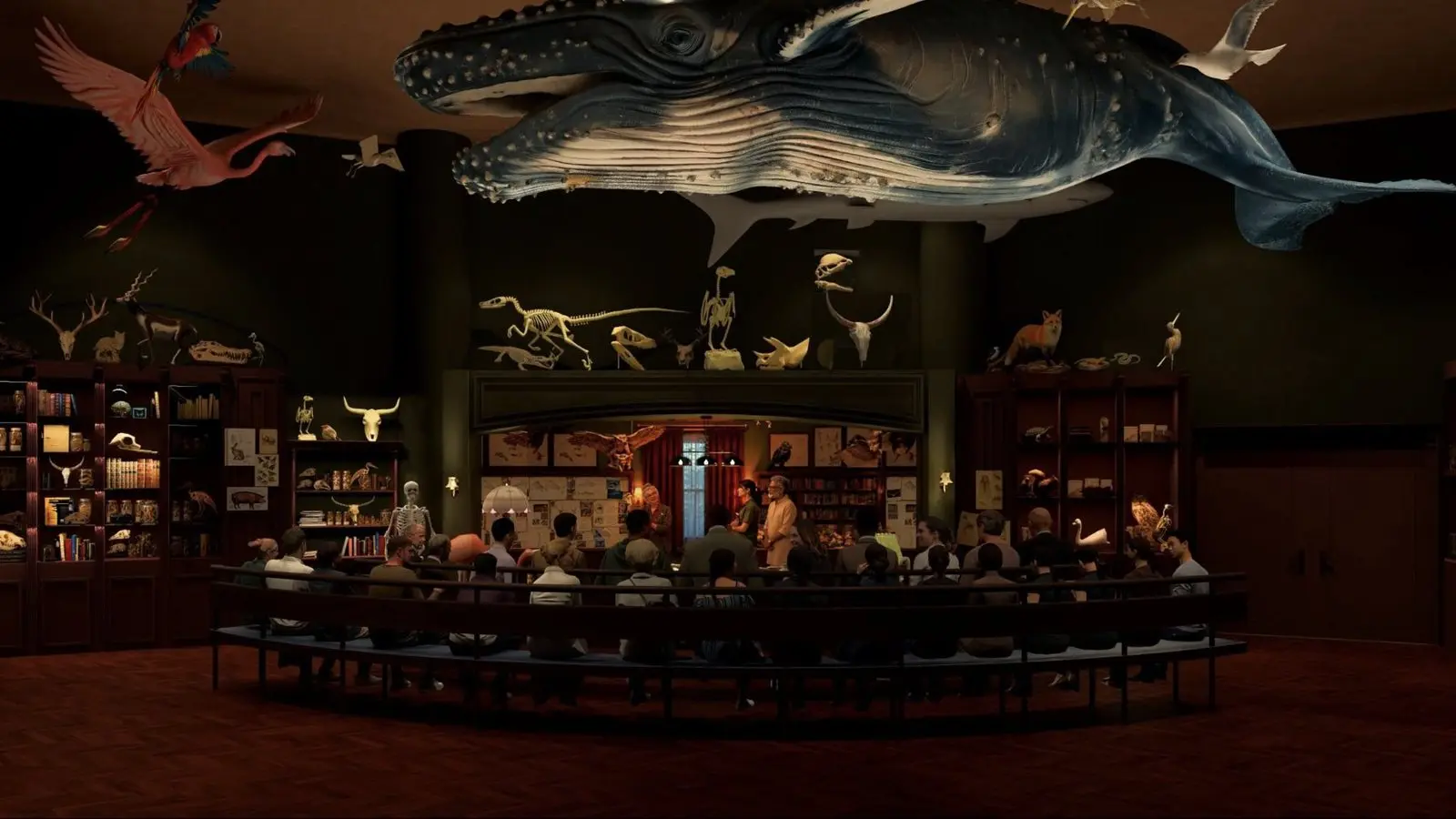
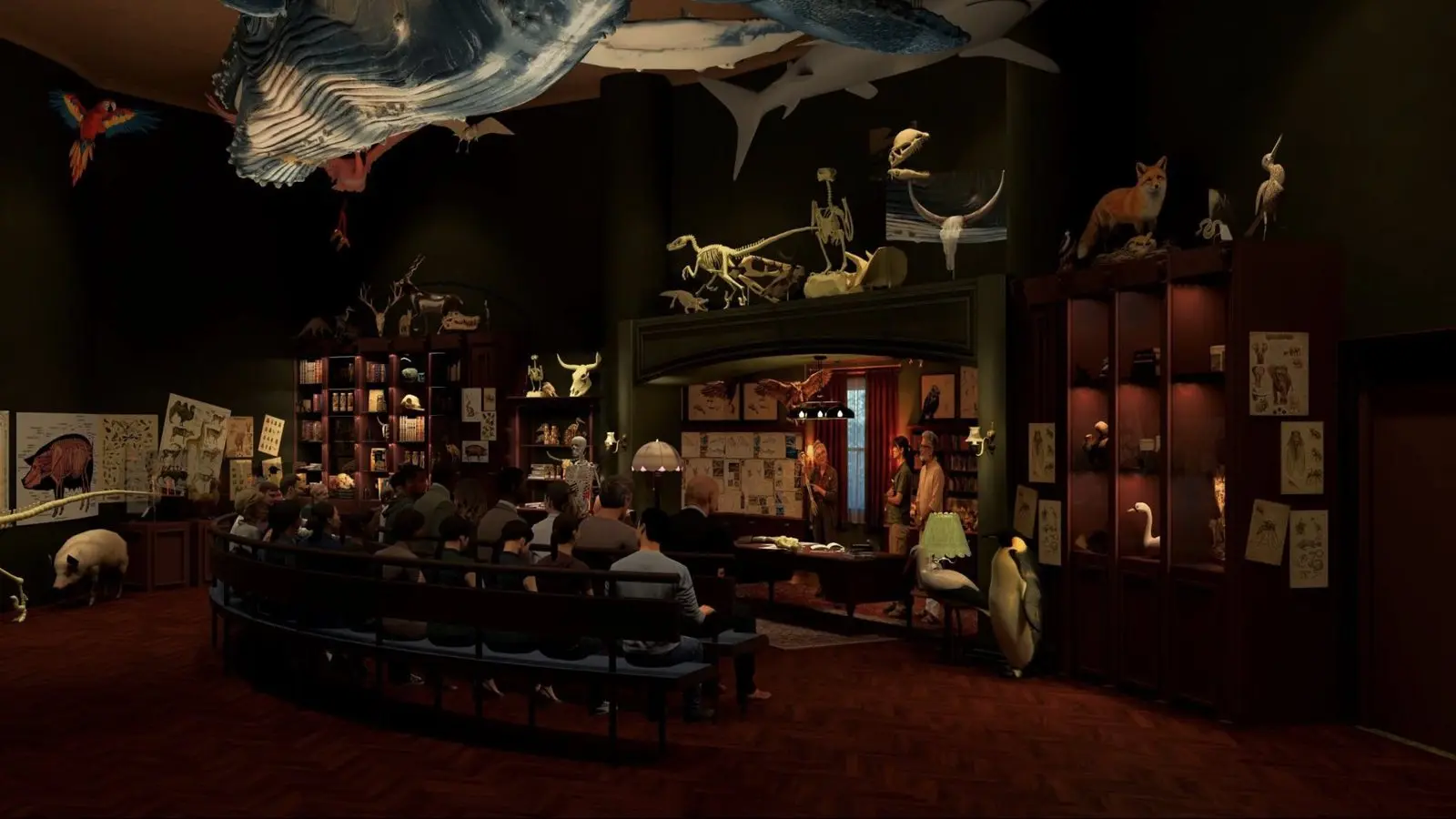
You step into an old-fashioned zoologist's office. Bones and skeletons line the shelves, taxidermy specimens stand watch, jars glint in the lamplight and diagrams are pinned across the walls. It feels like a room where generations of curious minds have worked, measured and wondered.
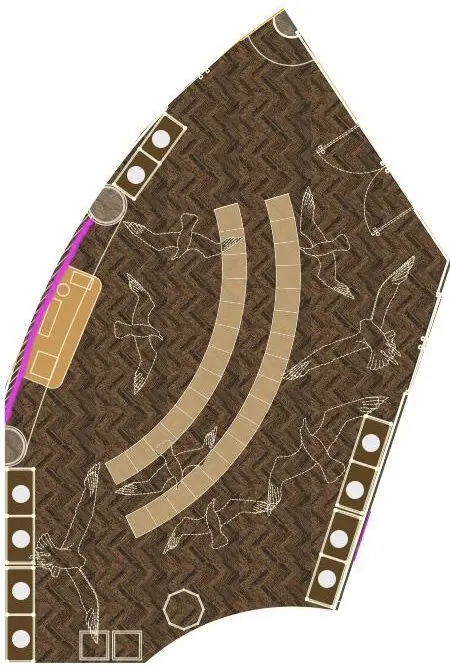
You sit on benches facing a panoramic screen behind a wooden table, where Dr. Miriam appears in conversation with Jane, Devarshi and the boys, lifting objects from the table to explain one of the classic arguments for evolution: that shared features point to a common ancestor. Models hang from the ceiling, and as each example is mentioned, its model, chart and specimen light up.
The conversation then turns to complications. You discover creatures that share similar features without sharing an ancestor, and others whose features are entirely their own, like the seahorse, whose males carry and give birth to their young. You leave the study seeing the living world as richer and more surprising than any single explanation.
Scene by scene
- 1The Zoologist's Office
You step into an old-fashioned zoologist's office. Bones line the shelves, taxidermy specimens stand watch, jars glint and diagrams are pinned across the walls. Behind his desk sits the zoologist, ready to talk with his colleague and the narrator.
- 2Common Features
The zoologist introduces homology, the argument that shared features between creatures point to a common ancestor. As he speaks, specimens around the room light up to illustrate each point, and you follow the conversation from shelf to shelf.
- 3Convergent Evolution
The talk turns to a complication: creatures that share strikingly similar features without sharing an ancestor. Specimens light up again as you see how similar designs appear in unrelated lines of life, and what that means for the argument.
- 4Unique Features
Finally you meet creatures whose features are entirely their own, like the seahorse, whose males carry and give birth to their young. You leave the study seeing the living world as richer and more surprising than any single explanation allows.
In pictures
The big idea
The argument from shared features is still widely taught, but similar features that arise independently, and features unique to one kind of creature, complicate the picture.
Questions it asks
- Do shared features prove a shared ancestor?
- How can unrelated creatures end up with similar features?
- Where do entirely unique features come from?
You will come away understanding
- What homology is and how it is used to argue for evolution.
- Convergent evolution shows similar features arising in unrelated creatures.
- Unique features, like the seahorse's male pregnancy, complicate the argument from shared features.
Bring it to life
Make this exhibit possible
Your support fills this study with its specimens and illuminated stories, inviting every visitor into a lively scientific conversation.
Part of Phase 2: the next galleries after the 2028 openingDesign Habit estimate for the gallery, including GST
Sponsor this exhibitLevel 2 · What Is Life?The whole level: galleries and visitor spaces
Sponsor the levelAny amountEvery gift is recorded for this exhibit and for SMOVP
Donate to this exhibitEstimates from Design Habit (April 2026), shown in US dollars at ₹95 per US$1. Final costs are confirmed with each sponsor.